Nana Wu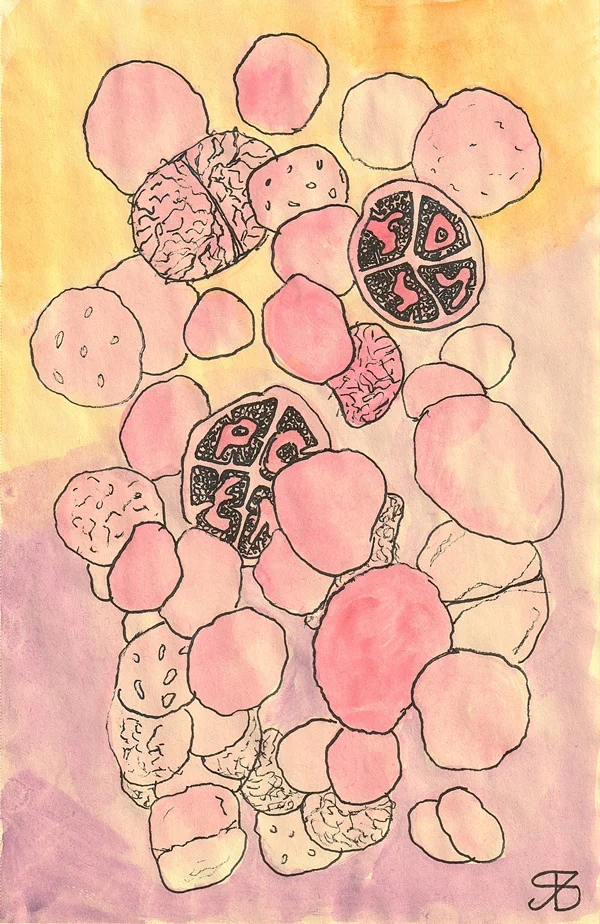
In a landmark convergence of avant-garde poetry and cutting-edge biotechnology, Canadian poet Christian Bök and University of Texas chemical engineer Lydia Contreras have achieved what was once the exclusive domain of science fiction: they have successfully encoded a poem into the genome of a living organism. By embedding literary art within the resilient DNA of Deinococcus radiodurans—an extremophile bacterium famously nicknamed "Conan the Bacterium"—the duo has created a biological vessel capable of preserving human expression long after paper has crumbled and hard drives have corroded.
This project, which challenges our fundamental understanding of archival storage and the permanence of art, suggests that the future of the human canon may not lie in digital clouds or stone tablets, but in the self-replicating, radiation-hardened cells of the world’s most durable life forms.
The Science of Resilience: Decoding "Conan the Bacterium"
The choice of Deinococcus radiodurans as the repository for this poetic project was not incidental. Discovered in 1956, D. radiodurans is widely recognized by the scientific community as one of the most resilient organisms on Earth. It possesses an extraordinary ability to withstand conditions that would prove lethal to virtually any other complex life form. It survives in environments of extreme vacuum, intense cold, acidic pH, and, most notably, ionizing radiation levels thousands of times higher than the dosage that would shatter human DNA.
While the average human cell suffers catastrophic damage when its DNA is fragmented by radiation, D. radiodurans maintains a sophisticated, rapid-response repair mechanism. It can reassemble its genome from hundreds of shattered fragments in a matter of hours, maintaining the integrity of its genetic blueprint with near-perfect fidelity. By translating poetic verse into the chemical language of life—the sequences of nucleotides adenine (A), cytosine (C), thymine (T), and guanine (G)—Bök and Contreras have essentially "hacked" this biological repair system. The poem is no longer just a set of words; it has become a functional component of the organism’s genetic code.
A Chronology of the Synthetic Archive
The genesis of this collaboration lies at the intersection of literary theory and molecular biology. The project’s timeline represents a multi-year effort to reconcile the ephemeral nature of ink-on-paper with the durability of biological memory.
- Conceptualization (2023–2024): Christian Bök, known for his work in "pataphysical" poetry and the exploration of extreme constraints in literature, began exploring the potential of DNA as a storage medium. Collaborating with Lydia Contreras, whose work in chemical engineering focuses on the interaction between biological molecules, the team began the process of "transliteration."
- The Translation Phase (Early 2025): The team mapped the linguistic structure of the poem—a series of carefully curated dashes, spaces, and phonemes—into a corresponding sequence of nucleotides. This was not a direct linguistic translation but a binary-style conversion, turning the aesthetic value of the poem into a genetic sequence.
- Insertion and Integration (Late 2025): Using plasmid technology, the researchers successfully inserted the synthetic genetic sequence into the bacterium. The cell, in its inherent biological capacity to replicate its own DNA, incorporated the poem into its internal library.
- Verification and Replication (2026): Throughout the first half of 2026, the team monitored the bacteria as they underwent cellular division. The results confirmed that the poem was being accurately replicated from one generation of the microbe to the next, effectively turning the population into a self-publishing, self-distributing library of verse.
The Mechanism: How the Poem Lives
To understand the magnitude of this achievement, one must look at the mechanics of the "living library." When the bacterium divides, it performs a high-fidelity copy of its entire genome. Because the poem has been integrated into the plasmid—a small, circular, self-replicating DNA molecule within the cell—the poem is essentially "reprinted" every time the bacterium splits.
"This is no longer a book," says Bök in descriptions of the process. "It is a living fossil." The poem is effectively shielded from the entropic decay that plagues traditional archives. While paper fades, ink oxidizes, and magnetic tapes undergo bit-rot, the D. radiodurans population, provided it is kept in a state of suspended animation (such as in permafrost or a vacuum-sealed, frozen state), could theoretically preserve the poem for millions of years. It is an artwork designed to outlast civilizations, waiting in the silence of a laboratory vial for a future that might one day possess the technology to "read" its resilience.
Implications for Global Archiving
The implications of this experiment extend far beyond the realm of poetry. We are currently facing a "digital dark age," where the rapid obsolescence of file formats and storage hardware threatens to erase the history of the 21st century.

The work of Bök and Contreras offers a compelling, if unconventional, alternative. If human information—be it the entirety of Wikipedia, the complete works of Shakespeare, or the records of our climate history—can be compressed into the DNA of extremophiles, we could theoretically store the sum total of human knowledge in a few test tubes of bacteria.
Technical Challenges and Ethical Considerations
While the prospect is revolutionary, the scientific community remains cautious. The primary hurdle is the "read-out" process. Sequencing DNA is a common practice, but retrieving complex literary structures from a living, evolving genome requires a sophisticated key. Furthermore, there is the risk of "genetic drift." As the bacterium evolves in response to its environment, natural selection might favor mutations that could eventually corrupt the poetic code. The researchers are addressing this by exploring "stable" sequences that are less prone to mutation, but the risk of artistic degradation remains a subject of ongoing study.
The Poet’s Perspective: Vinita Agrawal on Impermanence
The publication of this project, which was supported by a Kickstarter campaign and featured in Strange Horizons, has drawn significant attention from the literary world. Vinita Agrawal, a celebrated poet and editor whose work frequently engages with themes of climate change and the ephemeral nature of existence, notes that this project represents a fundamental shift in the relationship between the author and the work.
"We are moving from the era of the printed word to the era of the biological artifact," Agrawal notes. "By encoding a poem into a life form, we are admitting our own vulnerability. We are essentially asking a creature that can survive the death of the world to hold onto our memories for us. It is the ultimate act of trying to remember—a recognition that while we, the creators, are temporary, the art we produce is a hunger that refuses to be silenced."
Conclusion: The Soft, Human Sound of Trying to Remember
At its core, the project is a poignant meditation on the human condition. It is a technological marvel, yes, but it is driven by a very human anxiety: the fear of being forgotten.
By placing a poem—a vessel of human emotion—inside a creature that can endure the radiation of space and the harshness of the void, Bök and Contreras have created a bridge between the biological and the aesthetic. It is a monument that does not demand space or resources; it lives in the quiet, microscopic labor of a cell, replicating the "soft, human, utterly vulnerable sound of trying to remember."
As we look toward a future where our digital footprints may vanish, this experiment reminds us that the drive to record our existence is as fundamental as the biology that sustains us. Whether this poem is ever read by a future civilization is perhaps secondary to the act of its creation: a defiant, microscopic gesture against the inevitability of silence.

 Raul Delapena Setiawan
 Nila Kartika Wati