Nila Kartika Wati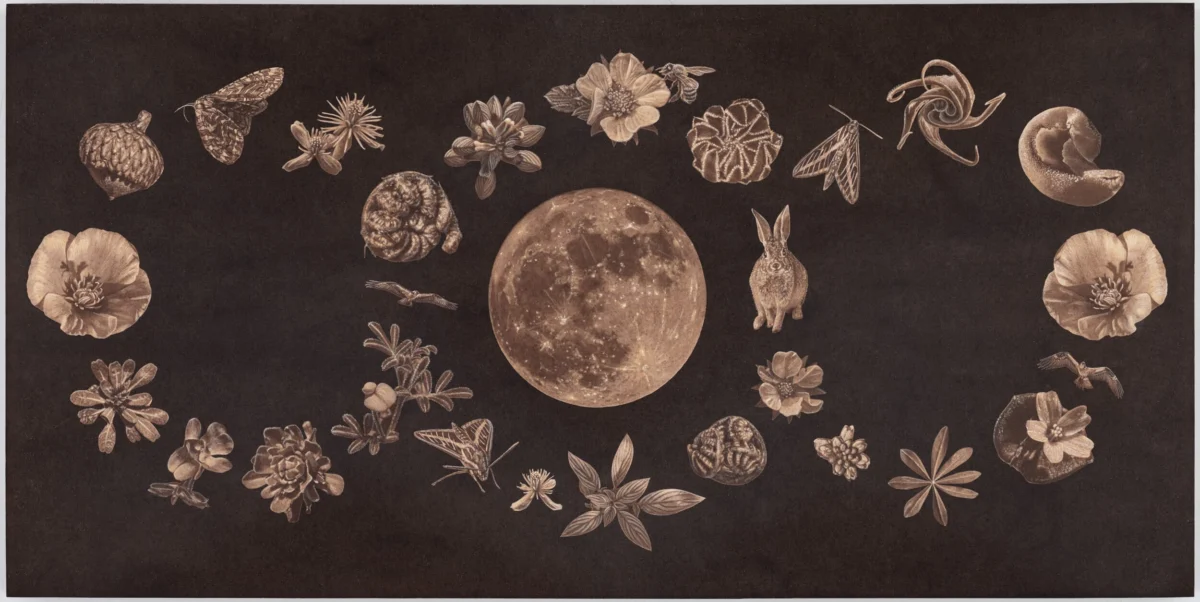
"Matter is memory, and memory is a medium," declares Annalise Neil, an artist whose practice defies simple categorization. By bridging the gap between scientific inquiry and artistic expression, Neil has carved out a unique space in contemporary multimedia art. Her work—a haunting, beautiful convergence of cyanotypes, botanical dyes, and sculptural elements—invites viewers to engage with the natural world not merely as observers, but as participants in a deep, rhythmic dialogue with the environment.
Main Facts: The Intersection of Science and Art
Annalise Neil’s oeuvre is defined by its tactile, almost primordial aesthetic. At the core of her process lies the cyanotype, a traditional photographic printing process that produces a cyan-blue print. However, in Neil’s hands, this medium is radically transformed. She augments these blue foundations with delicate watercolor and a sophisticated palette of natural dyes derived from the earth itself.

Her recent works showcase a transition from the iconic Prussian blue of the cyanotype toward a more complex, sepia-toned spectrum. By utilizing botanical teas—including wild strawberry leaf, oak gall, loquat leaf, and chestnut tannins—she alters the chemical composition of the prints, introducing deep, earthy browns, resonant purples, and muted ochres. This process is not merely aesthetic; it is a chemical collaboration with the flora she depicts.
Beyond the print, Neil’s pieces are multidimensional. They are frequently mounted on hand-carved wooden panels and embellished with diverse materials, including kiln-cast glass, cuttlefish-cast bronze, and delicate shellac inks. The result is a series of "talismanic" objects that feel as though they were unearthed from a natural history museum curated by a poet.

Chronology: The Evolution of a Process
Neil’s artistic journey is marked by a steady progression toward a more immersive, site-specific methodology.
Early Experimentation: For years, Neil focused on the technical mastery of the cyanotype, utilizing it as a direct, light-sensitive mirror of the natural world. During this period, her work emphasized the stark contrast between the blue prints and the organic forms—fungi, insects, and geological specimens—that populated them.

The Shift Toward Tonal Complexity: As her practice matured, Neil began to seek ways to soften the harshness of the traditional blue. Her experiments with botanical teas began as a subtle shift in hue but soon evolved into a central tenet of her work. The introduction of tannins from oak gall and chestnut allowed her to move beyond the binary of blue and white, enabling a layered, monochromatic depth that mirrors the decay and regeneration cycles of the forest floor.
The Current Residency: In 2026, Neil took up residency at the Volcan Mountain Foundation in Julian, California. This residency marked a pivotal moment in her career, forcing an explicit marriage between her artistic process and scientific research. Her time in the field has shifted her focus toward more rigorous site-specific documentation, where the act of collecting becomes the act of creation.

Supporting Data: The Methodology of the Wild
Neil’s work is fundamentally grounded in field research. Her process is rarely sedentary; it is a rhythmic engagement with the landscape.
- Field Collection: The artist spends days hiking, photographing specimens ranging from avian life to intricate insect structures. This, she describes, is a process of "melting, rolling, pinching, sanding, walking across meadows, cheek on sun-warmed boulders."
- Transmutation: The photographic negatives produced from these hikes are treated as fleeting ghosts of reality. By converting them into cyanotypes, she fixes a "brief version of their existence" onto paper.
- Materiality: The choice of substrate is deliberate. By utilizing high-quality papers like Canson Montval or Hahnemühle Sumi-e and mounting them to custom-built wood panels, she ensures that the work possesses a physical weight that demands attention. The inclusion of kiln-cast glass, often acting as a lens or a frame, creates a sense of "looking through" the art rather than just "looking at" it.
The technical requirements for such work are immense. For example, in her piece Littoral Talisman (2026), the complexity of materials—madder root, chestnut tannins, strawberry leaf tea, gouache, and copper—demonstrates a high level of chemical and artisanal expertise.

Official Responses and Curatorial Context
Neil’s work is currently receiving significant critical attention, finding a home in exhibitions that explore the intersection of technology and the environment. She is featured in Fast Forward: Analog Photography as a Third Space at the Los Angeles Center for Photography, and Sanguine Glimmers at Hey Books! in San Diego.
Curators often highlight Neil’s ability to treat the photograph as an object rather than a flat surface. In the context of Fast Forward, her work serves as a reminder that "analog" does not mean "obsolete." Instead, it suggests a "third space" where the chemical, the biological, and the mechanical converge to form a new kind of visual language.

"I endeavor to create work that will lead to contemplation and reflection," Neil stated during her residency at the Volcan Mountain Foundation. "It is an invitation to a thoughtful examination of our relationship to reality and our surroundings." Her work is being hailed as a vital contribution to the "New Nature" movement, where artists use traditional, low-tech methods to challenge the digital saturation of modern life.
Implications: The Philosophical Weight of the Work
What does it mean to treat "matter as memory"? For Annalise Neil, the implications are profound. In a world increasingly concerned with the rapid loss of biodiversity and the alienation of humans from the wild, her work acts as a bridge.

The Environmental Connection
By incorporating physical elements like shells, bronze, and wood into her prints, Neil forces a dialogue between the observer and the environment. She does not just present an image of a leaf; she uses the chemistry of that leaf to color the image. This creates a closed-loop system of representation that is both haunting and deeply respectful of the source material.
The Rejection of Digital Ephemerality
In an age where images are consumed by the millions on glass screens, Neil’s insistence on the "hand-carved," the "toned," and the "sculpted" is an act of resistance. Her work requires the viewer to stand in a specific place, at a specific distance, to fully appreciate the interplay of light on glass and the grain of the wood. It is an argument for the necessity of slow, deliberate observation.

Future Trajectories
As Neil continues to refine her practice, the integration of science and art appears to be deepening. Her use of pinyon pine pitch and other raw, foraged materials in pieces like Light Emergent (2026) suggests that she is moving toward a form of art that is as much about the process of foraging and chemistry as it is about the final visual output.
The art world is watching closely. As the environmental crisis looms larger, the demand for art that engages with the earth—not as an abstract concept, but as a tangible, chemical reality—is growing. Annalise Neil is not merely documenting the world; she is helping us reconstruct our memory of it, piece by piece, leaf by leaf, and print by print.

Conclusion
Annalise Neil stands at the vanguard of a movement that refuses to see the photographic process as a simple act of reproduction. Through her rigorous, alchemical approach, she turns the cyanotype into a living document. Her work challenges the viewer to reconsider their own role in the natural order, suggesting that memory, like the prints she creates, is something that must be carefully, chemically, and consciously cultivated.
Whether through the deep, meditative tones of her sepia-stained botanicals or the sharp, crystalline clarity of her kiln-cast glass, Neil reminds us that the world is full of ghosts waiting to be remembered. To follow her process is to embark on a hike through the meadows of her imagination, where every pinch of soil and every sun-warmed boulder holds a story worth telling.

 Basiran
 Asro
Asro