Layla Zulfa
In a significant shift aimed at reshaping the user experience on its flagship platform, Meta has announced a sweeping update to Facebook that introduces three sophisticated, AI-driven tools. As the tech industry continues to grapple with the "AI arms race," Meta’s latest move marks a deliberate attempt to move Facebook beyond a mere social networking site and into a functional, AI-assisted digital assistant and creative suite.
By leveraging large language models (LLMs) and generative AI, these features—ranging from an interactive search mode to advanced visual editing tools—seek to increase user engagement and provide more value within the Facebook ecosystem. This evolution reflects a broader corporate strategy to embed intelligence directly into the fabric of social interaction.
Main Facts: The Triple-Threat Update
Meta’s latest suite of tools is designed to address two primary user behaviors: information retrieval and content creation. The rollout consists of three distinct pillars:
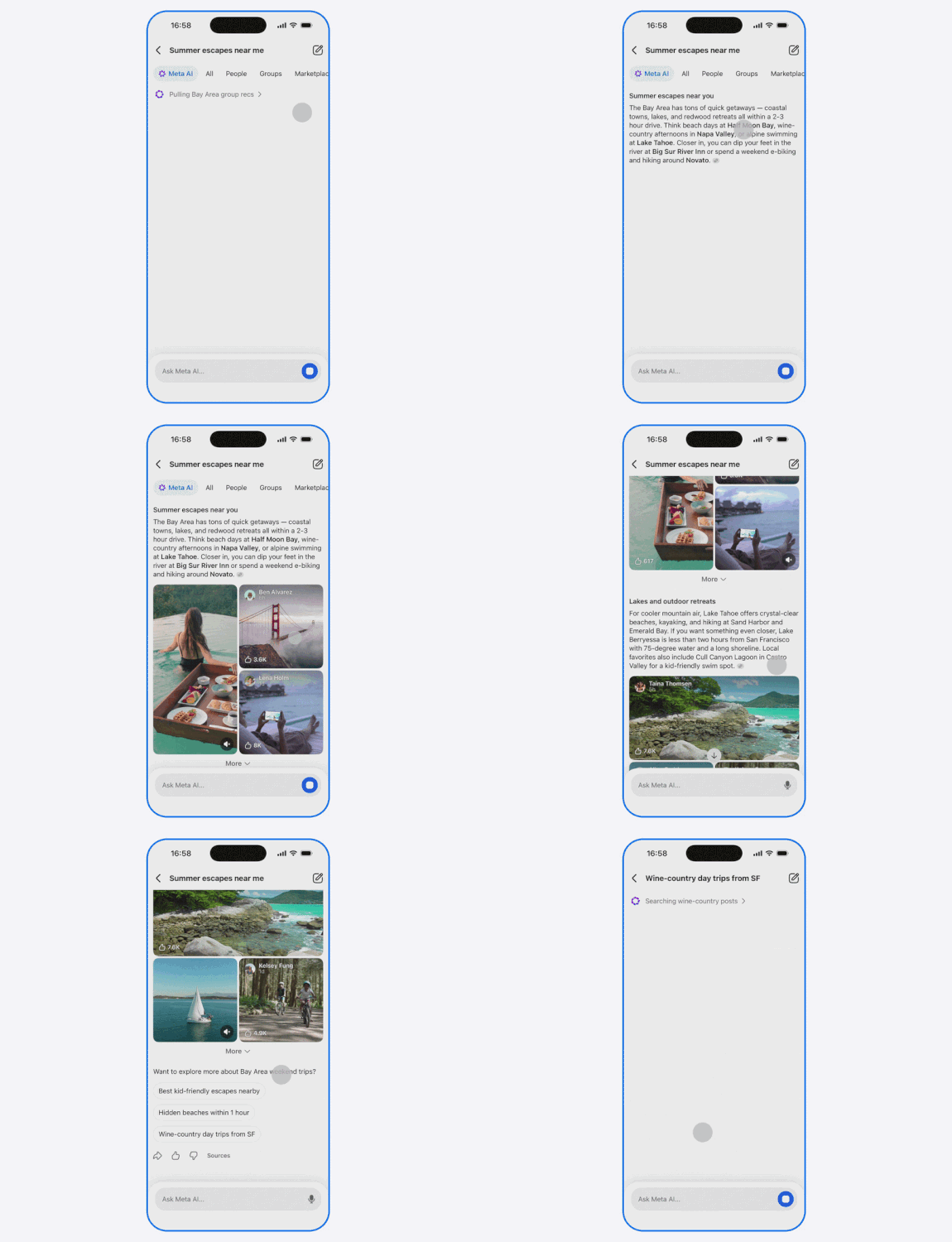
- AI Mode (Search Integration): Similar to the "AI Overviews" recently popularized by Google, Meta’s new AI mode will allow users to query the platform directly. By aggregating public data from across Meta’s ecosystem—including insights from Groups and Reels—the AI provides contextual answers to user questions, effectively turning Facebook into a real-time knowledge hub.
- Generative Video Montages: Expanding on the camera roll suggestions introduced in late 2023, the new update introduces AI-powered collage cutouts and fluid transition effects. This feature is designed to simplify the production of high-quality video montages for social sharing, requiring minimal effort from the user.
- "Wear It" AI Photo Presets: This is perhaps the most consumer-facing creative tool. By utilizing the "AI edit" icon, users can now manipulate their appearance in photos—specifically changing hair, clothing, and accessories—via simple prompts or presets, both in Stories and for profile pictures.
Chronology: A Timeline of Meta’s AI Pivot
Meta’s journey toward an "AI-first" company has been a carefully orchestrated process. The following timeline illustrates how the company arrived at this current rollout:
- Early 2023: Meta shifts its primary engineering focus toward generative AI and large language models, following the public success of OpenAI’s ChatGPT.
- Late 2023: Meta introduces the initial iteration of "Camera Roll Suggestions," a feature that used basic machine learning to group photos and videos into simplified slideshows.
- Early 2024: The company accelerates its development of Llama 3, the foundational model that powers its various AI interfaces across WhatsApp, Instagram, and Facebook.
- June 2026: Meta officially announces the integration of the AI Mode, advanced transition tools, and the "Wear It" photo-editing feature. This move is categorized as a "Phase 2" deployment of their generative AI roadmap, focusing on utility rather than just experimentation.
Supporting Data and Technical Framework
The underlying infrastructure for these features is built upon Meta’s proprietary Llama series of models. While Meta has not released the specific parameter count for the new "AI Mode," industry analysts suggest it is a fine-tuned version of their current flagship model, optimized specifically for low-latency retrieval from Facebook’s internal social graph.
The "Wear It" feature, in particular, utilizes generative adversarial networks (GANs) and diffusion models that allow for non-destructive editing. By mapping a user’s facial structure and body geometry, the AI can overlay clothing or hair textures that remain consistent even when the subject is in motion.
Regarding the "AI Mode," Meta’s data sourcing is restricted to public-facing content. By tapping into Groups and Reels, the AI acts as a search engine that prioritizes human experience over static web links—a key differentiator from traditional search engines. Meta notes that this data usage is subject to its standard privacy protocols, and the company has reiterated its commitment to transparency by ensuring that all AI-generated content is tagged with metadata to indicate its origin.
Official Responses and Strategic Vision
In a statement accompanying the announcement, Meta’s engineering leads emphasized that these tools are not merely "bells and whistles" but are essential for the modern creator economy.
"Our goal is to help you make things happen on Facebook," a spokesperson stated. "By removing the technical friction associated with video editing or searching for niche community advice, we are allowing our users to spend more time connecting and less time navigating complex menus or searching through disparate threads."
Crucially, Meta has addressed the potential for user discomfort regarding AI-assisted modifications. The video montage features and the "Wear It" presets are strictly opt-in. The company has integrated a granular settings dashboard where users can disable these features entirely, ensuring that those who prefer an "authentic" or traditional social experience are not forced to engage with generative elements.
Implications for the Future of Social Media
The integration of these features carries profound implications for the social media landscape:
1. The Death of the "Static" Feed
With the rollout of AI-assisted montages, the Facebook feed is transitioning from a repository of static images and text to a dynamic, video-first experience. This shift likely aims to reclaim the demographic share currently dominated by TikTok, where high-production-value video is the standard.
2. The Rise of the "Searchable Social Graph"
By allowing users to ask questions that pull from public Groups, Meta is effectively challenging the dominance of traditional search engines. If a user can ask Facebook, "What are the best hiking trails near me?" and get an answer derived from local community discussions in a hiking group, the incentive to leave the app for Google diminishes significantly.
3. Ethical and Aesthetic Concerns
The "Wear It" feature raises inevitable questions regarding digital identity. As photo editing becomes instantaneous and AI-driven, the boundary between reality and digital representation continues to blur. While Meta has focused on the creative aspects—such as trying on new styles or customizing profile pictures—critics point to the potential for misinformation and the erosion of digital authenticity.
4. Economic Impact for Creators
For influencers and content creators, these tools represent a massive reduction in the cost of production. The ability to generate polished montages or modify content on the fly without professional software tools levels the playing field. This could lead to a massive influx of content volume, further increasing the competition for visibility within the Facebook algorithm.
Conclusion: A New Era for Facebook
Meta’s decision to infuse AI into the core Facebook experience is a calculated gamble. By prioritizing user utility—through search, creative expression, and simplified editing—the company is attempting to revitalize its platform for a new generation of users.
However, the success of these features will depend on user trust. As Meta continues to roll out these tools, the balance between providing helpful, automated services and maintaining the integrity of human-to-human connection will remain the defining challenge. For now, the integration of these three features marks the most significant change to the Facebook user experience in years, signaling that the platform is no longer just a place to talk—it is a place to create, inquire, and reimagine.
As the technology continues to evolve, the industry will be watching closely to see how effectively Meta can manage the complexities of generative AI at such a massive scale. If successful, these tools could set the blueprint for how all major social platforms integrate AI in the coming decade.


 Jia Lissa
 Asro
Asro