Nana Muazin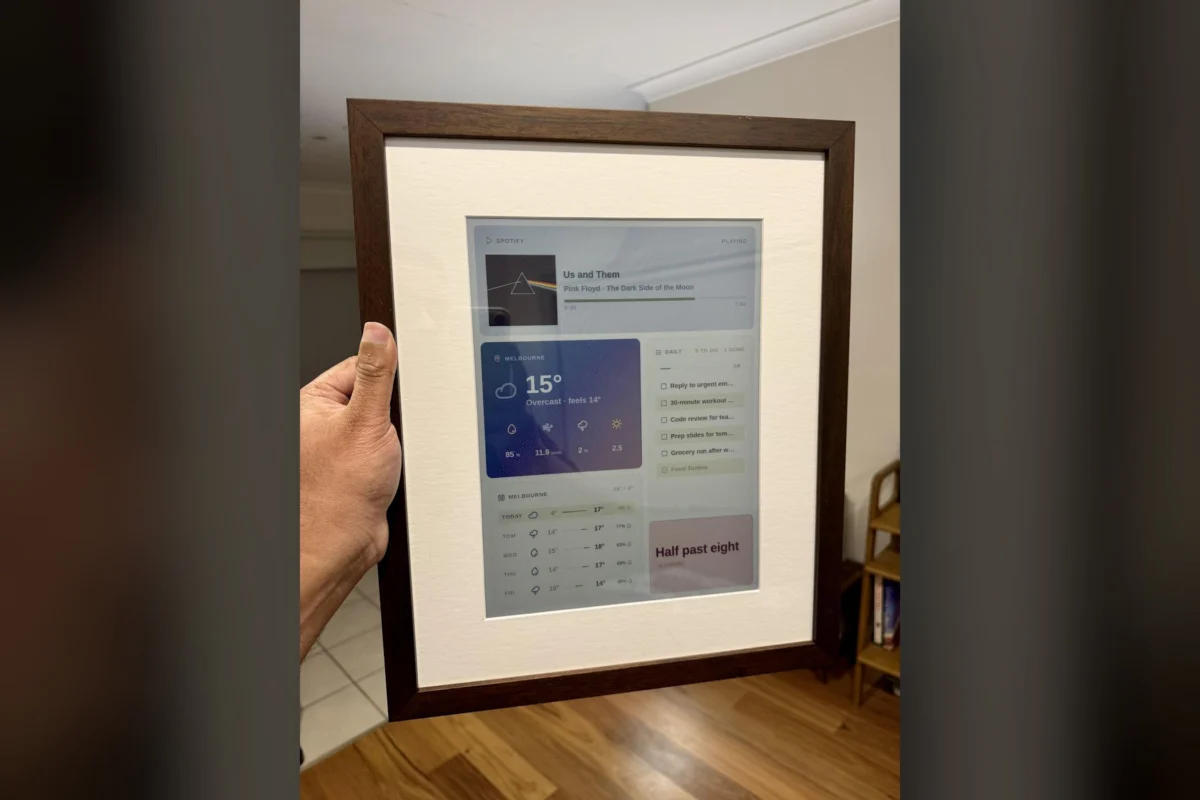
In the rapidly evolving world of smart home automation, the challenge has never been connecting devices—it has been displaying that information in a way that feels like home. While high-resolution LCD tablets and dedicated smart displays have become common, they often carry the aesthetic burden of being "tech." They glow, they glare, and they scream of digital clutter.
Enter the world of e-Ink, a display technology that has captured the imagination of the maker community for its paper-like appearance and low power consumption. Recently, a project shared on the Raspberry Pi subreddit by user "dmellok" has set a new benchmark for aesthetic integration, demonstrating that a smart home dashboard can be as beautiful as a gallery print.
The Intersection of Function and Fine Art
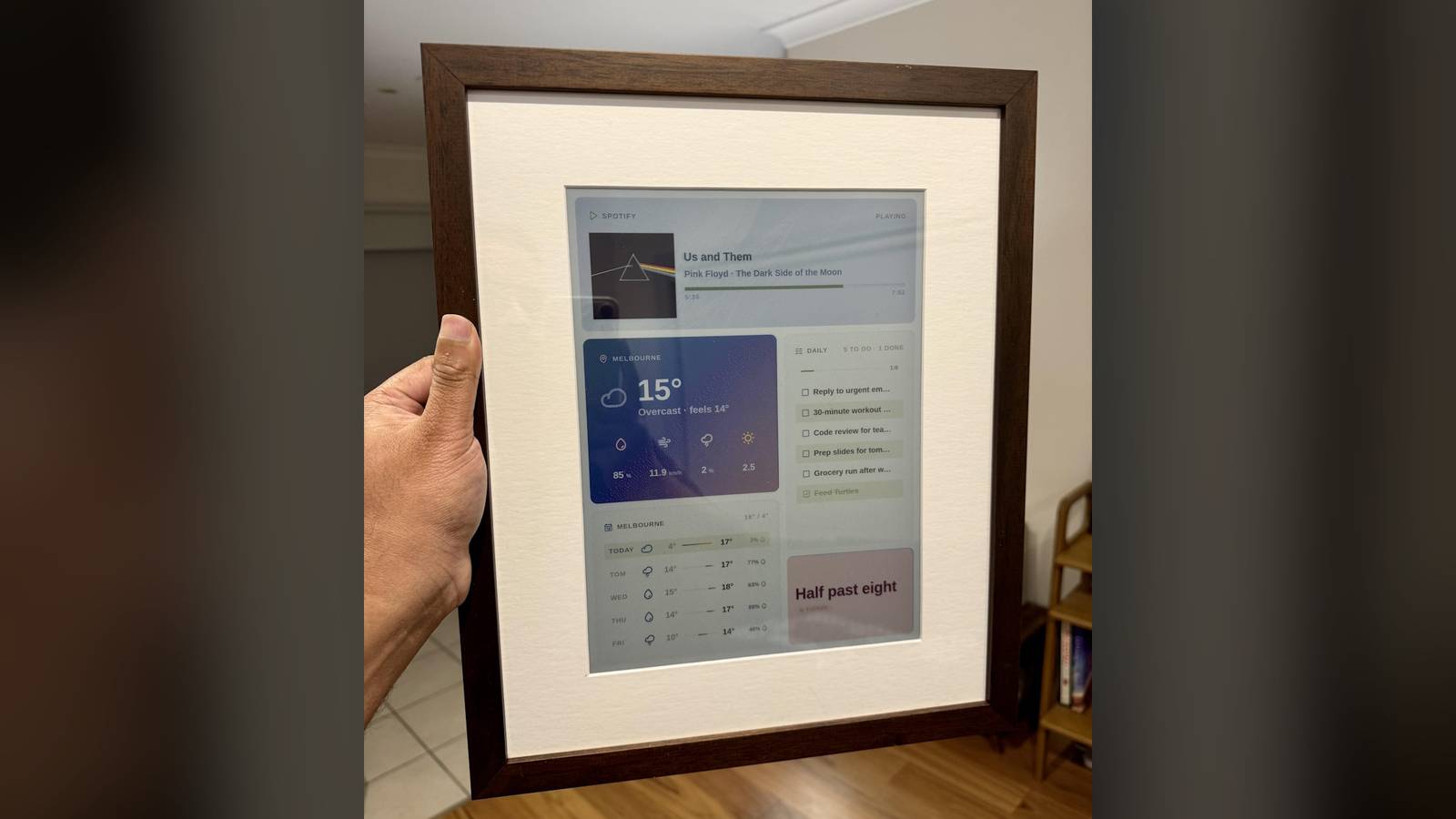
The project, which centers on a 13.3-inch color e-Ink display powered by a Raspberry Pi Zero 2 W, is more than just a mounting job; it is a masterclass in software-hardware synergy. Housed within a traditional picture frame, the display cycles through a series of highly curated information pages. At a glance, it provides the weather, Spotify playback status, a dynamic to-do list, a word-based clock, and a five-day meteorological forecast.
Unlike standard tablet displays that often look jarring when wall-mounted, the e-Ink panel achieves a "physical" quality. It doesn’t just show information; it presents it. This shift in medium changes the user’s relationship with the data. It is no longer an intrusive notification center but a passive, ambient source of knowledge that respects the interior design of a living space.
A Chronology of the Build: From Concept to Calibration
The development process for this dashboard was rooted in a desire for technical refinement rather than just rapid deployment. According to the developer, the journey began with the hardware selection: a large-format 13.3-inch color e-Ink panel capable of utilizing the "Spectra 6" color palette.
- Hardware Assembly: The choice of the Raspberry Pi Zero 2 W was strategic. Its compact footprint allowed for a discreet mounting solution behind the display frame, ensuring the electronics remained invisible to the viewer.
- Software Development: The core of the project is a custom-built software suite dubbed "Tesserae." Recognizing the limitations of existing off-the-shelf dashboard software, the creator opted for a modular approach that prioritized flexibility and low-resource overhead.
- Visual Tuning: Perhaps the most technically impressive phase was the dithering process. Because the Spectra 6 palette is limited to just seven colors, the developer had to spend significant time fine-tuning the Floyd-Steinberg dithering algorithm. This ensured that images and icons appeared intentional and crisp rather than suffering from the "halftoning" artifacts that often plague low-color-depth displays.
- Deployment: Once the software was calibrated, the final integration involved housing the unit in a frame that allows for easy maintenance while maintaining a gallery-grade finish.
Under the Hood: The Power of Tesserae
At the heart of this project is Tesserae, an open-source software project that is quickly gaining traction among DIY enthusiasts. Tesserae is not merely a static image generator; it is a comprehensive dashboard platform designed to interface seamlessly with Home Assistant.
Key Features of the Tesserae Platform:
- Browser-Based Control: It allows users to manage and visualize multiple Home Assistant entities directly through a simplified browser interface.
- Widget Ecosystem: The software includes over 30 pre-built widgets, allowing users to customize their dashboard layout without needing to write complex code for every new data point.
- Template Flexibility: With 10 pre-set templates, users can transition from a weather-focused view to a GitHub statistics tracker or a full-bleed photo frame with ease.
- Open-Source Philosophy: By making the software open-source, the developer has invited a community-driven expansion, where other users can contribute new widgets, templates, and optimizations.
Data and Efficiency: Why e-Ink Wins
To understand why this project is significant, one must look at the data surrounding display power consumption. A standard 10-inch LCD tablet typically consumes between 5W and 15W of power, requires a constant power supply, and generates heat. In contrast, an e-Ink display only consumes power when the image is being updated.
For a static dashboard—like one displaying a grocery list or a weather forecast—this means the display can remain active for days, weeks, or even months on minimal power. This efficiency profile makes it an ideal candidate for "always-on" displays that don’t need to be tethered to a wall outlet, provided the battery and power management circuitry are implemented correctly.
Furthermore, the "Spectra 6" palette, while limited, provides enough color depth to convey essential information categories—such as warnings, temperatures, or progress bars—without the eye strain associated with backlit displays.
Implications for the Future of Smart Home Design
The success of the "dmellok" build highlights a broader shift in the smart home industry. For years, the industry pushed "more": more pixels, more touch sensitivity, more brightness. This project suggests that the "less is more" approach is finding a home among tech-savvy consumers.
1. Aesthetic Integration
We are moving away from the "Star Trek bridge" aesthetic of the early 2010s smart homes and toward a "calm technology" paradigm. By hiding the hardware and utilizing materials that blend into home decor, users are creating environments that feel less like laboratories and more like living spaces.
2. The Rise of "Prosumer" DIY
Projects like Tesserae prove that independent developers are now producing software that rivals commercial offerings in terms of polish and utility. When an open-source tool can provide a better user experience than a proprietary closed-system app, the market must take notice.

3. Sustainability in Electronics
By repurposing older hardware (or using efficient microcontrollers like the Raspberry Pi Zero) to drive long-lasting e-Ink displays, the DIY community is indirectly promoting a more sustainable approach to tech consumption. It reduces the "e-waste" cycle by extending the utility of components that might otherwise be discarded.
A Call to the Community
The documentation provided by the creator on GitHub serves as an invitation. For those looking to replicate this project, the barrier to entry is lower than it might appear. The combination of a Raspberry Pi, an e-Ink HAT (Hardware Attached on Top), and the Tesserae software provides a robust starting point.
As the smart home market continues to mature, we will likely see more crossover between traditional interior design and high-tech instrumentation. Whether it’s a framed dashboard in the hallway or an e-Ink panel on a desk, the future of smart homes looks remarkably like paper.
In conclusion, the project serves as a reminder that technology’s greatest trick isn’t being everywhere—it’s being useful enough to stay, yet subtle enough to disappear. For anyone interested in exploring the intersection of art and automation, the Tesserae project is a testament to what is possible when patience, design sensibility, and open-source software converge.

 Suro Senen
 Jia Lissa