Ammar Sabilarrohman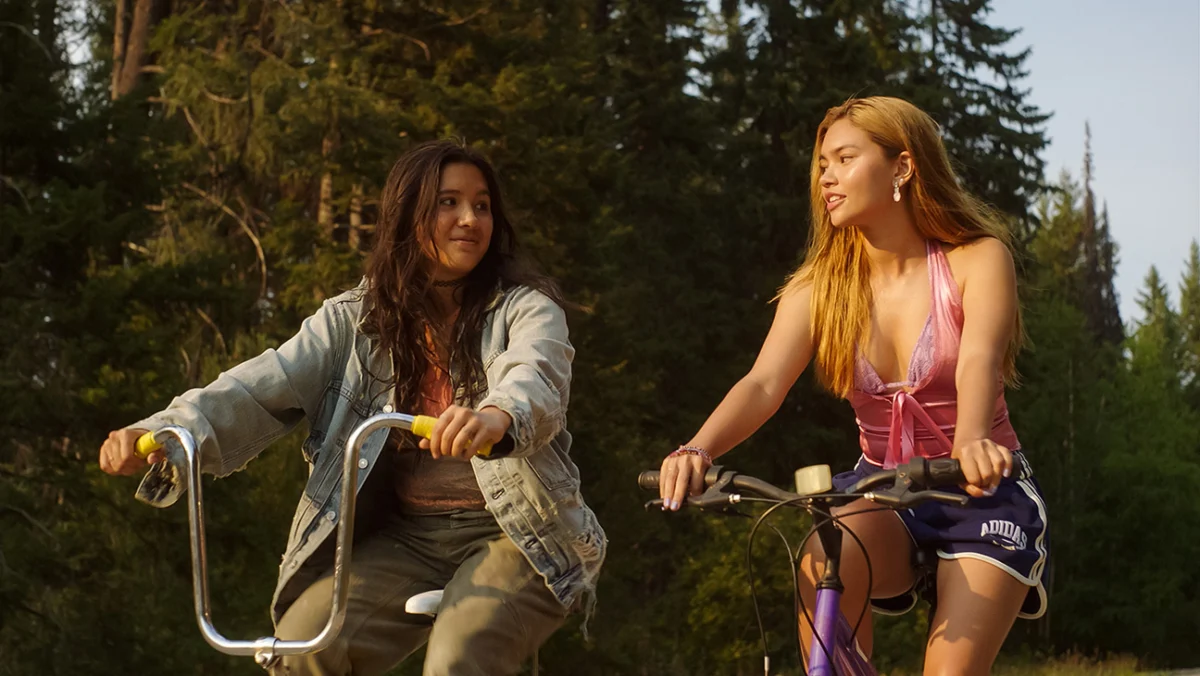
To paraphrase the lyrics of “Girls Like Girls,” the 2015 breakthrough track by singer-songwriter Hayley Kiyoko that serves as the spiritual and narrative bedrock for her feature-length directorial debut, there is “nothing new” about the story at its heart. The premise—the budding, often agonizing attraction between two teenage girls—is a familiar trope in the landscape of coming-of-age cinema. The filmmaking, while aesthetically polished and soaked in the hazy, golden-hour light of a Pacific Northwest summer, does not seek to reinvent the cinematic language. It offers no radical formal departures or mind-bending plot twists.
Yet, to categorize Girls Like Girls as merely "familiar" would be to miss the point entirely. The film operates on the premise that while teen love is a universal experience, it never feels universal to the person living it. Every generation of adolescents stumbles into the dizzying, terrifying, and exhilarating reality of their first queer awakening as if they are the first humans to ever discover it. It is that specific experience—the sensation of uncovering a hidden part of oneself and navigating the turbulence that follows—that Kiyoko captures with such aching precision that the film transcends its humble trappings to become a small, radiant revelation.
The Production: A Mid-Aughts Time Capsule
Girls Like Girls arrived in theaters on June 19, marking a significant transition for Kiyoko from pop star to filmmaker. The film, which runs 94 minutes and carries an R rating, is anchored by a breakout performance from Maya da Costa as Coley, and Myra Molloy as the effervescent Sonya. They are supported by a cast that includes Zach Braff, who delivers a understated, poignant turn as Coley’s father, and Levon Hawke.
The screenplay, penned by Kiyoko alongside Chloe Okuno and Stefanie Scott, leans heavily into the tactile nostalgia of the mid-2000s. Set in 2006, the production design by Lindsey Moran is nothing short of masterful. From the signature, rhythmic bloop of an AOL Instant Messenger notification to the specific visual texture of a decade defined by the transition from analog to digital, the film acts as a sensory time machine. For the "geriatric millennial" viewer, the film is a hauntingly accurate mirror of a world that existed just before the ubiquity of the smartphone, capturing a fleeting window of teenage autonomy that feels both long ago and yesterday.
Chronology of a Summer Awakening
The narrative arc of Girls Like Girls is deceptively simple. It is the summer of 2006 in a quiet, tree-lined corner of the Pacific Northwest. Coley, shy and carrying the weight of recent, profound loss, moves in with her father, Curtis (Braff), on the outskirts of town. She is an outsider, defined by her sad eyes and a palpable sense of internal isolation.
Then, she meets Sonya. Sonya is everything Coley is not: popular, bubbly, and seemingly at ease in her environment. The connection is immediate, bordering on the gravitational. The film chronicles their summer through the archetypal markers of youth: bike rides through suburban streets, lazy afternoons at the pool, and the intimate, late-night digital exchanges that defined the mid-aughts social experience.
As the weeks progress, the friendship pivots. The easy, platonic comfort of physical proximity—legs draped over one another in the backseat of a car, shared glances—slowly becomes fraught with the heavy, unspoken tension of romantic desire. It is here that the film hits its stride, documenting the transition from "friend" to "crush" with a sensitivity that rarely graces the screen.
The Performance Dynamics: Chemistry Over Complexity
The success of Girls Like Girls rests entirely on the shoulders of its two leads. Maya da Costa’s portrayal of Coley is a masterclass in non-verbal storytelling. She is not a character who speaks in grand declarations; instead, she communicates through the intensity of her gaze. DP Sonja Tyspin’s camera acts as a secondary character, lingering on the subtle shifts in da Costa’s expressions, the way her eyes follow Sonya, and the physical effort she exerts to maintain composure.
Myra Molloy’s Sonya is equally complex. Initially presented as the "girly girl" with a penchant for strays—a characterization cruelly echoed by her boorish boyfriend, played by Levon Hawke—Molloy slowly strips away the mask of confidence. As she begins to reciprocate Coley’s feelings, her performance becomes defined by a burgeoning, nervous innocence. She captures the specific anxiety of a young person realizing that their identity is shifting, and the fear of social alienation that often accompanies that realization.
Narrative Implications and Internal Conflict
Perhaps the most refreshing element of the Girls Like Girls script is its refusal to rely on external villains. There is no homophobic antagonist lurking in the bushes or dramatic, cinematic intervention to stop the girls from being together. The conflict is entirely internal.
Sonya, a person who has spent her life following the path of least resistance, finds herself paralyzed by the prospect of living her truth. As their relationship shifts from friendship to romance, Sonya begins to withdraw, terrified of the labels and the social consequences of being "out." Coley’s heartbreak is visceral, rendered more devastating by the backdrop of her own life: she is a girl already grieving the loss of her mother, and Sonya’s subsequent abandonment serves as a secondary, crushing blow.
While Zach Braff’s performance as Curtis is tender and well-intentioned, the father-daughter dynamic remains a secondary layer to the core romance. Some critics might argue this is a narrative weakness, but in the context of the film’s singular focus, it is a deliberate choice. First love, especially queer first love, has a way of creating a vacuum where the rest of the world—including parents and social obligations—fades into the background. Kiyoko captures this all-consuming tunnel vision with remarkable, unwavering empathy.
The Director’s Vision: A Case Study in Emotional Authenticity
Hayley Kiyoko’s directorial approach is defined by restraint. Despite her own background as a musician, she uses her own catalog sparingly, opting instead for a dreamlike score by Jessica Rose Weiss that amplifies the film’s ethereal, summertime mood. By keeping the plot lean and the stakes personal, she allows the audience to project their own experiences onto the screen.
The film serves as a testament to the importance of "small" queer stories. In an era where LGBTQ+ representation in film is often tied to trauma or political struggle, Girls Like Girls offers a space for pure, unadulterated yearning. It does not try to solve the mystery of being gay; it simply depicts the beauty of the experience.
Supporting Data and Reception
Since its release, the film has garnered attention for its ability to resonate with both Gen Z audiences and those who lived through the era it depicts. The "Bottom Line" for most critics has remained consistent: it is a work brimming with tenderness.
- Production Notes: Though the press notes cite Oregon as the primary location, the geography is a nod to the Canadian production, which adds to the film’s sense of "anywhere-ness."
- Target Audience: While the film is aimed at young adults, its focus on the "first crush" dynamic ensures a cross-generational appeal.
- The Soundtrack: The decision to lean away from the director’s own hits is a testament to the film’s desire to stand on its own as a narrative work rather than a promotional vehicle.
Final Reflections
Girls Like Girls is a film that feels special because it dares to be ordinary. By stripping away the need for high-concept drama, Kiyoko has created something that feels remarkably intimate. It reminds the viewer that the most monumental events in our lives are often the ones that go unnoticed by the world at large: a touch, a glance, a secret shared in the dark.
For those who have ever felt the earth tilt on its axis because of a single person, the film serves as a mirror. It is a quiet, beautiful, and deeply resonant piece of filmmaking that succeeds precisely because it understands that, even if the story has been told before, it has never been told this way. In the end, Girls Like Girls is not just a film about two girls falling in love; it is a film about the courage it takes to recognize that love, and the enduring, transformative power of being seen for the first time.


 Asro
Asro
 Nana Wu