Lina Irawan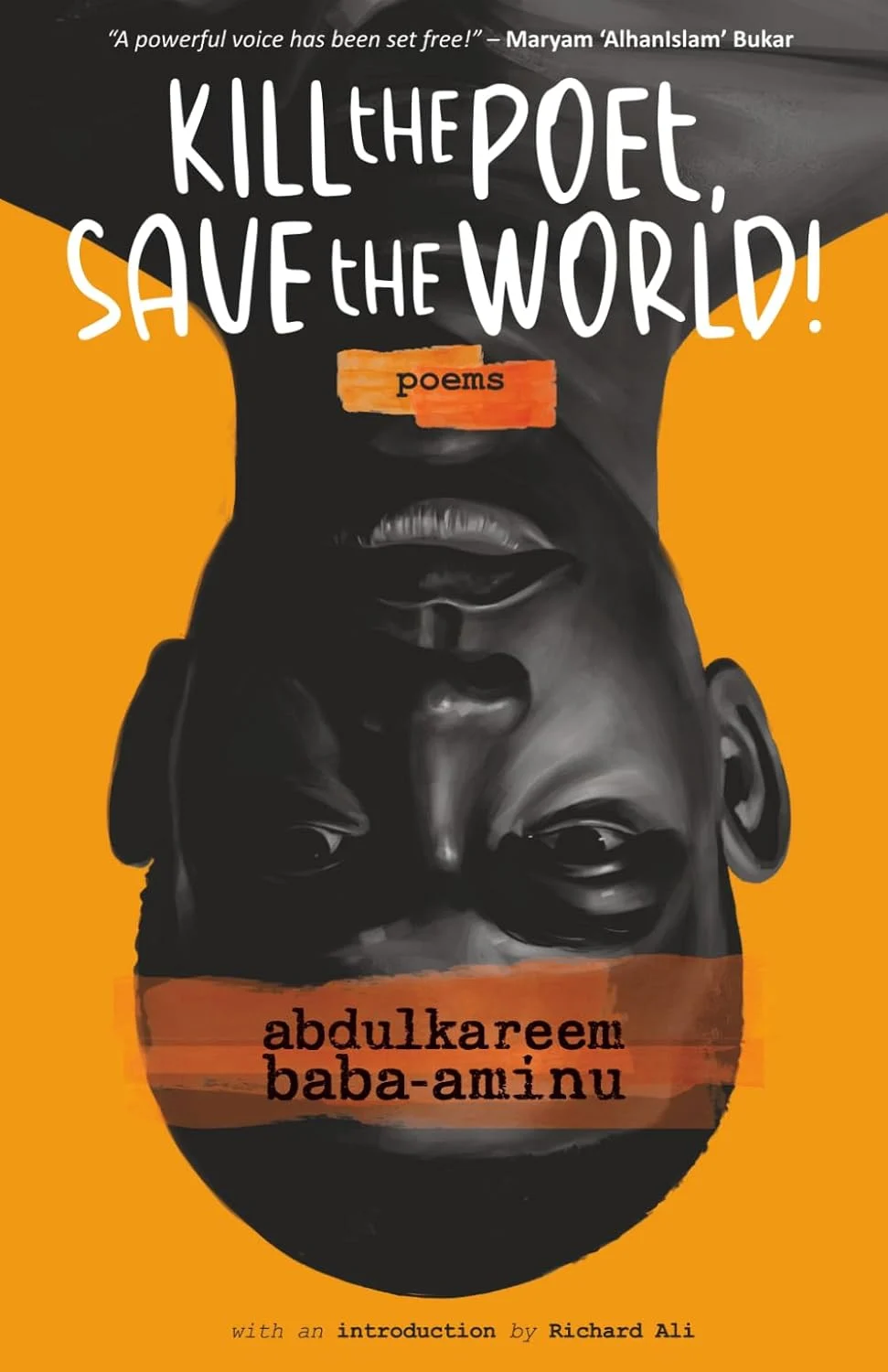
In the landscape of contemporary African literature, few debut collections have arrived with the intellectual heft and technological audacity of Abdulkareem Baba-Aminu’s Kill the Poet, Save the World!. A bracing fusion of Africanfuturism, personal trauma, and sociopolitical critique, the collection challenges the traditional boundaries of poetry, reframing the poet not merely as an observer of beauty, but as an “engineer of consciousness” capable of recalibrating the moral trajectory of society.
The Temporal Paradox: A Philosophical Core
The title of the collection is an immediate, provocative callback to the cultural zeitgeist of the mid-2000s—specifically, the iconic "Save the cheerleader, save the world" mantra from the television series Heroes. While the reference may lean into the tropes of sci-fi nostalgia, Baba-Aminu utilizes this framework to interrogate a far more serious obsession: our human fixation on fate and the potential to undo historical catastrophe.
Baba-Aminu is deeply preoccupied with the temporal paradox. In his poem "The Past is Not a Place," he dares to confront the origins of terror, imagining a confrontation with an infant Abubakar Shekau—long before he became the face of Boko Haram’s atrocities. Baba-Aminu’s musing—"If I end this heartbeat now, will Chibok still sing?"—serves as the collection’s emotional pivot. It forces the reader to confront the ethical weight of intervention: if one could surgically remove the root of a tragedy, would the resulting timeline be free of ghosts, or would the fabric of reality simply tear elsewhere?
Chronology of a Visionary Work
To understand the gravity of this collection, one must view it as the culmination of the author’s multifaceted career as a journalist and cultural commentator.
- Early Development (Pre-2020s): Baba-Aminu’s early writing, largely seen through his columns in the Daily Trust, established his voice as a sharp, analytical observer of Northern Nigerian life.
- The Catalyst (2024): A severe car accident, which resulted in prolonged hospitalization and inadequate medical care, served as a traumatic turning point. This period of physical suffering shifted his work from intellectual observation to visceral, embodied experience.
- Publication (2026): Kill the Poet, Save the World! is released, synthesizing his background in engineering, his journalistic rigor, and his evolving spiritual life.
- Contemporary Reception (Present): The work is currently being hailed as a pivotal text in the Africanfuturist movement, bridging the gap between Nnedi Okorafor’s imaginative scope and the grounded, elegiac traditions of Nigerian poetry.
Scientific Skepticism and the "Engineer of Consciousness"
While many poets shy away from the cold language of science, Baba-Aminu embraces it. He treats poetics with the precision of coding. However, this is not a celebratory embrace of technocracy. In "The Genegineer," he explores the moral hazards of genetic engineering. He posits that while we possess the tools to fix nature’s "flaws," we inevitably lose the essential, messy, and vital elements of humanity in the process.
This stance defines his role as an "engineer of consciousness." He argues that modern poetry has become an insular, navel-gazing activity. By calling for the "death" of the poet—or at least the death of the poet as a detached, self-absorbed figure—he demands a return to the prophet-status of the bard. He seeks a poetry that is forward-facing, capable of diagnosing the systemic dysfunction of the state and offering a "rational anthem" for survival.
Supporting Data: Thematic Pillars of the Collection
The collection is structured around a thirty-five-poem suite that draws from diverse sources, ranging from Hausa linguistics to the remnants of Nigeria’s thirty-year military history.
1. The Intersection of Trauma and Mortality
Following his 2024 accident, the author’s work took an intensely personal turn. Poems like "The Body Forgets" and "Clinical Findings After Two Harmattans" document the indignity of the medical system and the reality of chronic pain. His writing here transitions from the abstract to the painfully specific. As he writes in the meditation "Farewell":
Call: What is a body when spared or betrayed?
Response: A rumour of light that the dark has mislaid.
2. The Romantic as a System Error
Baba-Aminu does not abandon the heart, but he refracts it through a technological lens. In poems like "/pulse.exe," he treats love as a form of malware. This is not necessarily an indictment of love, but rather a reflection of the volatility of human connection. Yet, in "Equilibrium of Two," he finds a path toward redemption, asserting that love is "a choice made across time"—an act of agency that transcends the viral nature of heartache.
3. Geopolitical and Ecocritical Concerns
The collection serves as a map of modern Nigeria. In "River Kaduna" and "A Code of Zaria," the poet laments the erosion of the "Liberal State." Once defined by its cosmopolitan, academic atmosphere at Ahmadu Bello University, the region has been scarred by sectarian violence. Baba-Aminu captures the contradiction of this environment, mourning the loss of a home that no longer exists as it once did.
Official Responses and Literary Significance
Literary critics have noted that Baba-Aminu’s work occupies a unique space between the spiritual and the digital. His frequent use of religious motifs—often compared to the works of Rumi—coupled with his Rilkean dedication to the "hard work of loving," has garnered praise for its depth.
While there have been no formal "official" state responses, the collection has resonated deeply within Nigeria’s literary circles. The inclusion of Hausa, the lingua franca of the North, serves as a deliberate reclamation of language in a space often dominated by colonial literary standards. By weaving these threads together, Baba-Aminu provides a blueprint for what a post-conflict, tech-literate Nigerian identity might look like.
Implications: The Future of the "Poet-Engineer"
The publication of Kill the Poet, Save the World! suggests a shifting tide in African literature. The collection implies that the era of the "observer poet" is waning, to be replaced by the "participant poet."
The Ethical Burden of the Artist
Baba-Aminu’s work leaves the reader with a daunting question: If we are all "engineers of consciousness," what are we building? His commitment to his mother’s memory in "For Yaya, For Everything" acts as the emotional anchor for this massive, sprawling project. It reminds us that no matter how much "chrome and circuitry" we apply to our art, the root remains in the human connection.
A Transnational Appeal
Though deeply rooted in the Nigerian experience, the themes of the collection—the ethics of technology, the navigation of grief, and the struggle to maintain one’s humanity in a crumbling political system—possess a universal resonance. Whether the reader identifies as a geek, a mystic, a revolutionary, or a romantic, the collection offers a point of entry.
Ultimately, Abdulkareem Baba-Aminu has produced a work that is as challenging as it is necessary. By dismantling the poet, he has created the space for a new kind of social architect. Kill the Poet, Save the World! is not just a book of verses; it is a diagnostic tool for a world in flux, a reminder that even when the circuits go cold, the human spirit continues to learn "a hymn so bold." As the collection suggests, the work is hard, the trial is ultimate, and the preparation begins with the very first page.


 Ammar Sabilarrohman
 Pevita Pearce