Neng Nana
For years, the gold standard for gaming immersion—OLED display technology—was the exclusive domain of enthusiasts with significant disposable income. The promise of near-instantaneous response times, infinite contrast ratios, and "true black" levels made OLED the holy grail of monitor technology, rendering traditional IPS and VA panels obsolete in the eyes of many. However, as of mid-2026, the barrier to entry has finally crumbled.
While the sudden affordability of 27-inch 1440p OLED monitors is a monumental win for the general consumer, it presents a peculiar dilemma for the veteran gamer. For those who have been parked at the 1440p resolution for the better part of a decade, this "revolution" feels less like a leap forward and more like a sideways shuffle.
The Chronology of the OLED Price Collapse
The transition of OLED from a luxury item to a commodity began in earnest in late 2024. Before this period, owning an OLED monitor required an investment of upwards of $800 to $1,000.
- 2024–2025: Initial market expansion saw manufacturers introducing "budget" OLEDs, though these still hovered in the $500–$600 range. The industry was testing the waters, gauging whether the average gamer was willing to pay a premium for self-emissive pixels.
- Late 2025: A pivotal shift occurred as manufacturing yields improved and new players entered the market. We witnessed the first significant price corrections, with older-generation OLED panels dipping below the $400 threshold.
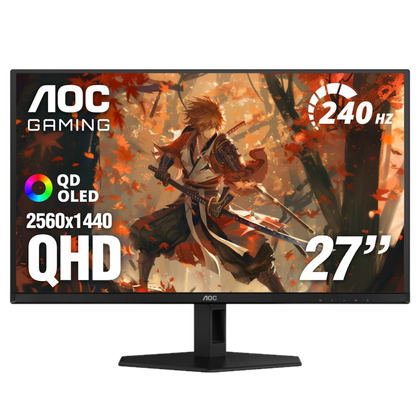
- Q1–Q2 2026: The current landscape is defined by aggressive competition. Models like the Gigabyte GO27Q24G and the AOC Q27GAZD hit the market at $400, while legacy stock from Samsung’s Odyssey G5 and G6 series plummeted to the $350 mark.
Today, a high-refresh-rate (240Hz) 1440p OLED monitor is no longer a "pro-tier" exclusive; it is a mainstream purchase. But this accessibility comes at a cost, both literal and figurative.
Supporting Data: What $350 Actually Buys You
When analyzing the current market, it is vital to distinguish between "affordable" and "premium." A $350–$400 OLED monitor in 2026 is an impressive piece of hardware, typically offering:
- DisplayHDR True Black 400 certification: Excellent contrast but moderate peak brightness.
- Connectivity: Modern standards such as HDMI 2.1 and DisplayPort 1.4.
- Panel Tech: Primarily QD-OLED (Quantum Dot OLED), which offers vibrant color saturation.
However, the "cut-down" nature of these budget panels is where the disparity lies. To hit these lower price points, manufacturers have implemented subtle compromises. Many of these units suffer from lower peak brightness compared to their $1,000+ counterparts, which can leave images looking washed out in well-lit rooms. Furthermore, color depth management is often restricted; some units throttle their refresh rates if users attempt to push the display to full 10-bit color depth, forcing a choice between fluid motion and color fidelity.

The "Upgrade" Trap: Why 1440p Gamers Are Hesitant
For a gamer currently using a standard 1080p monitor, upgrading to a 27-inch 1440p OLED is a transformative experience. The pixel density jump, combined with the superior contrast, creates a visual fidelity that feels like a generational leap.
But what of the gamer who has been using 1440p for the last seven years?
For this cohort, the monitor market has hit a plateau. A 1440p display—regardless of whether it is IPS or OLED—still occupies the same screen real estate and offers the same resolution. Switching to an OLED version provides better blacks and faster motion clarity, but it does not provide the "wow" factor of a resolution jump.

The dream upgrade for most 1440p veterans is a 32-inch 4K OLED monitor. These displays offer the crispness of high pixel density and the beauty of OLED technology. Unfortunately, these monitors remain firmly in the high-price bracket, typically retailing for $650 to $700 even during seasonal sales. Consequently, many gamers feel they are being offered a "budget" side-grade rather than a true premium upgrade.
The Technical Implications of Budget OLEDs
Beyond the price tag, there are physical and environmental factors that potential buyers must consider before abandoning their current monitors.
The QD-OLED "Grey" Factor
Most of these affordable models utilize QD-OLED panels. While these panels are visually stunning, they possess a unique physical characteristic: they are highly susceptible to ambient light. In a room with overhead lighting or sunlight, the "true black" levels of these monitors can shift to a deep purple or grey. This isn’t a defect—it’s a physical property of the panel’s anti-reflective coating and sub-pixel structure. For gamers who don’t have a dedicated, light-controlled "bat cave" office, the performance of these monitors can fluctuate wildly based on the time of day.
Build Quality and Maintenance
The cost-cutting measures also extend to the chassis and surface treatment. Users have reported that the anti-reflective coatings on entry-level OLEDs are more prone to micro-scratches than the more robust coatings found on professional-grade displays. This necessitates a more rigorous, gentle cleaning regimen, adding a layer of "maintenance anxiety" to the ownership experience.
Official Manufacturer Perspectives
Industry analysts and hardware manufacturers suggest that this current stagnation at the 1440p level is a temporary phase of the "OLED lifecycle."
Representatives from major panel manufacturers have indicated that the current focus is on clearing out high-volume 1440p panel inventory. The logic is simple: by driving the price of 1440p OLEDs down, companies can get the technology into the hands of the masses, normalizing the "OLED look" across the gaming community. They argue that once 4K manufacturing yields improve and the "twinning" of OLED layers (tandem OLED technology) becomes cheaper to produce, the 4K price cliff will eventually mimic the 1440p decline we are seeing today.
The Verdict: To Buy or To Wait?
If you are a gamer running a 1080p setup, or if your current 1440p monitor is failing, the $350–$400 OLED market is a godsend. The jump in motion clarity and contrast will be immediately apparent, and the price is finally low enough that the risk of burn-in or panel degradation feels less financially catastrophic than it did two years ago.
However, for the veteran 1440p gamer, the situation is different. If your current monitor is still functional, there is a strong argument for patience. The jump to 4K OLED is the "endgame" experience that many are waiting for. By waiting another 18 to 24 months, we are likely to see the $650+ 4K monitors drop into that sweet spot of $400–$500.
In the world of PC hardware, there is always a "next big thing." While it is tempting to jump on the $350 OLED bandwagon today, savvy consumers should ask themselves if they are buying an upgrade, or merely chasing a trend that has yet to offer the resolution leap they truly desire. The OLED revolution is here, but for many, the best version of that revolution is still a year or two away.


 Raul Delapena Setiawan
 Azzam Bilal Chamdy