Evan Lee Salim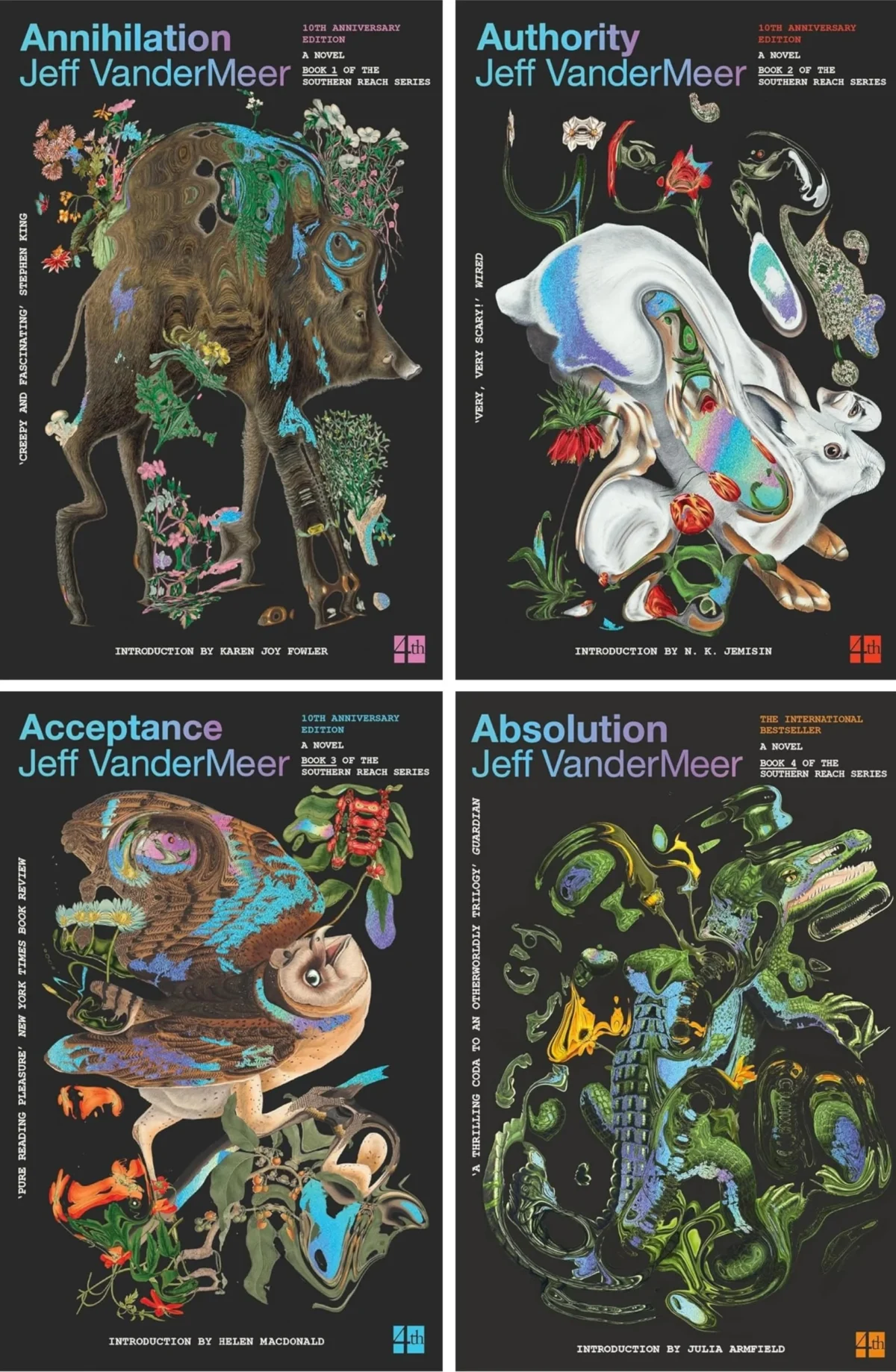
The boundaries of the human body, the rigidity of linear time, and the perceived "purity" of the natural world are being violently redrawn in contemporary and classic speculative fiction. From the stitching of dead flesh in Mary Shelley’s Frankenstein (1818) to the fungal, oceanic metamorphoses in Jeff VanderMeer’s Southern Reach series and the vengeful, spectral elk-human hybrids of Stephen Graham Jones’s The Only Good Indians (2020), literature has long served as a laboratory for the nonhuman.
By analyzing these works through the lens of queer theory and ecological philosophy, we discover that the "monster"—the hybrid, the mutated, and the anomalous—is not merely a figure of horror. Rather, these beings represent a radical "queering" of the world, challenging the hierarchies that prioritize human exceptionalism over the vibrant, interconnected materiality of the planet.
The Chronology of Disruption: From Shelley to Area X
The publication history of these texts spans over two centuries, yet they share a profound preoccupation with the "out-of-joint" nature of existence. While Frankenstein is often cited as the foundational text of Science Fiction and Fantasy (SFF), it operates on the same ontological frequency as its 21st-century successors.
In Frankenstein, the moment Victor stitches together disparate limbs to spark life, he initiates a defiance of natural reproduction. In The Only Good Indians, Stephen Graham Jones uses the figure of the "Elk Head Woman" to collapse the distance between the past and the present, as a historical trauma erupts into the contemporary reality of the protagonists. Finally, in Jeff VanderMeer’s Area X, the landscape itself functions as a sentient, expanding hyperobject that consumes and rewrites the genetic and chronological markers of those who enter it. Reading these works together reveals that the queering of the body and time is not a fleeting literary trend, but a persistent, necessary intervention in how we define "life."
Theoretical Foundations: Vibrant Matter and Queer Temporality
To understand the mechanics of these transformations, we must look to the theoretical frameworks that ground them. This investigation relies on five key pillars:
- Jane Bennett (Vibrant Matter): Advocates for the recognition of "vital materiality," arguing that we should stop distinguishing the human self from the field of nonhuman matter.
- Mel Y. Chen (Animacies): Explores how the "queer" can disrupt binary systems like life/death and human/animal, proposing that animacy itself is a political and queer force.
- Elizabeth Freeman (Time Binds): Introduces "chrononormativity," the idea that society enforces a linear, reproductive timeline. Queer theory, in this context, acts as a site of failure for these societal demands.
- Timothy Morton (Hyperobjects): Defines hyperobjects as entities—like climate change or the biosphere—that are so massively distributed in space and time that humans cannot fully perceive them.
- Donna Haraway (Staying with the Trouble): Calls for the "making of kin" across species lines, moving away from human-centric narratives.
These theorists collectively argue that when the "normal" (heteronormative, human-centric) world fails, the monstrous becomes a site of potentiality. It is not an error; it is an alternative mode of being.

Supporting Data: The Anatomy of the Monstrous
The transformation of the body serves as the primary data point for these narratives. In The Only Good Indians, a man shoots a woman through the shoulder, and in her agony, her very biology mutates. "Her cheeks and chin tear with a wet sound and the bones crunch," eventually manifesting as the "Elk Head Woman." This is not merely physical damage; it is a rewriting of her species identity.
Similarly, in Area X, a woman begins to spasm in the grass, dreaming of a "moat of vast sea creatures" as her genes turn "queerly towards the sea." She is not dying; she is relinquishing her position as a human. As VanderMeer writes, she descends into the "light of contamination and change."
These transformations demonstrate what Mel Y. Chen describes as "animacy"—a modulation of life force that blurs the hierarchy of human, animal, vegetable, and mineral. These beings are "queered" because they cannot be assimilated into the frameworks of capitalism or neoliberalism. They are, by definition, un-productive, existing outside the traditional markers of success and lineage.
Official Literary Implications: Hauntology and the Ruptured Present
A recurring theme across these texts is the concept of "hauntology," an ethics of responsibility toward the past and the dead. As Elizabeth Freeman suggests, the present is always split by prior violence.
In The Only Good Indians, when the character Ricky interacts with a logging foreman, the modern world falls away, and he is transported into a "canvas tent"—a memory of ancestral history pressing into the present. This is a haunting that transcends time.
In Area X, this haunting manifests as the "Ghost Bird"—a duplicate of the Biologist who carries the memories and the genetic echo of her predecessor. The Biologist and the Ghost Bird are two alternative pasts and futures, haunting one another. They represent the "unrealized potentials" that society usually discards. By existing as these fractured, doubled entities, they refuse the singular, productive timeline demanded by chrononormativity.

Mary Shelley’s Frankenstein serves as the archetype for this erotic and existential haunting. The Monster is a cobbling together of corpses, a "stitched-together history of desire." His creation is not a miracle of science, but a queer creationist act that bypasses the mother entirely. Victor Frankenstein’s desire to be a progenitor—a "father" to a new species—is the ultimate rejection of the heterosexual, reproductive imperative.
The Promise of the Queer Monster
If we accept these narratives as a reflection of our current ecological and social reality, the implications are profound. We are living in a time where the "hyperobjects" of our era—climate change, systemic inequality, and mass extinction—are forcing us to acknowledge that we are "lost inside them," as Morton puts it.
The conclusion to be drawn from these works is that the "monstrous" is actually an avenue toward empathy. When characters like the Biologist in Area X or the daughter Denorah in The Only Good Indians encounter these strange, nonhuman, or hybrid others, they do not find the end of the world. They find a new way to relate to it.
The "failure" of these characters to remain human is, in fact, a triumph. By breaking down the barriers between species, between the living and the dead, and between the past and the future, these narratives suggest that queerness is not just a sexual or gendered identity—it is a way of inhabiting the world. It is a commitment to the "vital materiality" of our surroundings.
Ultimately, the queer reading of these monsters offers a blueprint for solidarity. Even when the outcomes are tragic—as they are in Frankenstein—the underlying impulse of the monster is to seek understanding. The promise inherent in "queering the world" is that the untouchable, the monstrous, and the "other" can become the very things that allow us to survive the end of the world as we know it. By embracing the "light of contamination and change," we move toward a subjectivity that values kinship over exceptionalism and connection over categorization.

 Laily UPN