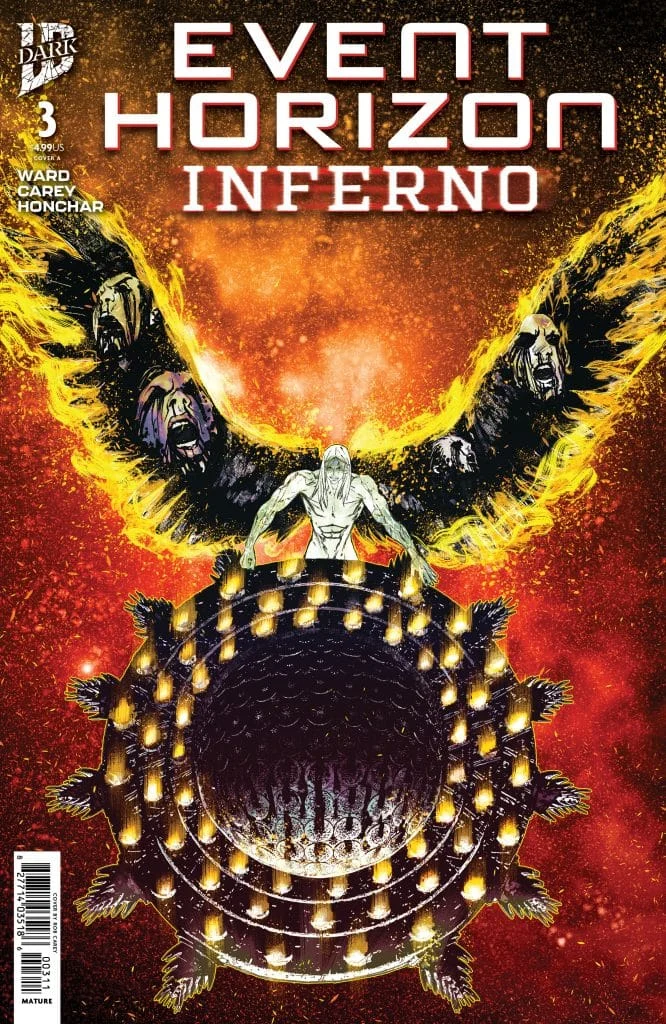
Two centuries after its disappearance, the Event Horizon remains the most notorious vessel in science fiction history. Once intended to push the boundaries of human exploration, the ship has instead become a static monument to suffering—a purgatory where time is not a linear progression, but a jagged, repeating cycle of agony. In the latest installment of IDW Publishing’s expansion of this dark universe, Event Horizon: Inferno #3, the narrative shifts from simple survival horror to a complex, character-driven exploration of psychological endurance.
The Core Narrative: A Cycle of Eternal Recurrence
The central conceit of Event Horizon: Inferno #3 is the horrifying realization that the ship does not merely kill its inhabitants; it consumes them. For 200 years, the Event Horizon has functioned as a closed system, a microcosm of Hell that traps souls in a temporal feedback loop. Survivors are forced to experience their own deaths repeatedly, a mechanism designed to mine their suffering as a form of "fuel" for the ship’s sentient, malevolent machinery.
In this third issue, writer Christian Ward pivots the focus toward the character of Starck. Following the previous installments, which functioned primarily as visceral horror, this issue acts as a psychological deep dive. We witness Starck and her companion, Cooper, struggling to navigate this "Groundhog Day of terror." The narrative establishes a critical shift in tone: while the Event Horizon universe was birthed in the claustrophobic, supernatural dread of the original film and its prequels, Inferno is consciously evolving into a survivalist epic.
The Chronology of the Event Horizon Expansion
To understand the stakes of Inferno #3, one must look at the progression of the franchise:
- The Origin (The Film Era): The initial exploration of the ship established the baseline for the "Hell dimension." It was a pure horror experience, focusing on the corruption of the crew and the ship’s transformation into a conduit for evil.
- The Prequel Series: These works built the foundation, detailing the ship’s initial launch and the catastrophic failure of its gravity drive.
- The Inferno Arc: The current series serves as a bridge. It moves away from the "haunted house in space" trope and adopts a structure reminiscent of James Cameron’s Aliens—a transition from atmospheric dread to high-octane, tactical survival.
This transition is significant. By shifting the focus to a "battle-tested" Starck, Ward is attempting to transform the Event Horizon from an unbeatable antagonist into a puzzle to be solved. The question is no longer just "can they survive the gore?" but "can they outmaneuver the architecture of Hell itself?"
Artistic Execution: Balancing Gore with Action
The visual language of Event Horizon: Inferno #3 is provided by artist Rob Carey, with color work by Xenon Honchar and lettering by Alex Ray. The creative team faces a difficult balancing act: they must maintain the franchise’s identity as a fountain of body horror while pivoting toward the more kinetic, action-oriented requirements of a survival narrative.
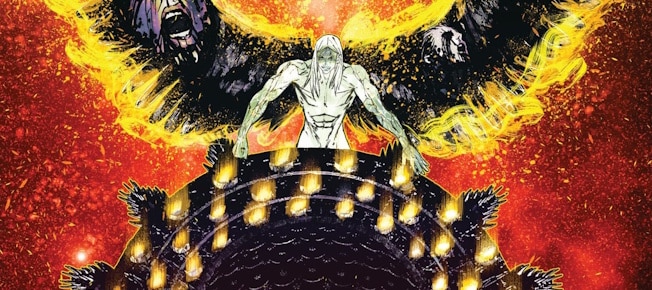
Carey’s art remains steeped in the unease that defined the previous issues. The depiction of the ship’s interior—a labyrinth of metallic decay and biomechanical horror—serves as the primary antagonist. Honchar’s color palette is particularly noteworthy, utilizing harsh, infernal tones that remind the reader that despite the increased focus on combat and tactical planning, this remains a place where the laws of physics are subservient to the laws of torment.
However, critics have noted that the "dialed back" intensity of the gore in this issue is a double-edged sword. By focusing more on the tactical struggle, the series risks losing the visceral impact that made the original property so polarizing and memorable. Yet, this restraint allows the story to prioritize character agency. As Starck begins to understand the mechanics of her prison, the "monsters and demons" she encounters serve as physical manifestations of her internal battle to break the loop.
Implications for the Franchise
The pivot taken in Inferno #3 has profound implications for the future of the Event Horizon intellectual property. By transforming the ship into a dynamic, shifting environment that can be "mined" for fuel and mapped by survivors, the story opens the door for a much larger narrative scope.
- Genre Fluidity: The successful shift from pure horror to survival-action proves that the Event Horizon setting is robust enough to sustain multiple sub-genres. This allows IDW to expand the universe without falling into the trap of repetitive scares.
- Character Empowerment: By focusing on a "battle-tested" Starck, the story provides a roadmap for how humanity might eventually conquer the ship. If the ship requires fuel—the agony of its occupants—then the ultimate goal becomes a fight against the system itself, rather than just fleeing from individual threats.
- The "Hell as a Loop" Concept: This thematic element is the strongest contribution Inferno makes to the mythos. It provides a logical, albeit terrifying, explanation for why the ship has remained "active" for two centuries. It suggests that the Event Horizon is not just a place, but a predator that has perfected the art of sustainable consumption.
Analysis of the Creative Team’s Vision
Christian Ward’s writing deserves credit for maintaining the integrity of the original source material while daring to alter its trajectory. In Inferno #3, the dialogue between Starck and Cooper serves as the emotional anchor of the issue. They are not merely fodder for the ship’s gore-filled gears; they are architects of a potential escape.
The art team’s contribution is equally essential. While the body count remains high, the composition of the panels suggests a greater focus on spatial awareness. Readers are given a better sense of the ship’s geography, which is necessary if the plot is to move toward a grand escape. Alex Ray’s lettering remains sharp, effectively capturing the frenetic pace of the action sequences while punctuating the darker, more introspective moments with clarity.
Official Reception and Critical Standing
With an overall rating of 8.0/10, Event Horizon: Inferno #3 is positioned as a "must-read" for fans of the franchise. While some purists may lament the shift away from pure, unadulterated terror, the broader consensus is that the series is evolving into a more complex narrative.
The partnership with IDW Publishing has provided a platform for these creators to take risks that might have been stifled in other mediums. By providing a "free" review copy to outlets like Graphic Policy, IDW has signaled a strong confidence in the quality and direction of this specific arc. The commercial performance of this series will likely dictate whether we see further expansions into the Event Horizon timeline or if this arc will serve as a definitive conclusion to the saga.
Future Outlook: The Battle to Come
As Event Horizon: Inferno #3 draws to a close, the stage is set for a dramatic confrontation. The "victims" are no longer just cowering in the shadows; they are organizing. The narrative is building toward a climax that promises to reveal the ultimate fate of the ship and those trapped within its gravity-warped halls.
We can anticipate more "twists and turns," as the series has consistently kept the reader off-balance regarding the nature of the ship’s consciousness. Does the ship have a will of its own, or is it a mindless parasite? Does breaking the loop mean destroying the ship, or is there a way to purge the evil while keeping the vessel intact? These questions will likely define the final acts of the series.
In conclusion, Event Horizon: Inferno #3 is a sophisticated, albeit bloody, chapter in a long-standing science fiction tradition. It proves that even after two centuries of darkness, there is still room to find new ways to terrorize—and captivate—the audience. By leaning into the survivalist aspects of the story, Christian Ward and his team have successfully breathed new life into a dying ship, ensuring that the legacy of the Event Horizon will continue to haunt readers for years to come. Whether the characters succeed in breaking their chains remains to be seen, but the journey to that resolution has become one of the most compelling narratives in modern comic book science fiction.