Developer: Nejcraft | Publisher: Quite OK Games | Genre: City Builder / Strategy | Platforms: Nintendo Switch, PC
In the crowded landscape of city-building simulations—a genre often defined by sprawling, flat expanses of terraformed land—Laysara: Summit Kingdom arrives as a breath of thin, high-altitude air. Developed by Nejcraft and published by Quite OK Games, the title fundamentally challenges the spatial conventions of the genre. By swapping the traditional horizontal grid for the treacherous, narrow verticality of mountain ranges, Laysara transforms the familiar loop of resource management into an intricate, high-stakes architectural puzzle.
The Core Concept: Engineering Amidst the Clouds
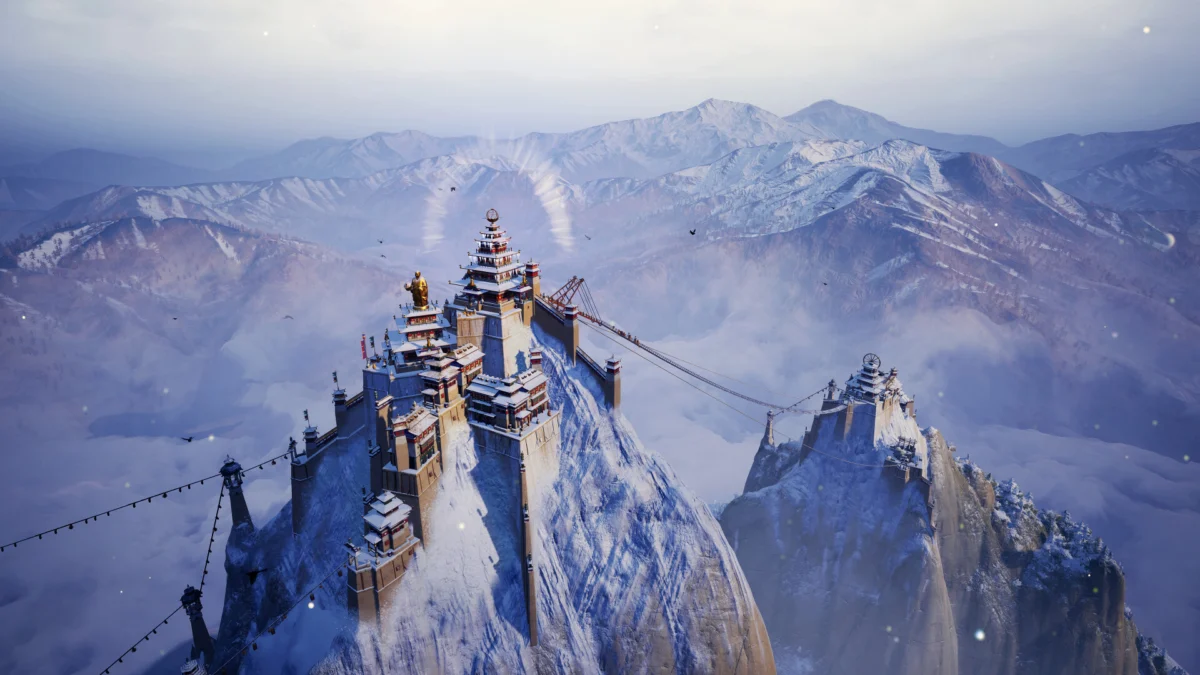
At its heart, Laysara: Summit Kingdom is a game about conquering geography. While most city builders allow for expansive, sprawling suburbs and wide-reaching industrial districts, Laysara dictates that every square inch of terrain is a premium commodity. Players are tasked with establishing human settlements on the slopes of massive, treacherous mountains, with the ultimate, ambitious goal of constructing a legendary temple at the very peak.
The gameplay loop is deceptively simple: extract resources, satisfy the needs of your growing population, and expand your reach. However, the implementation is anything but straightforward. The population is stratified into three distinct social classes—Lowlanders, Artisans, and Monks—each with their own unique demands and roles within the mountain ecosystem. Successfully managing these classes requires not just raw production power, but a delicate, interlocking logistics network that spans across multiple settlements, connected by complex, interdependent trade routes.
A Chronology of the Climb: From Humble Outposts to Summit Splendor
The progression in Laysara follows a distinct, rewarding, and sometimes punishing trajectory.
Phase I: The Foothills (Early Game)
The journey begins at the base of the mountain. Here, players learn the fundamentals of the game’s unique physics and spatial constraints. The focus is on establishing basic supply chains, gathering essential resources like food and stone, and housing the Lowlander population. At this stage, the mountain feels manageable, and the threat of logistical failure is low.
Phase II: The Ascent (Mid-Game)
As players progress, the challenge intensifies. To support the Artisans, production chains must become more sophisticated. This is when the "vertical puzzle" truly begins to shine. You are no longer just building; you are optimizing for space, trying to fit mills, quarries, and warehouses onto narrow ledges that seem barely large enough for a single structure. The need for inter-settlement trade becomes vital, as different elevations provide different raw materials.

Phase III: The Summit (Late Game)
The final phase of the game is where Laysara reveals its most demanding face. Building at the peak requires the expertise of the Monk class, who have the most demanding needs of all. By this point, the entire mountain is often a tapestry of interconnected supply lines. The late-game experience is defined by the requirement to build the "Summit Temple," a feat that often necessitates the total restructuring of your previous, carefully crafted infrastructure to accommodate the temple’s gargantuan footprint.
Supporting Data: The Mechanics of Success
What sets Laysara apart from its contemporaries—such as Cities: Skylines or Anno—is its rigorous commitment to its own constraints.
Vertical Logistics
In most simulations, logistical distance is calculated by pathfinding algorithms on a flat plane. In Laysara, distance is measured in altitude and elevation. If a settlement is positioned poorly, the cost of transporting goods to the peak can lead to a collapse of the entire chain. This forces the player to engage in "vertical planning," where every structure’s location must be evaluated based on its accessibility to other tiers of the mountain.
Tibetan-Inspired Aesthetic and Atmosphere
The visual identity of Laysara is one of its strongest assets. The game draws heavily from Tibetan architectural influences, utilizing vibrant colors, intricate stonework, and iconic prayer flags that flutter in the mountain winds. This is matched by a soundscape that eschews high-energy, bombastic orchestral themes for a more ambient, meditative, and atmospheric score. It is a design choice that reinforces the game’s core theme: the tranquility of nature standing in stark contrast to the grueling effort of human industry.
The Nintendo Switch Port
Transitioning a mouse-and-keyboard-heavy genre to a console controller is a notorious hurdle in game development. On the Nintendo Switch, Laysara performs admirably. While the complexity of the menus can occasionally feel cumbersome—particularly when managing multiple, sprawling settlements—the control scheme is intuitive enough to keep the experience fluid. The game retains its visual fidelity in both docked and handheld modes, proving that the artistic direction is scalable and optimized for the platform’s limitations.
Official Perspectives and Development Philosophy
The team at Nejcraft has been vocal about their desire to create a game that feels "different." In various developer diaries and community updates, the studio has emphasized that Laysara was built to discourage the "blob" style of building common in other games. By restricting space, they force the player to be an architect rather than a land-developer.
Quite OK Games, the publisher, has noted that they viewed Laysara as a high-risk, high-reward project. "We wanted to see if players still had the patience for a game that doesn’t just let them win through brute force," a representative noted. The inclusion of multiple game modes—Campaign, Sandbox, Challenge, and Free-build—is a deliberate effort to cater to different types of players, ranging from those who want a structured, narrative-driven experience to those who want a purely creative, low-stress building environment.

Implications: The Future of the City-Builder Genre
Laysara: Summit Kingdom serves as a case study for the evolution of the city-builder genre. It suggests that players are becoming increasingly interested in "niche" strategy games that prioritize depth and constraint over sheer map size.
However, the game also highlights the inherent frustrations of such design. The late-game requirement to dismantle and rebuild infrastructure is a point of contention among the community. It raises a question about the balance between "challenging gameplay" and "tedium." When a player has spent hours optimizing a mountain slope, being told they must tear it all down to fit a single end-game structure can feel less like a strategic challenge and more like a punishment for early-game success.
Despite these minor pacing issues, Laysara is a success in terms of mechanical identity. It occupies a space that few games dare to tread. For the strategy enthusiast, it offers a refreshing, often meditative, and occasionally infuriating experience that demands a high level of patience and foresight.
Final Verdict
Laysara: Summit Kingdom is not a game for the casual builder looking to mindlessly plop down skyscrapers. It is a game for the obsessive strategist, the fan of logistical spreadsheets, and the architect at heart. While the interface can occasionally struggle under the weight of the game’s complexity, and the late-game requirements might test the patience of even the most dedicated player, the satisfaction of watching a mountain-wide supply chain function with clockwork efficiency is nearly unparalleled in the genre.
It is a testament to the fact that, even in the saturated market of strategy games, there is still room to climb—provided you have the right tools and the steady hand to navigate the ascent. Whether played on a desktop or on the go with the Switch, Laysara invites you to look up, plan carefully, and eventually, reach for the peak.