In the evolving landscape of contemporary American art, few practitioners manage to bridge the gap between the tactile history of oil painting and the ephemeral, digital-age aesthetic quite like Shane Walsh. Walsh, an artist whose career has spanned prestigious academic institutions and high-profile gallery representation, has cultivated a visual language that feels both nostalgic and profoundly futuristic. By treating the canvas as a site of negotiation—a "cut and paste" laboratory—Walsh interrogates how we perceive imagery in an era of infinite visual bombardment.
The Architecture of an Artistic Career: Main Facts
Shane Walsh’s trajectory is defined by a rigorous commitment to the intellectual foundations of abstraction. After completing his Master of Fine Arts at the University of Washington-Seattle, Walsh established himself as a prominent figure in the Midwestern art scene while maintaining a vital link to the global art market. He currently serves as an instructor of painting and drawing at the University of Wisconsin-Milwaukee, a role that keeps him deeply tethered to the pedagogical evolution of the medium.
His professional life is a study in geographic and creative duality. Walsh splits his time between studios in Milwaukee and New York City, the latter where he is represented by the esteemed Asya Geisberg Gallery. This bicoastal existence provides the necessary friction for his work; the quiet, methodical focus of the Midwest acts as a counterweight to the frantic, saturated stimuli of the New York art world. His paintings are not merely depictions of objects or spaces; they are architectural compositions that dissect, rearrange, and reassemble the fragments of our visual culture.
A Chronology of Influence: From Zines to Geometry
To understand Walsh’s work, one must look at the cultural artifacts that defined his formative years. The 1990s—a decade characterized by the rapid transition from analog to digital—serve as the primary source material for his "cut and paste" ethos.
The 1990s Subcultural Roots
Walsh’s adolescence was framed by the subcultures of the 90s, a time when graphic design, street art, and underground publishing were beginning to bleed into one another. He cites xeroxed zines, early television motion graphics, and the aesthetic markers of disco and early graffiti as foundational elements of his artistic toolbox. These were not merely pastimes; they were lessons in how to manipulate information, how to layer meaning, and how to create impact through low-fidelity production.
The Academic Synthesis
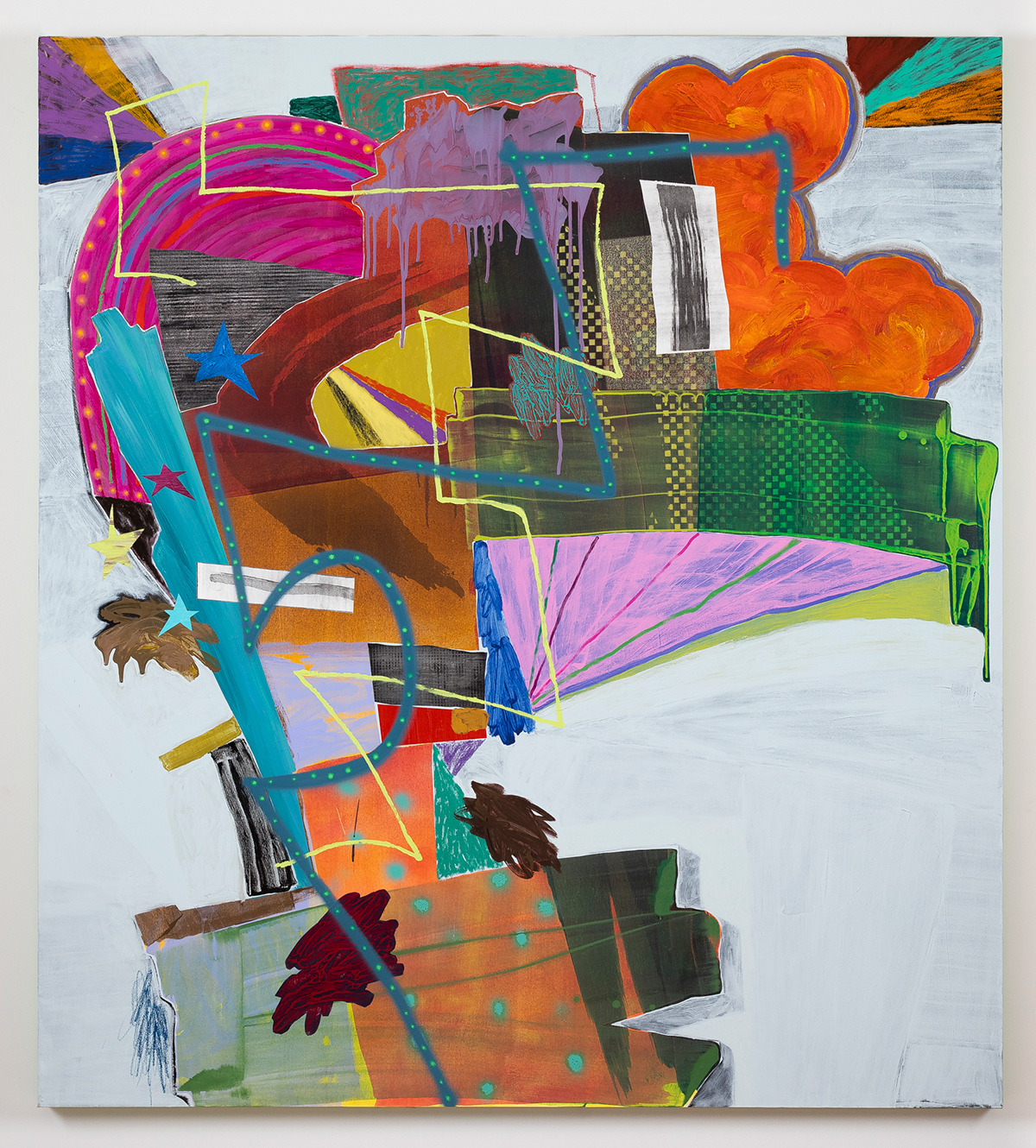
Following his time in the Pacific Northwest, Walsh’s work moved away from pure graphic illustration and toward a more sophisticated dialogue with historical abstraction. By integrating geometric precision with loose, painterly gestures, he began to explore how "high art" traditions—such as those pioneered by the Abstract Expressionists or the geometric minimalists—could be subverted by the "low art" imagery of his youth. This synthesis is the hallmark of his MFA-era development, where he first began to treat the canvas as a collage, refusing to settle for a singular style or a monolithic approach to paint handling.
The Mechanics of Abstraction: Supporting Data and Methodology
Walsh’s methodology is less about the finished image and more about the "choreography" of the painting surface. His work operates on the principle that the viewer should feel the weight of history while simultaneously experiencing the disruption of contemporary visual codes.
The "Cut and Paste" Philosophy
In a recent artist statement, Walsh articulated his core motivation:
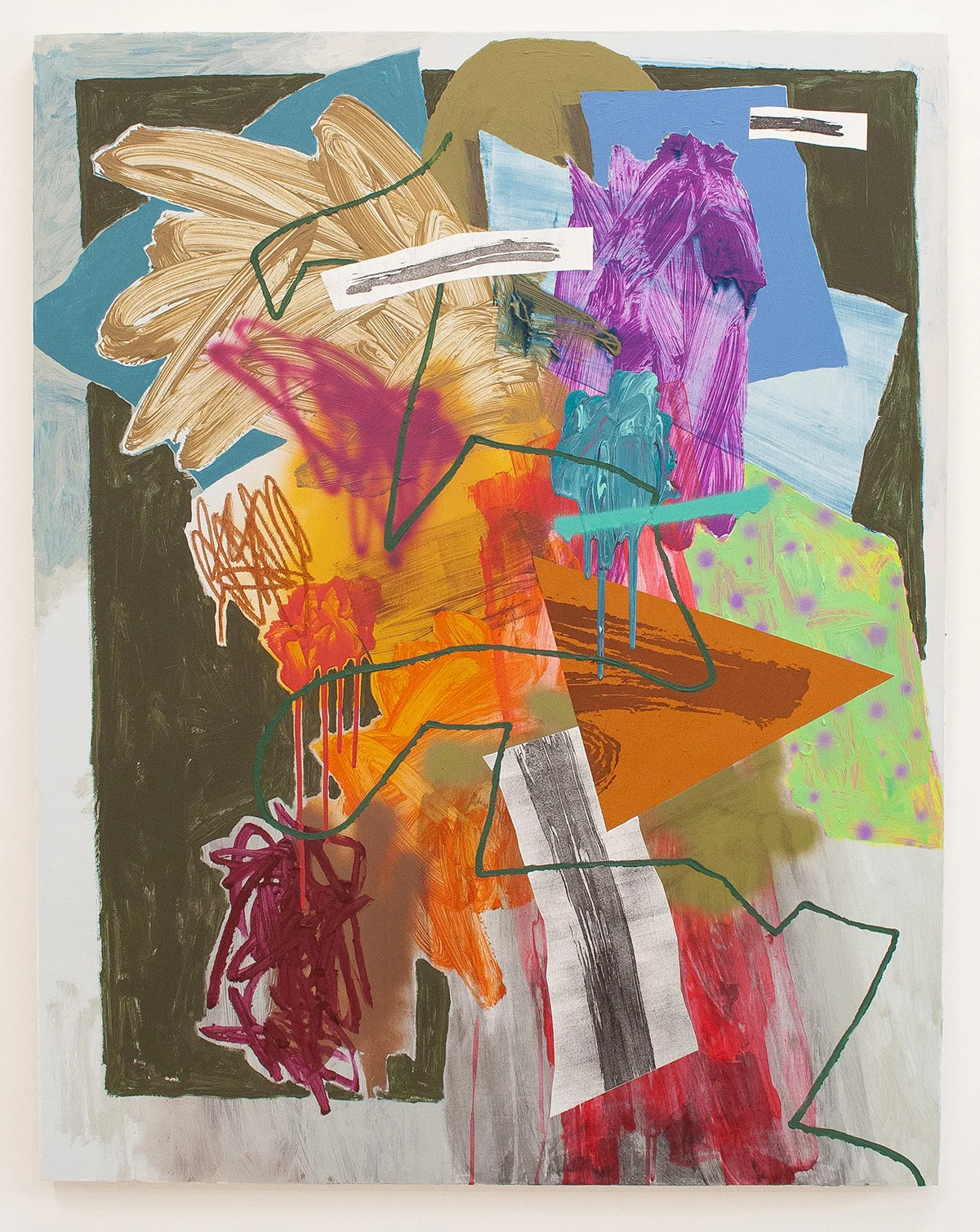
"This cut and paste ethos is a direct result of my involvement in the subcultures of the 1990’s… With all these elements in my toolbox, I then redirect and choreograph this ensemble on the painting surface, employing a variety of paint handling techniques and charged interactions."
This statement highlights the importance of "charged interactions." Walsh does not merely place colors next to each other; he forces a collision between textures. A flat, digital-looking geometric shape might be placed directly against a thick, impasto brushstroke, creating a sensory dissonance that reflects the complexity of the modern gaze.

Materiality and Technique
Technically, Walsh employs a vast array of materials. His studio practice is as much about curation as it is about creation. By gathering design elements from various sources—be it a pattern from a vintage magazine or a color palette inspired by early computer interfaces—he creates a "customized, reinvented, individualized version of abstraction." This is not just a style; it is a document of his life experiences, a personal taxonomy of the images that have defined his internal world.
Official Perspectives and Critical Reception
The art world has responded to Walsh’s work with increasing interest, noting that his ability to synthesize disparate influences makes him a relevant voice in a post-internet art scene.
Represented by Asya Geisberg Gallery, Walsh has been positioned as an artist who refuses the trap of nostalgia. Critics often point out that while his work leans on the "retro" aesthetics of the 90s, the end result is never purely nostalgic. Instead, it is a forward-looking inquiry into how our brains process layered information. By reshaping existing visual codes, Walsh aims to create something "relevant to this time and place," acknowledging that the viewer’s eye is now trained to process multiple, competing layers of information simultaneously.
The Implications of a "Reinvented Abstraction"
What does it mean for contemporary painting when the artist acts as a curator of subcultural history? The implications of Walsh’s approach are significant for both the medium and the observer.
Reclaiming the Abstract
For decades, abstract painting was often viewed as a vacuum—a place where the artist attempted to escape the "real" world. Walsh’s work suggests the opposite: that abstraction is the best tool for documenting the "real" world in the 21st century. By incorporating the graphic language of zines and television, he grounds abstraction in reality, proving that the abstract form can be just as descriptive and narrative as a figurative painting.
The Digital-Analog Hybrid
Walsh’s work serves as a bridge between the physical and the digital. In a world where so much art is experienced through screens, his paintings demand a physical encounter. The texture of his paint, the specificity of his edges, and the sheer scale of his compositions act as a rebuke to the flatness of the digital display. Yet, because he uses a digital-native aesthetic (the cut-and-paste logic), he remains in conversation with the very technology that threatens to replace physical painting.
Future Trajectories
As Walsh continues his work in both Milwaukee and New York, the evolution of his practice will be worth watching. His recent explorations suggest a move toward even more complex layering, where the distinction between a "found" graphic element and a "painted" gesture becomes increasingly difficult to discern. This ambiguity is precisely where the power of his work resides.
Conclusion: A Living Library of Visual Language
Shane Walsh represents a new generation of painters who are comfortable existing in the "in-between." He is neither purely a classicist nor purely a digital artist; he is a chronicler of the visual noise that has defined the last thirty years. By mining the subcultures of his past and the geometric traditions of the art historical canon, he constructs a visual language that is uniquely his own.
Whether he is teaching his students at the University of Wisconsin-Milwaukee or preparing a new series for an exhibition in New York, Walsh remains dedicated to the idea that painting is not dead—it is simply being reconstructed. For those who follow his work, the reward is in the discovery: the realization that a painting can be a record of a decade, a celebration of a medium, and an intimate reflection of a single life, all occurring within the boundaries of a single, meticulously choreographed frame.
As the art world continues to grapple with the role of the artist in an era of infinite digital reproduction, Shane Walsh’s "cut and paste" ethos offers a compelling path forward—one that honors the history of the brush while embracing the radical, chaotic energy of the modern image.