

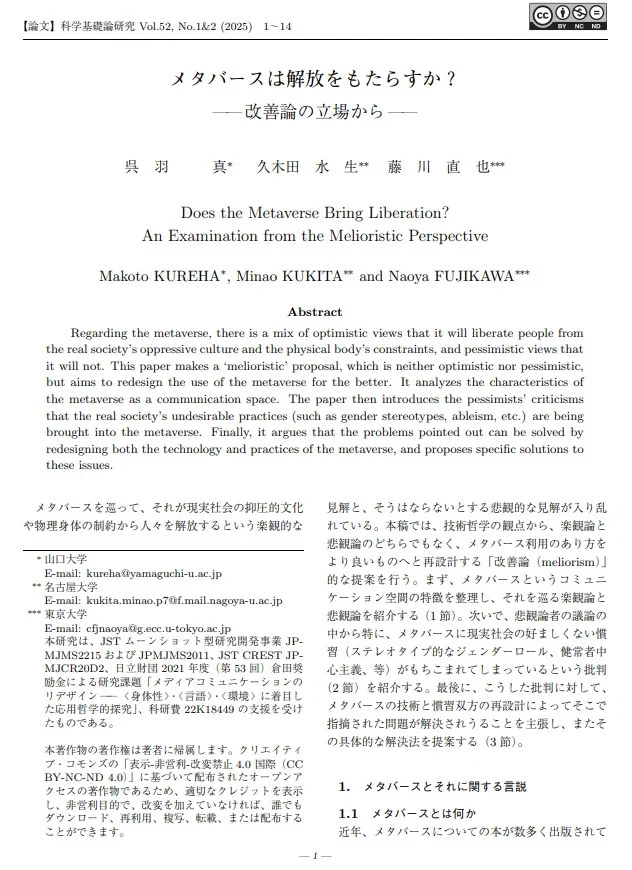
The landscape of digital content creation has undergone a seismic shift with the rise of Virtual YouTubers (VTubers)—content creators who utilize motion-captured digital avatars to interact with their audiences. While often viewed through the lens of entertainment, this phenomenon has increasingly become a subject of rigorous academic inquiry. A recent study, published in the April 2025 issue of the Journal of Fundamental Studies (Vol. 52, No. 1-2), offers a comprehensive analysis of the social, technological, and psychological underpinnings of the VTuber movement.
Main Facts: The Academic Lens on Virtual Avatars
At its core, the VTuber phenomenon represents a departure from traditional "face-cam" content creation. By decoupling the creator’s physical identity from their digital persona, VTubers create a unique space for performative expression. The study highlights that this is not merely a trend in gaming or entertainment but a significant shift in how digital intimacy is constructed.
The research underscores that VTubers—who utilize advanced 3D or 2D rigging software to mirror their facial expressions and movements in real-time—have successfully cultivated parasocial relationships that rival, and in many cases exceed, those of traditional influencers. The anonymity provided by the avatar acts as a catalyst for creative freedom, allowing individuals to inhabit personas that might diverge from their physical reality while maintaining a consistent "soul" or personality that fans connect with.
Chronology of a Digital Revolution
The evolution of the VTuber space can be categorized into several distinct phases:
- 2016-2017: The Genesis: The term "Virtual YouTuber" was popularized by Kizuna AI, who is widely considered the pioneer of the genre. During this period, the technology was rudimentary, relying on basic face-tracking software like FaceRig combined with simple avatar models.
- 2018-2020: The Corporate Expansion: Major agencies began forming, standardizing the production process. This era saw the rise of professional-grade motion capture studios and the integration of sophisticated character lore as a fundamental aspect of the "character design."
- 2021-2022: The Shift to VRSNS: The migration into Virtual Reality Social Networks (VRSNS), most notably VRChat, allowed VTubers to interact in 3D spaces, moving beyond the flat, two-dimensional screen environment.
- 2023-Present: Institutional Recognition: As noted in the 2025 Journal of Fundamental Studies, academic and mainstream media institutions have begun to treat the industry as a legitimate field of media and sociological study, rather than a niche subculture.
Supporting Data: The Scale of Engagement
The impact of the VTuber industry is quantifiable through both viewership metrics and demographic reach. According to the research, leading VTubers consistently rank among the top-earning streamers on platforms like YouTube and Twitch, often outperforming traditional streamers in terms of live-chat engagement rates.
Data cited from industry trackers such as PANORA and various market analyses indicate that:

- Audience Retention: VTuber audiences show a higher degree of loyalty, with average watch times exceeding those of standard lifestyle vloggers.
- Technological Accessibility: The barrier to entry has lowered significantly. The availability of open-source software (like VRM-based tools) has enabled a "democratization" of the medium, allowing independent creators to launch high-quality avatars with minimal capital investment.
- Cross-Platform Integration: The research notes that the success of the medium is heavily dependent on the "multi-platform" approach, where YouTube serves as the main content hub, Twitter (X) as the primary community management tool, and Discord as the central "fan-base" hub.
Official Perspectives and Academic Analysis
The academic community has expressed a keen interest in the concept of "melioristic" content—the idea that the virtual space can be used to improve the human condition or provide a sanctuary for expression.
In a notable contribution to the study, researchers Liudmila Bredikhina and other digital media experts explored the "Virtual Reality and Identity" framework. Their findings suggest that for many creators, the avatar is not a "mask" but a "liberator." By removing physical judgment from the equation, creators are able to focus entirely on the quality of their performance, humor, and community building.
Furthermore, the study references the "Prix Genre" in virtual media, which awards excellence in digital performance. This institutional validation signifies that the artistic merit of a VTuber’s performance—which includes voice acting, improvisational comedy, and narrative consistency—is now being evaluated with the same scrutiny as traditional acting or performance art.
Implications for the Future of Digital Identity
The implications of the VTuber phenomenon extend far beyond the screen. As we look toward the future, the research suggests several key areas of development:
1. The Normalization of Digital Avatars
We are moving toward a future where the use of avatars in professional and educational settings will become common. The "VTuber model" of performance—using an avatar to represent oneself in a digital meeting or classroom—is already being explored as a method to reduce social anxiety and maintain professional privacy.
2. The Evolution of Parasocial Dynamics
As AI integration becomes more prevalent, the interaction between VTubers and their fans will likely become even more personalized. We may soon see "AI-enhanced" VTubers capable of real-time, context-aware responses, further blurring the line between scripted content and spontaneous interaction.

3. Ethical and Regulatory Considerations
With the growth of the industry, the research calls for a closer look at the rights of digital creators. Issues surrounding intellectual property, the ownership of digital personas, and the psychological impact of "living" in a digital space are becoming increasingly relevant. The academic community emphasizes that as these digital identities become central to a creator’s livelihood, legal frameworks must evolve to protect them from exploitation.
4. Societal Integration
The study concludes that VTuber culture is a "mirror" of our current societal transition into a digital-first existence. By embracing the fluidity of identity, VTubers are essentially testing the limits of what it means to be a "public figure" in the 21st century.
Conclusion
The transition of VTubing from an internet subculture to a subject of serious academic study marks a turning point in digital history. It is no longer enough to dismiss the industry as merely "cartoons on the internet." Instead, we must recognize it as a complex, technologically sophisticated, and deeply human-driven medium. As we continue to navigate the relationship between our physical selves and our digital avatars, the lessons learned from the VTuber community will undoubtedly serve as a foundational blueprint for the future of human connection in virtual spaces.
For those interested in further reading, the full report is available via the J-STAGE platform, providing an extensive bibliography of the shift from 2D face-tracking to the immersive, high-fidelity 3D environments of today. The ongoing evolution of this space promises to reshape not just how we entertain ourselves, but how we define, express, and maintain our identities in an increasingly virtual world.











No comments yet. Be the first to join the conversation!