Jia Lissa
For the average observer of contemporary Japanese culture, the word "maid" conjures a singular, vivid image: the neon-drenched streets of Akihabara, frilly Victorian-inspired aprons, and the high-pitched, welcoming chirps of servers in themed cafés. For nearly three decades, the pop-culture phenomenon of the "moe maid" has dominated the domestic and international imagination, effectively obscuring the profession’s historical roots.
However, a recent announcement from the Japan Butler Association (JBA) has sent ripples through the internet, challenging these deeply ingrained perceptions. The organization has launched what it terms Japan’s first systematic "Maid School." To the surprise of many—and the disappointment of some anime enthusiasts—this institution has absolutely nothing to do with cosplay, cat ears, or pop-culture tropes.
This is a serious, high-stakes venture into the world of elite private domestic service.
The Mandate: Professionalism Over Performance
The Japan Maid School is not a training ground for customer entertainment; it is an academy for high-end domestic management. The curriculum is designed to prepare students for careers within the private residences of the ultra-wealthy—a sector where discretion, efficiency, and expert hospitality are the primary currencies.
Operated by the Japan Butler Association—a group already renowned for grooming butlers to serve the global elite—the school aims to professionalize the role of the modern domestic worker. The inaugural program, set to run from July 28 to September 3, consists of 12 intensive online sessions via Zoom. With enrollment strictly capped at 20 students, the exclusivity of the course reflects the high standard of service the JBA intends to cultivate.
At a tuition cost of ¥290,000 (approximately USD $1,790), the program is a significant investment. However, the association emphasizes that it is an egalitarian pursuit: applicants aged 20 and over are welcome, regardless of gender or prior professional background.
A Curriculum of Refinement
While the digital nature of the lectures has invited some scrutiny, the JBA maintains that the curriculum covers the essential pillars of domestic mastery. The coursework is divided into seven core competencies:
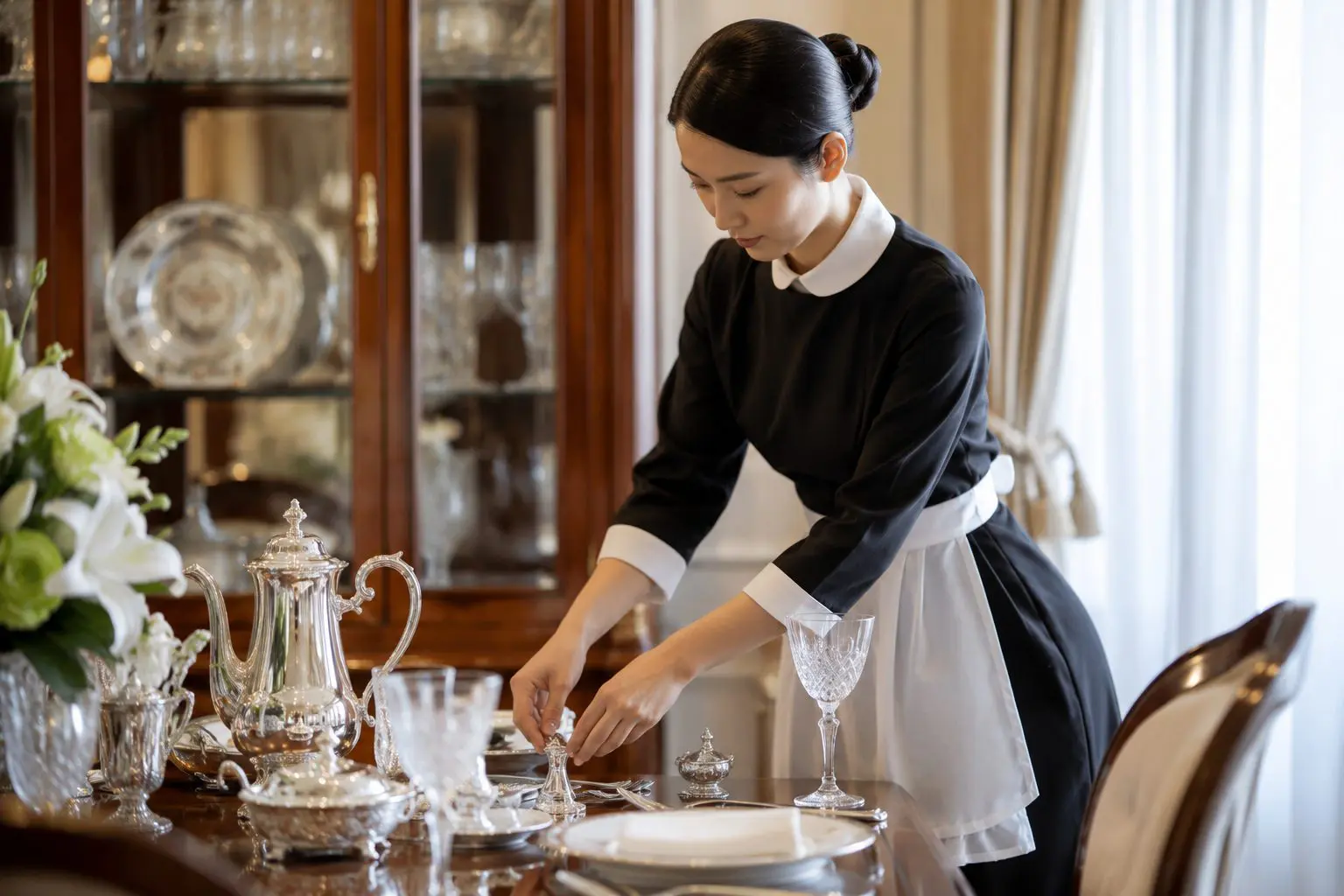
- Advanced Housekeeping: Specialized techniques for the maintenance of luxury residences, moving far beyond standard cleaning to encompass the care of high-end surfaces, antiques, and fine art.
- Wardrobe and Textile Care: The intricate art of managing luxury garments, including proper storage, fabric identification, and complex garment maintenance.
- Table-Service Coordination: Formal dining protocols, silver service, and the nuances of hosting high-net-worth guests.
- Confidentiality and Professional Ethics: Perhaps the most critical pillar, this module focuses on the absolute discretion required when working within the private spheres of influential individuals.
- Serving VIP and High-Net-Worth Clients: Understanding the specific expectations and temperaments of the ultra-wealthy.
- Coordination with Butlers and Concierges: How to operate as part of a synchronized household staff.
- Emergency Response: Protocols for handling household crises, from medical emergencies to sudden security concerns.
Upon successful completion of the course, students are eligible to earn one of three certification levels: Associate Maid, Certified Maid, or Senior Maid.
Historical Context: From "Jochū" to "Maid Café"
To understand why this school feels like such a radical departure, one must look at the shifting history of domestic service in Japan.
Prior to World War II, and continuing into the early postwar era, live-in domestic workers were a staple of affluent Japanese households. These individuals, historically referred to as jochū and later as otetsudai-san, were the backbone of the upper-class domestic sphere. They were responsible for the holistic management of the home—cleaning, cooking, childcare, and laundry.
However, as Japan modernized and the economy shifted during the late 20th century, the cultural stigma surrounding domestic service grew, and the availability of full-time, live-in help plummeted. The role of the "maid" effectively vanished from the public consciousness, only to be resurrected in the late 1990s through the lens of otaku culture.
The Akihabara "maid café" transformed the domestic servant into a character in a fantasy role-playing game. For an entire generation, the only association with the term "maid" became the performative, cute, and service-oriented fantasy of the themed café. The Japan Maid School is effectively attempting to "reclaim" the term, stripping away the cosplay aesthetics to restore the prestige of private domestic management.
The Digital Reaction: Skepticism and Curiosity
The announcement, when posted to social media platform X (formerly Twitter), triggered an immediate and polarized response. The primary reaction was one of bewilderment: "Wait, this isn’t about Akihabara?"
Many users expressed skepticism regarding the efficacy of an online-only curriculum. "How can you teach someone how to iron a silk shirt or set a table for a banquet over a Zoom call?" asked one prominent commentator. Others raised valid questions about the market demand for such a service, wondering if these graduates would simply end up in the same roles as existing, lower-cost housekeeping agencies.

The JBA has countered this by emphasizing the mentorship component of their program. Beyond the Zoom lectures, the school promises in-person role-playing exercises and one-on-one mentorship, ensuring that the theoretical knowledge is bridged with practical application.
The Luxury Market Opportunity
The skepticism regarding market demand is countered by current economic data. The Japanese luxury-service market has seen a consistent upward trajectory, with a growing segment of ultra-high-net-worth individuals (UHNWI) requiring bespoke, professional, and entirely discreet household management.
The JBA is uniquely positioned to fill this gap. By leveraging their existing network of elite clients—individuals with assets exceeding ¥5 billion and annual incomes in the hundreds of millions of yen—the association is not just offering a course; they are offering a gateway to employment. For a graduate of the program, the association’s stamp of approval serves as a "gold standard" credential, potentially bypassing the typical recruitment barriers for domestic staff.
Implications: A New Era of Professionalism?
The existence of the Japan Maid School signals a shift in how domestic labor is viewed in the Japanese luxury sector. By formalizing the training, the JBA is attempting to elevate the role of a domestic worker from that of a "helper" to a "household executive."
If successful, this model could have profound implications. It could lead to the emergence of a standardized, professionalized domestic workforce that is recognized for its technical skills and ethical standards rather than its cultural novelty. However, the school’s success will ultimately depend on its ability to prove that its graduates possess a level of finesse that cannot be replicated by standard cleaning agencies or AI-assisted home management.
The Japan Maid School is betting on the idea that the wealthy, in their quest for privacy and perfection, are ready to return to a more traditional, yet modernized, model of house management. They are banking on the hope that there is a hunger for "authentic" service—a service defined by silence, grace, and impeccable execution.
As the first class convenes this July, all eyes will be on the Japan Butler Association. Whether this experiment remains a niche curiosity or becomes the foundation for a new, elite industry in Japan remains to be seen. But one thing is certain: for the students of the Japan Maid School, the fantasy of the café is over. The reality of the estate begins.
Summary of Key Data
- Institution: Japan Maid School (operated by the Japan Butler Association).
- Duration: July 28 to September 3.
- Format: 12 online Zoom sessions, supplemented by in-person mentoring.
- Enrollment Cap: 20 students.
- Tuition: ¥290,000 (excluding tax).
- Target Demographic: Individuals aged 20+, seeking professional careers in luxury domestic service.
- Goal: To establish a standard for "authentic" private domestic service and bridge the gap between high-net-worth households and trained staff.


 Neng Nana
 Asro
Asro