

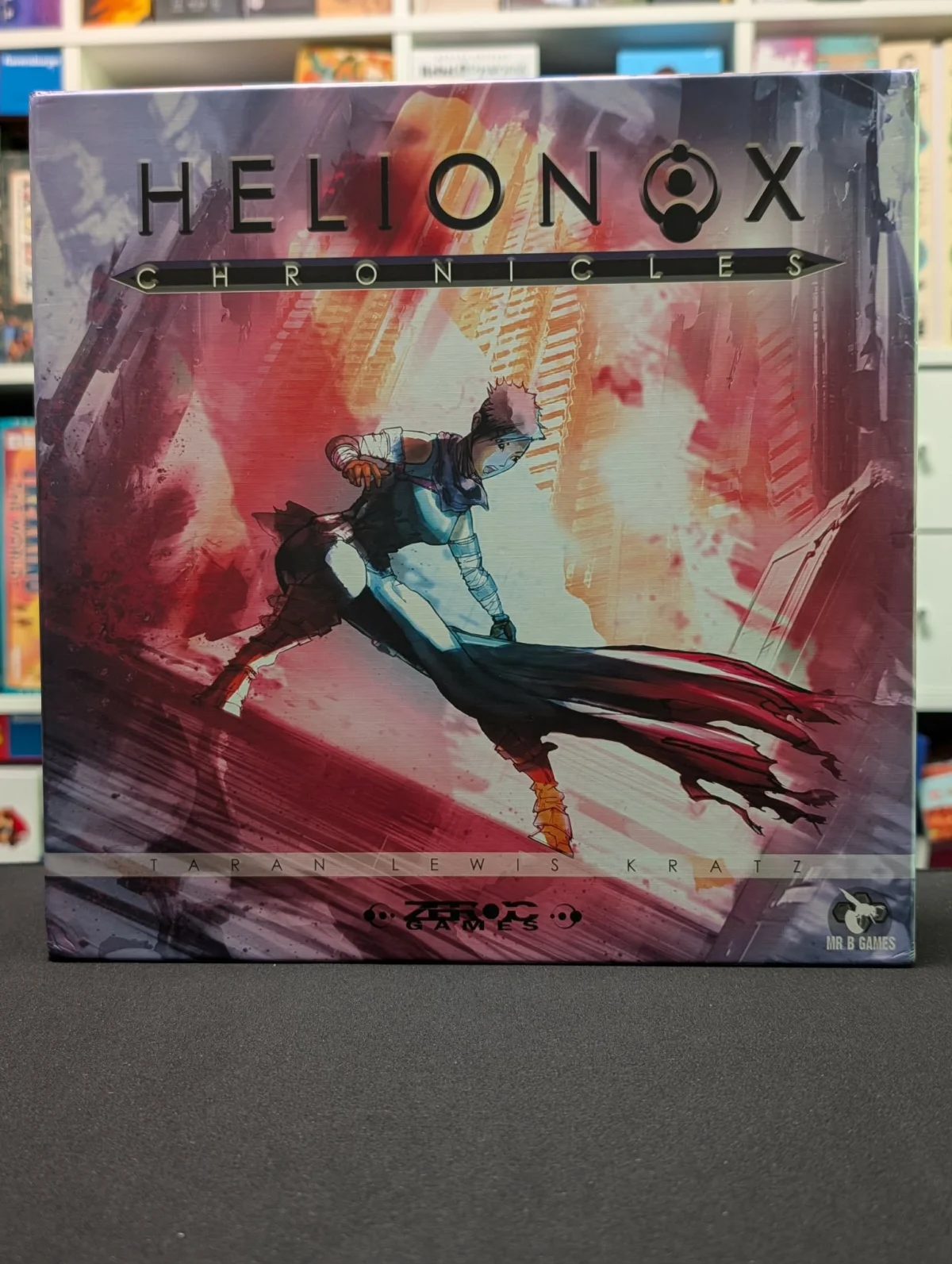
In the crowded landscape of cooperative tabletop gaming, titles often fall into two distinct camps: the frantic, fire-fighting simulators or the slow-burn, engine-building strategists. Helionox: Chronicles, the latest release from Zeroic Games, attempts a daring synthesis of both. Designed by Taran Lewis Kratz with contributions from artists Luke Green, Kratz, and Seth Rutledge, the game challenges players to stabilize a crumbling solar system while navigating the encroaching shadow of an enigmatic hostile presence.
It is a game of high stakes, where the fate of humanity—spread thin across Earth, Mars, Mercury, and the Moon—hangs in the balance. In Helionox: Chronicles, the "no biggie" attitude is a facade; beneath the surface lies a rigorous, rewarding, and deeply atmospheric puzzle that demands total coordination.
The Core Concept: Managing the Entropy of Empire
At its heart, Helionox: Chronicles is a deck-building, worker-placement hybrid that leans heavily into the "crisis management" sub-genre. Unlike games that focus on a single localized threat, this title tasks players with safeguarding the entire solar system.
The gameplay is structured into four distinct "eras." Each era serves as a temporal pressure cooker, introducing new event cards that manifest as outbreaks of civil unrest, economic collapse, or outright sabotage. These events are not merely flavor text; they are active, escalating threats that demand immediate triage. If players fail to contain these disasters, they risk losing the game to an opposing score track that ticks forward with every unchecked failure.
The Mechanics of Command
The engine driving Helionox is its action-selection system. Players utilize dice to command their "Architects"—specialized characters capable of maneuvering across the planetary board, deploying resources to resolve event cards, or investing in infrastructure to bolster their decks.
In a standard multiplayer session, each participant manages two dice, while solo players command three. This subtle shift in dice allocation ensures that the game’s difficulty scales intuitively. However, the true depth lies in the end-of-round maintenance. As the dice are spent and the actions concluded, the game responds with a systemic "enemy phase," triggering enemy movement and the spawning of new hazards. The win condition is elegant but punishing: survive all four eras, neutralize the looming enemy presence in the finale, and ensure your team’s score exceeds the threshold set by the encroaching darkness.
A Chronology of Chaos: How the Gameplay Unfolds
The progression of Helionox: Chronicles is best described as a cinematic arc. By breaking the experience into four eras, the designers have successfully avoided the "flat" difficulty curve found in many lesser cooperative games.

Era I & II: The Foundation of Survival
The early game is characterized by scarcity. Players start with limited deck power and must prioritize efficiency. You aren’t just saving the world; you are building the foundation of your future success. This phase involves heavy "table talk"—debating whether to clear a minor economic disaster on Earth or to start building the infrastructure necessary for the harder, inevitable mid-game crises.
Era III & IV: The Last Stand
As the game progresses into the third and fourth eras, the board state becomes increasingly volatile. The narrative shifts from "maintaining order" to "desperate defense." The enemy presence, which began as a distant threat, becomes an active participant in the game’s geography. The transition from the relative calm of the opening turns to the high-pressure finale is where Helionox shines, providing a sense of escalating stakes that keeps players engaged even when they are not actively taking their turn.
Supporting Data: Interaction and Replayability
What sets Helionox apart from its peers is the requirement for genuine, high-level interaction. In many cooperative games, "alpha gaming"—where one player dictates the strategy for the group—is a frequent criticism. Helionox mitigates this by making the board state too complex for a single player to track alone.
The Necessity of Teamwork
Because serious threats frequently require the pooled resources of multiple players, the game forces communication. You cannot win by playing your own hand; you must play into your teammates’ strategies. If one player is focusing on "event control," another must pivot to "infrastructure development." This interdependency fosters a sense of shared accomplishment that is rare in the genre.
Infinite Horizons: Replayability Metrics
For a game with a defined campaign, the replayability is surprisingly robust. The core campaign spans six episodes, acting as a tutorial that introduces mechanics gradually. Once the narrative conclusion is reached, the "Eternal Mode" takes over. This sandbox-style addition allows players to mix and match locations, enemies, and difficulty modifiers. Whether you are a fan of tight, optimized puzzles or chaotic, high-difficulty encounters, the modularity ensures that the game remains fresh long after the initial campaign is completed.
Official Perspective: The Designer’s Vision
While Zeroic Games has maintained a relatively quiet profile regarding the post-release roadmap, the design philosophy behind Helionox is clear. In various designer notes, Taran Lewis Kratz has emphasized that the goal was to create a game that felt like a "living system."
The shift from cube-management to narrative-driven strategy was intentional. By creating distinct roles for Architects and providing a variety of deck-building paths—ranging from aggressive military support to diplomatic resource management—the team ensured that no two playthroughs feel identical. The feedback from early playtests focused heavily on the "fiddliness" of the game’s setup, a critique that the team addressed by focusing on the quality of player aids and the organization of the component footprint.

Implications for the Cooperative Genre
Helionox: Chronicles occupies a significant space in the current board game market. It serves as a bridge for players who have outgrown the foundational mechanics of Pandemic and are looking for something with more "meat on the bone."
The "Mass Effect" of Tabletop
The game’s thematic weight is a major selling point. In an industry dominated by abstract space-themed games, Helionox succeeds because it anchors its mechanics in a coherent narrative. The sense of dread as you watch the enemy presence drift from the Moon toward Mars is palpable. It captures the spirit of classic science fiction—the feeling that humanity is a fragile coalition on the brink of collapse.
Component Quality and Table Presence
From a production standpoint, the game is a triumph of design. The components are not just functional; they are evocative. The board layout, when fully populated with events and enemy trackers, creates a "command center" aesthetic that immerses players in the role of planetary protectors. While the initial setup can be time-consuming, the visual payoff is significant. It is a game that demands a large table and a dedicated evening, rewarding those who put in the effort to learn its complex, interlocking systems.
Final Assessment: Who is this game for?
Helionox: Chronicles is a demanding, high-functioning cooperative puzzle. It is not designed for the casual Sunday afternoon player who wants a light, breezy experience. Instead, it is aimed at the strategy-minded gamer who enjoys deep, systemic interaction and the satisfaction of overcoming long odds.
Key Recommendations:
- For the Solo Gamer: The game scales exceptionally well. Managing three dice as a solo commander feels like playing a complex simulation, offering a meditative yet challenging experience.
- For the Strategy Enthusiast: If you enjoy games that force you to triage constant crises, the shifting landscape of Helionox will provide endless entertainment.
- For the Sci-Fi Fan: The lore and the atmosphere are top-tier. It hits the same emotional notes as Battlestar Galactica or Mass Effect, making it an easy recommendation for fans of space-faring political drama.
With an impressive 8.5/10 rating for its depth, thematic cohesion, and structural integrity, Helionox: Chronicles is a bold step forward for Zeroic Games. It proves that there is still room in the cooperative space for games that don’t hold the player’s hand, but instead invite them to work harder, think faster, and save the solar system before the clock runs out.












No comments yet. Be the first to join the conversation!