Reynand Wu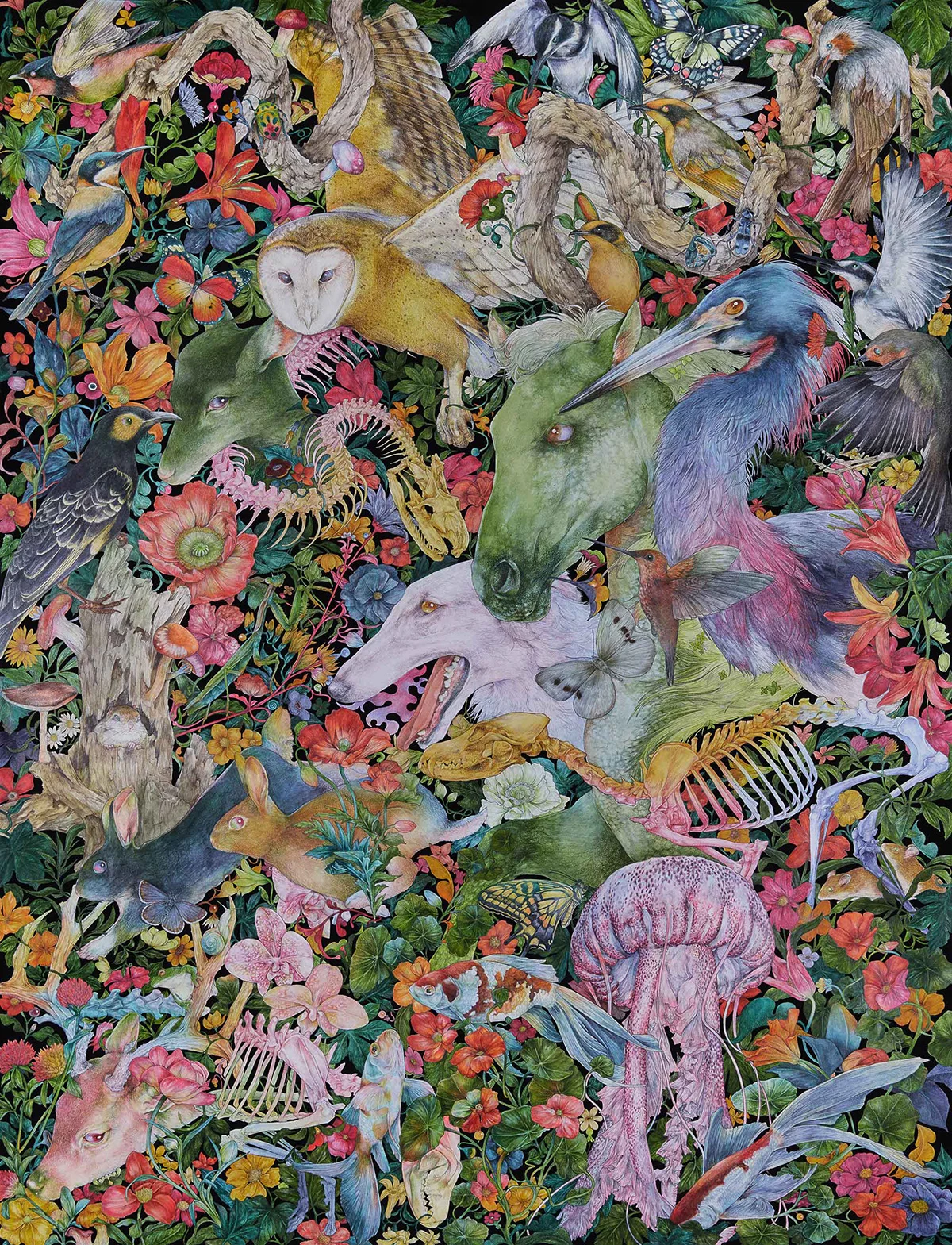
Introduction: The Poetic Cartography of Nature
In the contemporary art world, few illustrators manage to capture the fragile, ephemeral boundary between the organic world and the human psyche with the precision of Fumi Nakamura. A Shizuoka-born artist now operating out of the bustling, concrete-heavy landscape of New York City, Nakamura’s work serves as a visual bridge to her roots. Her practice is not merely an exercise in technical illustration; it is a profound meditation on the perpetual cycles of existence—the inevitable dance of life, decay, and rebirth.
Nakamura’s recent recognition as a shortlisted artist in the 2025 Booooooom Illustration Awards has thrust her intricate, layered aesthetic into the spotlight. By marrying the precision of colored pencils with the raw intimacy of graphite, she invites viewers into a realm where the tranquility of the forest meets the complexity of human emotion.
Chronology: A Trajectory of Transformation
The narrative of Fumi Nakamura’s career is one of geographical and stylistic migration, characterized by a constant refinement of her artistic voice.
Early Foundations in Shizuoka
Nakamura’s aesthetic language was forged in the coastal and mountainous landscapes of Shizuoka, Japan. This region, defined by its proximity to Mount Fuji and the vast expanse of the Pacific Ocean, instilled in her a reverence for the natural world. These early years were not just a childhood experience but the foundational bedrock of her artistic philosophy.
The Californian Chapter
Seeking to expand her horizons, Nakamura moved to the United States to study at San Jose State University. This period in the Bay Area served as a critical intersection between her Japanese sensibilities and the diverse, modern art scene of Northern California. During this phase, she began to experiment with the juxtaposition of Western illustration techniques and the minimalist, atmospheric traditions of her home country.
The New York Evolution
Following a brief residency in the Bay Area, Nakamura relocated to New York City. The transition from the sprawling natural vistas of Japan to the dense urbanity of New York acted as a catalyst for her work. Faced with the absence of the wild, her drawings became a form of psychological preservation. Today, from her New York studio, she channels her memories of forests and mountains into meticulously rendered works that serve as a quiet resistance against the frantic pace of city life.
Supporting Data: The Anatomy of a Masterpiece
To understand Nakamura’s impact, one must look at the technical rigor that defines her portfolio. Her work is categorized by several key elements:
The Medium as Message
Nakamura utilizes colored and graphite pencils, a choice that contrasts sharply with the digital dominance of modern illustration. By layering these mediums, she creates "variable textures" that mimic the tactile quality of bark, fur, and skin. This layering process is labor-intensive, often requiring hundreds of hours for a single piece.
The Cycle of Life and Death
In her own words, Nakamura’s work centers on the "continuous cycle of life and death." Her subjects are often hybrid entities—animals intertwined with flora or human figures dissolving into the landscape. This is not morbid; rather, it is a celebration of the interconnectedness of all living things. Her pieces often feature:
- Botanical motifs: Ferns, mosses, and blossoms that represent growth.
- Zoological subjects: Animals that serve as totems for human emotions.
- Atmospheric negative space: The deliberate use of white space to evoke the silence of the forest.
Recognition and Accolades
The 2025 Booooooom Illustration Awards serves as a significant marker in her professional development. Being selected for the shortlist out of a global pool of applicants validates her position as a leading voice in contemporary narrative illustration. Her representation by Thinkspace Projects in Los Angeles has further cemented her status, providing her work with a platform that bridges the gap between commercial illustration and fine art.
Official Responses and Artistic Philosophy
The depth of Nakamura’s work is perhaps best understood through her own reflections on the relationship between nature and the human condition.
"Spending many years surrounded by forests, mountains, and the oceans have taught and given me value to appreciate nature and life itself," Nakamura states. She views her artistic practice as a conduit for empathy. When she depicts a creature in a state of decay, she is not focusing on the end of life, but on the nutrients and the new beginnings that follow.
Her process is deeply meditative. "Colored and graphite pencils create layers of variable textures that capture the tranquility," she explains. "It helps to breathe life into drawings." For Nakamura, the act of drawing is an act of breathing, a way to sustain the natural world within the confines of a frame.
Thinkspace Projects, her representatives, have long championed her work for its "unapologetic sincerity." In an art market often driven by irony or cynical commentary, Nakamura’s work stands out for its earnest, almost spiritual approach to storytelling.
Implications: The Future of Narrative Illustration
The implications of Nakamura’s work extend beyond the canvas. As the world faces increasing climate anxiety and urban isolation, her art offers a necessary balm.
Bridging the Urban-Nature Divide
Nakamura’s work represents a growing trend of artists who use their platforms to advocate for environmental empathy. By documenting the "heavy influences" of nature on her emotional landscape, she encourages her audience to cultivate their own relationships with the environment. Her work suggests that nature is not merely a setting for human activity, but an active participant in our internal development.
The Resurgence of Traditional Media
Her success also highlights a significant shift in the illustration industry. Despite the capabilities of AI-generated art and digital rendering, there is a burgeoning market for the "human hand." Nakamura’s success with pencils—a medium accessible to all but mastered by few—proves that audiences are hungry for the imperfections, the labor, and the soul inherent in analog art.
Long-term Legacy
As she continues to evolve, Nakamura’s influence is likely to grow. Her ability to synthesize personal memory with universal themes of mortality ensures that her work remains timeless. Whether it is through her upcoming exhibitions at Thinkspace or future collaborations, she is establishing a visual legacy that prioritizes the slow, deliberate observation of the world over the transient nature of digital trends.
Conclusion: A Quiet, Persistent Voice
Fumi Nakamura is an artist of profound patience. From the forests of Shizuoka to the studios of New York, her journey has been defined by a commitment to the delicate, often overlooked cycles of the natural world. As she continues to gain recognition on global stages like the Booooooom Illustration Awards, her work serves as a reminder that the most powerful art often speaks in whispers.
Her drawings do not shout; they breathe. They remind us that we are all part of a larger, interconnected web of life and death, and that through the simple act of observation, we can find a profound, lasting tranquility. In an era of constant noise, Nakamura’s graphite-etched forests offer a place to rest, to reflect, and to reconnect with the rhythms of the earth.
As we look toward the future of illustration, it is artists like Nakamura who provide the anchor, ensuring that even as the world changes, the core of human experience—our relationship with the natural world—remains visible, textured, and deeply felt.
Further Reading
- For a deeper look into the 2025 Booooooom Illustration Awards and the full list of shortlisted artists, readers are encouraged to visit Booooooom’s official portal.
- To explore Fumi Nakamura’s complete body of work and current availability, visit her official portfolio at miniminiaturemouse.com.
- Follow Thinkspace Projects for updates on upcoming exhibitions featuring Nakamura’s latest series.

 Nana Wu
 Muslim