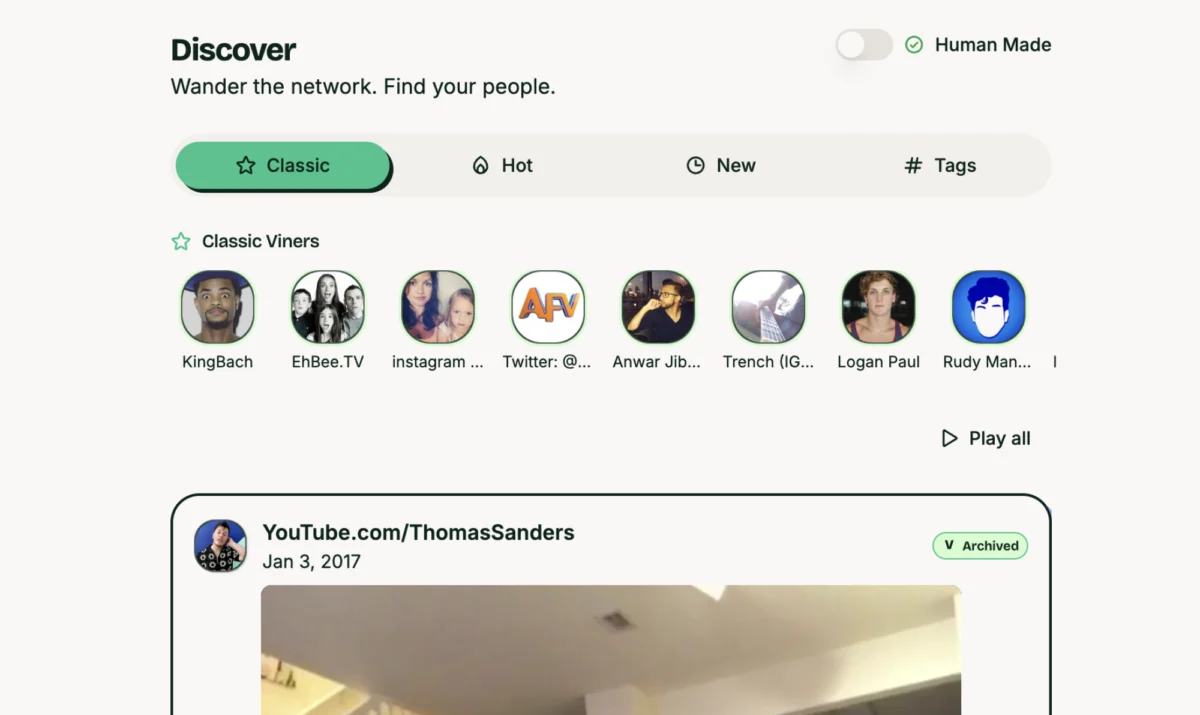
It is a sentence that would have sounded like science fiction—or perhaps a cruel joke—a decade ago. Vine, the platform that defined the early 2010s with its six-second loops and idiosyncratic comedy, has returned. In 2026, the short-form video landscape is dominated by the monolithic algorithmic feeds of TikTok, Instagram Reels, and YouTube Shorts. Yet, standing in stark contrast to this landscape is "Divine," a new application that seeks to recapture the lightning-in-a-bottle spirit of the original Vine while simultaneously waging a war against the encroaching tide of generative AI.
Perhaps the most poetic, if not ironic, aspect of this revival is its provenance: Divine is funded by Jack Dorsey, the former Twitter CEO whose company famously shuttered the original Vine in 2017, effectively killing a cultural phenomenon at its peak.
The Chronology of a Digital Phoenix
To understand the significance of Divine, one must look back at the trajectory of the original Vine. Launched in 2013, the app became an overnight sensation, hitting 100 million monthly active users at its zenith. It was a digital sandbox that birthed a new generation of celebrity, launching the careers of creators like Logan Paul and King Bach. When Twitter pulled the plug in 2017, the internet mourned the loss of a unique creative medium.
For years, the void left by Vine was filled by the rise of TikTok, which adopted the short-form, infinite-scroll format but evolved it through aggressive, AI-driven recommendation engines. The idea of a "Vine reboot" floated in the ether for years; even Elon Musk briefly flirted with the notion of reviving the app under the X umbrella to compete with TikTok. That plan never materialized.
Instead, the task fell to Evan Henshaw-Plath, a former Twitter engineer known online as "Rabble." Initially, Henshaw-Plath’s ambition was modest: to create a permanent, archival home for the hundreds of thousands of six-second clips that had been scattered to the wind when Vine died. With backing from Dorsey’s nonprofit, and Other Stuff—an organization dedicated to funding open-source social media—the project evolved from a simple archive into a full-fledged social platform. Following a quiet, invitation-only test launch in November 2025, Divine has now officially opened its doors to the public.
A Stance Against "AI Slop"
The defining feature of Divine—and its primary point of differentiation in a crowded market—is its aggressive stance against artificial intelligence. In an era where deepfakes, synthetic voices, and AI-generated content threaten to dilute the concept of digital authenticity, Divine has positioned itself as a "human-only" sanctuary.
The platform’s mission is explicitly stated: "freedom from AI slop." To enforce this, Divine has implemented a rigid verification process. Users are encouraged to record content directly within the application. For those who prefer to upload existing files, the platform requires that the content pass through a human verification tool. This infrastructure is powered by the Guardian Project, a human rights nonprofit focused on digital security and privacy.
By requiring this layer of verification, Divine is attempting to solve a problem that most social media platforms are currently struggling to contain. While competitors have largely embraced AI-driven creation tools, Divine is betting that the pendulum of user sentiment will swing back toward raw, unfiltered human interaction.
The Philosophy of Ownership and Decentralization
Jack Dorsey’s involvement in Divine is not merely financial; it represents a pivot in his philosophy regarding social media. In statements provided to The Guardian, Dorsey acknowledged the structural shortcomings of the original Vine, specifically noting the lack of creator sovereignty.
A core principle of the Divine relaunch is the empowerment of the creator. Unlike traditional platforms, where followers and content are effectively held hostage by the host company’s proprietary algorithm, Divine is built on a framework that emphasizes content portability. The goal, according to the project’s leadership, is to ensure that creators own their work and their relationship with their audience, allowing them to monetize their output directly without being at the mercy of opaque, platform-wide policy changes or algorithmic suppression.

This reflects a broader trend in the tech industry: the move toward "decentralized" or "creator-led" social media. By removing the incentive to optimize content for an AI-driven feed, Divine hopes to foster a community where "virality" is a product of human connection rather than machine-learning optimization.
The Competitive Landscape: A David vs. Goliath Scenario
Divine enters a market that bears little resemblance to the one Vine left in 2017. Today, the short-form video space is characterized by massive scale and hyper-monetization:
- TikTok: The industry standard, boasting an algorithm that is widely considered the most effective in the world at keeping users engaged through tailored, AI-generated recommendations.
- Instagram Reels: A powerhouse of the Meta ecosystem, leveraging billions of existing users to dominate the social video space.
- YouTube Shorts: Having recently surpassed 200 billion daily views, Shorts represents the might of the world’s largest video repository, backed by a mature ad-revenue model.
Against this backdrop, the proposition of a "six-second, human-only" app seems, at first glance, like a niche endeavor. However, the creators of Divine argue that this is precisely the point. The platform is not trying to be a wholesale replacement for TikTok or YouTube; it is trying to be a return to a specific type of creative friction. By limiting the duration and demanding human provenance, Divine is curating a digital environment that values the "loop" as a form of art rather than a delivery vehicle for advertisements.
Implications for the Future of Social Media
The launch of Divine poses a fascinating question for the digital age: Is there still a demand for "unoptimized" social media?
For over a decade, social media users have been conditioned to expect an endless, personalized stream of content that evolves alongside their viewing habits. This model has brought immense success to tech giants but has also been blamed for shortening attention spans, increasing political polarization, and normalizing the consumption of synthetic, AI-generated content.
Divine is a test case for a different philosophy. If it succeeds, it could prove that there is a viable, sustainable market for platforms that prioritize human-centric interaction over algorithmic efficiency. If it fails, it may serve as a reminder that the "internet of 2013"—where the social graph was simpler and the content was more authentic—is a relic that cannot be resurrected in the face of modern consumption habits.
Furthermore, the involvement of the Guardian Project suggests that the app may become a haven for journalists, activists, and creators who prioritize security and provenance in their media. As misinformation becomes increasingly difficult to distinguish from reality, having a verified, human-only archive could prove to be an invaluable asset.
Conclusion: The Path Ahead
Divine is now available on the Google Play Store and the Apple App Store, inviting users to return to a format that once changed the world. Whether it will simply remain a nostalgic digital museum of 500,000 old Vines or grow into a legitimate challenger to the giants of the industry remains to be seen.
The challenge ahead is significant. Retaining users in an environment where they are not constantly "fed" by an AI algorithm requires a level of engagement and community building that is difficult to sustain. Yet, for those who grew up in the early days of mobile video, or for those who are weary of the current state of digital "brainrot" and synthetic content, Divine offers something that few other platforms do: the promise of an internet that feels like it was made by people, for people.
As we move deeper into the latter half of the 2020s, the battle for the soul of the internet is shifting. It is no longer just about who can hold our attention the longest; it is about who can provide the most authentic experience in a world that is increasingly becoming a copy of a copy. In the quiet, six-second loops of Divine, we may find the answer.