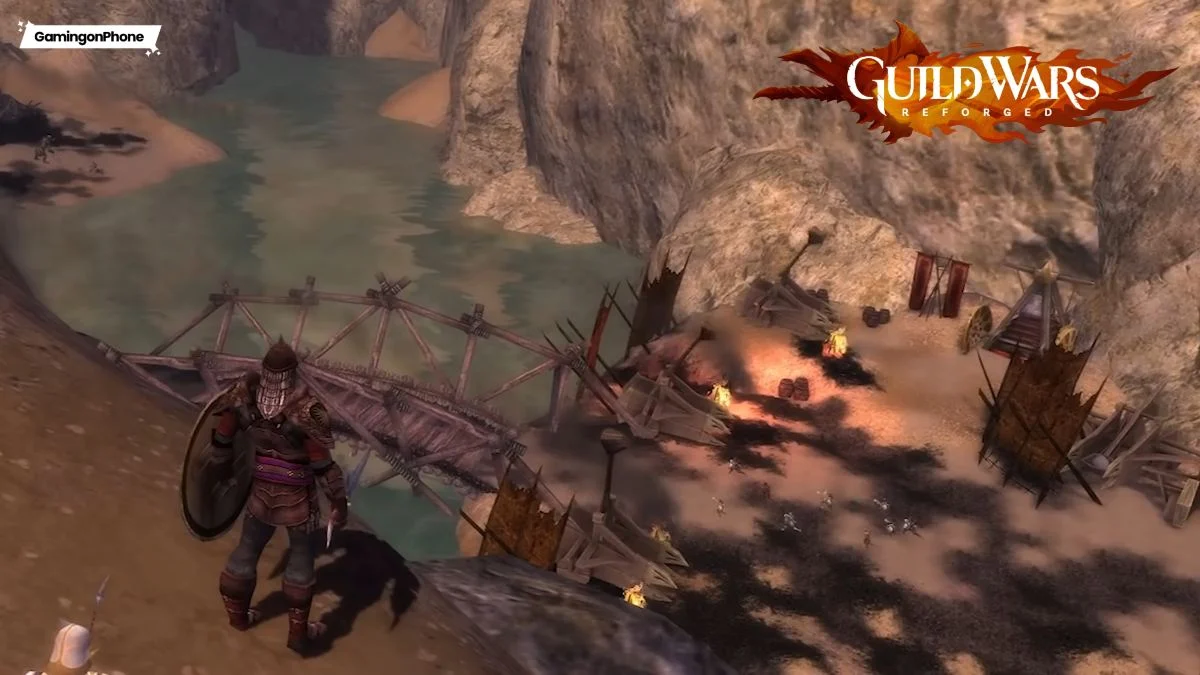
Tyria Reimagined: Guild Wars Reforged Launches Globally on Mobile, Bringing Back a Classic RPG Experience
[CITY, STATE] – [Date] – ArenaNet has officially launched Guild Wars Reforged globally on both Android and iOS devices, marking a significant milestone for fans of the beloved 2005 MMORPG. This modernized revival of the original Guild Wars saga, famously launched without a subscription fee, aims to introduce a new generation of players to the rich world of Tyria while satisfying the nostalgia of veterans. With revamped visuals, streamlined systems, and the complete saga accessible on the go, Guild Wars Reforged is poised to carve out its niche in the competitive mobile gaming market.
The global release follows an eagerly anticipated announcement in April 2026 and a successful soft launch in select regions during May of the same year. Players worldwide can now delve into the strategic depth of Guild Wars‘ iconic profession system, choosing from ten distinct classes that will shape their journey through a world brimming with epic battles, challenging dungeons, and dynamic PvP encounters. The core of the Guild Wars experience—its innovative dual-profession system and build customization—remains intact, offering unparalleled strategic freedom.
A Chronology of Revival: From Tyria’s Origins to Mobile Mastery
The journey of Guild Wars Reforged is a testament to the enduring legacy of its predecessor. The original Guild Wars, launched by ArenaNet in 2005, was revolutionary for its time. It dared to defy the prevailing subscription-based model of MMORPGs, offering a premium game with free ongoing content updates and expansions. This "buy-to-play" model, coupled with a deep skill system, instanced PvE, and robust PvP, garnered a dedicated fanbase and critical acclaim.
Fast forward to April 2026, when ArenaNet officially announced Guild Wars Reforged, promising a mobile-optimized experience that would preserve the essence of the original while enhancing it for modern platforms. The announcement ignited a wave of excitement, particularly among long-time fans who had yearned for a return to the classic Guild Wars gameplay. Pre-registration went live shortly after, indicating the company’s confidence in the project’s appeal.
A critical phase in the development involved a soft launch in May 2026. This period allowed ArenaNet to fine-tune server performance, gather crucial player feedback on the mobile interface, and test the revamped systems ahead of the broader global rollout. The insights gained from this initial release undoubtedly contributed to the polished experience now available to millions. The full global launch ensures that players can embark on their adventures through Ascalon, Cantha, and Elona, experiencing the complete saga with enhanced visuals and intuitive mobile controls.
The Immutable Choice: Understanding Guild Wars Reforged’s Profession System
At the heart of Guild Wars Reforged‘s character progression lies its unique profession system, a design philosophy that sets it apart from many contemporary MMORPGs. Unlike titles where class changes are common or highly flexible, your primary profession in Guild Wars Reforged is a permanent decision made at character creation. This choice fundamentally shapes your character’s core identity, their primary attribute, and the foundational playstyle you will maintain throughout every mission, dungeon, and PvP skirmish.

This permanence imbues the initial choice with significant weight, demanding careful consideration from new and returning players alike. Your primary profession dictates access to certain unique skills and, more importantly, enhances a specific primary attribute that no other class can fully replicate. This attribute often defines the class’s inherent strengths and strategic niche.
The flexibility, however, comes with the secondary profession. After the initial hours of gameplay, unlocked through an early quest, players can freely swap their secondary profession in any town. This innovative dual-class system allows for immense build diversity and tactical adaptability. It enables players to combine the strengths of two professions, creating unique synergies and allowing for tailored strategies to overcome various challenges. For instance, a Warrior primary might take Monk as a secondary for self-healing, or a Ranger primary might dip into Assassin for burst damage.
This guide aims to explain each of the ten available professions in detail, providing the necessary insights to make an informed decision for your primary class, ensuring confidence rather than regret as you journey through Tyria.
Guild Wars Reforged: A Comprehensive List of All Professions
There are ten distinct professions available in Guild Wars Reforged. Six are considered core classes, accessible from any campaign, offering a foundational experience for all players. The remaining four are exclusive to the Factions and Nightfall expansions, providing specialized roles and adding further depth to the game’s strategic options.
Your primary profession is irrevocably locked after character creation, emphasizing the need for a well-thought-out choice. Conversely, your secondary profession, once unlocked, can be changed freely in any town for the remainder of your character’s life, encouraging experimentation and adaptation to different group compositions or combat scenarios.
The Core Six Professions
-
Warrior: The Unyielding Frontline
Warriors are the quintessential heavy-armor tanks and damage dealers of Guild Wars Reforged. Designed to absorb and return punishment, they are the ideal choice for players who prefer direct combat and high survivability. Warriors primarily wield Swords, Axes, or Hammers, generating Adrenaline to unleash their most devastating attacks. Their primary attribute, Strength, uniquely grants innate armor penetration on every hit, making their damage consistently impactful.
Beyond raw offense, Warriors utilize stances and shouts to bolster their own durability and provide valuable utility to their team. Their straightforward controls and highest base survivability make them incredibly forgiving, especially for newcomers. If you’re new to Guild Wars and want a robust, easy-to-manage character without needing to master complex positioning or resource management early on, the Warrior is an excellent starting point. They are the backbone of many PvE and PvP compositions, providing reliable disruption and frontline presence. -
Ranger: The Versatile Pathfinder
The Ranger stands out as one of the most adaptable professions in Guild Wars Reforged‘s current meta. While the original Guild Wars 1 Ranger was often pigeonholed as a bowman accompanied by a pet, Reforged significantly expands their capabilities. Rangers can now effectively utilize spears and traps, and even benefit from powerful spirits, transforming them into a true jack-of-all-trades capable of fitting into almost any team composition.
Their primary attribute, Expertise, reduces the energy cost of all attack skills and Ranger-specific abilities. This grants them exceptional resource efficiency, particularly in sustained combat scenarios. Furthermore, Expertise’s cost reduction synergizes powerfully with secondary profession skills, opening up some of the game’s most creative and potent dual-class builds. The Ranger/Assassin pairing, for instance, is already a popular choice, leveraging Expertise to fuel rapid dagger combos. For players seeking long-term flexibility and the ability to adapt to various roles without feeling confined, the Ranger is an exceptionally safe and rewarding primary choice.
-
Monk: The Divine Healer
The Monk is Guild Wars Reforged‘s preeminent healer, an indispensable asset for keeping a party alive. However, this dedication to support comes with a significant caveat: solo Monk play is notoriously challenging. Their damage output in the early game is extremely low, making leveling a solo Monk a slow grind without a pre-made group to shoulder the combat burden. Divine Favor, the Monk’s primary attribute, adds a passive healing bonus to every Monk spell cast, ensuring their healing is more potent than any secondary-Monk character could ever achieve.
In group play, Monks typically specialize into two sub-roles: Healing Monks focus on reactive health restoration, while Protection Monks preemptively mitigate damage through layers of defensive buffs. Both roles are highly valued and often crucial for success in challenging content. If you have a dedicated group of friends to play with, the Monk is an excellent primary choice, allowing you to be the indispensable lifeline of your party. If you primarily plan to solo, it is strongly advised to choose another primary and utilize Monk skills as a secondary profession instead. -
Elementalist: The Elemental Scion
The Elementalist channels the raw power of the four elements—Fire, Earth, Air, and Water—into devastating spell damage, particularly effective against groups of enemies. Their primary attribute, Energy Storage, grants them the largest base energy pool in the game, allowing them to fuel their high-cost, high-impact spells for extended periods before running dry. Fire specialization, in particular, offers the strongest Area-of-Effect (AoE) damage output among all professions, making them excellent for clearing clusters of foes.
Mastering energy management is the core skill for any Elementalist; inefficient spell casting can quickly deplete their energy pool, leaving them vulnerable until it recovers. Once this rhythm is understood, few professions offer such satisfying power. The Elementalist is a straightforward and rewarding choice for beginners, especially those who revel in seeing large damage numbers and controlling the battlefield with elemental fury. Their diverse elemental attunements also allow for tactical shifts, from defensive earth magic to swift air attacks, offering adaptability within their specialized role. -
Necromancer: The Master of Undeath
The Necromancer is arguably the best profession for solo play in Guild Wars Reforged, offering a highly independent and self-sufficient playstyle. Their primary attribute, Soul Reaping, generates energy every time anything dies nearby. This unique mechanic means that the more enemies your summoned minions dispatch, the more freely you can cast your spells. Minion Mastery Necromancers excel at raising fallen enemies as undead allies, creating a disposable yet effective frontline that draws aggro and deals damage, allowing the Necromancer to operate safely from the back.
Beyond minions, Necromancers also wield powerful Curses that spread debuffs and conditions across enemy groups, weakening them for their undead army or allies. Death Magic further enhances the minion army, making it even more formidable. The Necromancer/Dervish combo, affectionately nicknamed the "Reaper," is currently one of the highest damage dealers in the game, especially when factoring in the power of the anniversary event weapon. This is a strong and highly independent class that rewards patient, thoughtful play and strategic resource management, making it excellent for both solo progression and group utility. -
Mesmer: The Mind Bender
The Mesmer is Guild Wars Reforged‘s most cerebral profession, known for its illusions, interruptions, and energy denial. It presents the steepest learning curve for new players, demanding a deep understanding of game mechanics. Their primary attribute, Fast Casting, subtly but powerfully reduces the activation time of all spells and signets. This crucial advantage allows Mesmers to interrupt enemy casters, strip their resources, and deploy their own skills faster than opponents can react.
In PvP, a skilled Mesmer can completely neutralize enemy spellcasters, creating devastating energy denial spirals that leave opponents unable to act. In PvE, they contribute through crucial interrupts, condition application, and support. The payoff for mastering a Mesmer is enormous, offering unparalleled control and disruption. However, it requires an understanding of the game’s intricate skill system that beginners simply won’t possess initially. Unless you thrive on steep challenges and complex tactical gameplay, it is generally advised not to start as a Mesmer.
Professions from the Expansions (Factions and Nightfall DLC)
-
Assassin (Factions DLC): The Silent Striker
The Assassin is the undisputed master of high-speed, high-stakes single-target combat, but it demands more mechanical precision than any other melee profession. Their dagger skills operate on a strict combo system: a Lead Attack must be followed by an Off-Hand Attack, which then enables a Dual Attack. Failing this sequence breaks the combo, significantly reducing effectiveness. Shadow Arts provide unparalleled teleport-range mobility, allowing Assassins to blink to targets or escape danger instantly, making them incredibly agile and elusive.
Critical Strikes, their primary attribute, not only improve their critical hit chance but also generate energy on those critical hits, fueling a continuous dagger spam loop once mastered. The Ranger/Assassin pairing is a popular and potent option, as the Ranger’s Expertise attribute reduces the energy cost of dagger skills, enabling longer, more sustained combo chains. The Assassin is not a beginner-friendly class; it requires dedication to learning precise skill sequencing and rapid execution. Frustration often precedes mastery with this profession. -
Ritualist (Factions DLC): The Spirit Weaver
The Ritualist is arguably the most flexible support class in Guild Wars Reforged and currently one of the strongest professions in the meta. They effectively fill the support role traditionally dominated by the Monk, but with significantly more versatility. Ritualists can serve as primary healers, summon spectral spirits to create a passive frontline of ghostly entities, or deal pure spell-based damage via Channeling Magic.
Spawning Power, their primary attribute, increases the duration and potency of spirits and weapon spell effects, capabilities that no secondary Ritualist can replicate at the same level. In the current Reforged meta, the responsibility for pure healing has largely shifted from Monks to Ritualists and Paragons, making the Ritualist a strong investment for players who enjoy support play without the limitations of a purely reactive healer role. Their ability to adapt to various group needs, from healing to damage to frontline support, makes them an invaluable asset. -
Paragon (Nightfall DLC): The Inspirational Leader
The Paragon is Guild Wars Reforged‘s most effective support-tank hybrid, a medium-armor class that engages enemies from range with thrown spears while simultaneously buffing and protecting the entire party through Shouts, Chants, and Refrains. Leadership, their primary attribute, returns energy for each ally affected by their Shouts, meaning the larger the group, the more freely they can chain their powerful abilities.
Refrains are persistent buffs that refresh every time a Shout or Chant ends on an ally, enabling long-term protection with minimal maintenance. Adrenaline builds naturally from spear attacks, powering the Paragon’s most impactful skills independently of energy. In the current Reforged meta, Paragons have emerged as a primary vector for team healing and mitigation alongside Ritualists, effectively covering many of the gaps that Monks used to fill. They are excellent for players who enjoy leading the charge, inspiring their allies, and controlling the flow of battle from a supportive yet active role.
-
Dervish (Nightfall DLC): The Whirlwind of Faith
The Dervish is arguably the strongest melee option in Guild Wars Reforged right now, combining incredible damage output with robust self-sustainability. They are the only profession to wield a scythe, a unique weapon that hits all adjacent enemies with every swing, making every attack an Area-of-Effect (AoE) hit in dense groups. Mysticism, their primary attribute, triggers health regeneration and reduces recharge times whenever an enchantment ends on them, transforming their enchantment cycling into a self-sustaining survival engine.
Chaining enchantments strategically keeps Dervishes incredibly durable while they cleave through multiple enemies simultaneously. The Dervish/Necromancer combo, specifically the "Reaper" build, is currently one of the highest DPS options available in the game. For pure solo farming speed, the Dervish sets the benchmark once you’ve mastered the art of enchantment cycling. This is a powerful pick for players who love beefy, self-reliant melee characters capable of dishing out massive damage while remaining resilient.
Strategic Dual-Classing and Recommendations for Your First Steps in Tyria
The dual-class system in Guild Wars Reforged is a cornerstone of its strategic depth. While your primary profession is a permanent commitment, your secondary profession offers unparalleled flexibility, allowing you to adapt your build to various challenges and team compositions. It can be changed in any town after the initial hours of play, so experimentation is highly encouraged.
Certain pairings have already proven exceptionally effective in Reforged‘s evolving meta:
- Warrior and Monk: Combines the Warrior’s frontline durability with self-healing capabilities.
- Ranger and Assassin: Leverages Ranger’s Expertise to fuel sustained Assassin dagger combos for high burst damage.
- Necromancer and Dervish: The potent "Reaper" build, offering immense AoE damage and self-sustainability.
- Warrior and Dervish: A robust melee combination, merging the Warrior’s tankiness with the Dervish’s scythe cleave.
- Elementalist and Monk: Provides Elementalists with crucial healing and defensive support, enhancing survivability.
- Mesmer and Necromancer: Combines Mesmer’s control and energy denial with Necromancer’s survivability and minion utility.
For absolute beginners, the following primary professions are highly recommended:
- Warrior: For pure durability and a straightforward melee experience.
- Ranger: For long-term flexibility and adaptability to various roles.
- Necromancer: If you plan to solo extensively, offering excellent self-sufficiency with minions.
If you are joining friends and they require a dedicated support character:
- Monk: The classic healer, essential for group survival.
- Ritualist: A versatile support option, capable of healing, summoning, and even damage.
For players who enjoy chasing the strongest meta picks right now, the Reforged community is gravitating towards:
- Dervish: For top-tier melee DPS and solo farming.
- Ritualist: For its unparalleled support versatility and healing capabilities.
- Ranger: For its adaptability and powerful build synergies.
Ultimately, the most important advice is to choose a profession that sounds fun to you. While meta builds offer optimal performance, enjoyment is paramount. There is no "wrong" answer in Tyria as long as you’re enjoying your journey and the unique playstyle your chosen profession offers.

Implications and the Future of Guild Wars Reforged on Mobile
The launch of Guild Wars Reforged on mobile carries significant implications for both ArenaNet and the broader mobile MMORPG landscape. For ArenaNet, it represents a bold step in reintroducing a beloved IP to a new platform, potentially expanding its player base and revitalizing interest in the Guild Wars universe. The "modernized revival" aspect, with revamped visuals and mobile-friendly controls, suggests a commitment to making the game accessible without sacrificing its core identity.
For the MMORPG genre on mobile, Guild Wars Reforged stands out with its buy-to-play model and deep, strategic gameplay. In a market often dominated by gacha mechanics and aggressive monetization, Reforged‘s approach offers a refreshing alternative, potentially attracting players seeking a more traditional and less intrusive RPG experience. The permanence of the primary profession choice and the depth of the dual-class system provide a level of strategic engagement rarely seen in mobile titles, fostering a community dedicated to mastery and build optimization.
The inclusion of content from the Factions and Nightfall expansions from day one implies a comprehensive offering, allowing players to experience the complete saga without additional purchases beyond the initial game. This rich content library promises longevity and a vast world to explore.
As players embark on their adventures, the ongoing development and community feedback will undoubtedly shape the future of Guild Wars Reforged. The ability to experiment freely with secondary professions and reassign attributes and skills in any town empowers players to adapt and evolve their characters, fostering a dynamic meta and continuous engagement. ArenaNet’s revival of this classic MMORPG on mobile is not just a nostalgic trip; it’s a testament to enduring game design and a promising new chapter for Tyria.
Remember: Don’t commit to a secondary profession too early. Experiment freely, as attributes and skills can be reassigned in any town at any time. Let your playstyle guide you toward the pairing naturally, rather than locking into a meta build before you’ve had a chance to explore. You can ignore meta and enjoy the game as what you find fun and good to look at.
For more Mobile Gaming news and updates, join our WhatsApp Channel, Telegram Group, or Discord server. Also, follow us on Instagram, Twitter, and Google News for quick updates.