

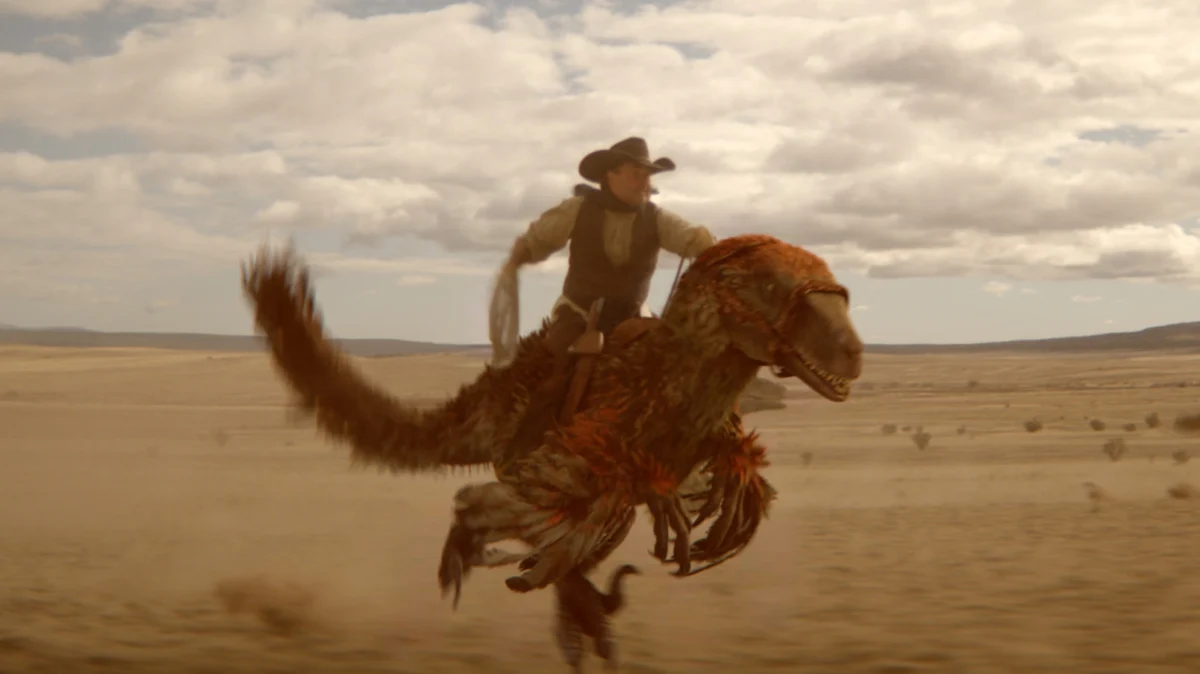
The landscape of creature features has long been dominated by the shadow of Michael Crichton and Steven Spielberg’s Jurassic Park. For decades, the industry standard for dinosaur-centric storytelling has been defined by genetic hubris, theme park disasters, and the inevitable pursuit of humanity by apex predators. However, director Luke Sparke—the visionary behind the acclaimed genre-bender Primitive War—is looking to shatter that mold. By pivoting from the humid jungles of the Vietnam War to the dusty, high-stakes plains of the 19th-century American frontier, Sparke is preparing to launch a project that aims to do for prehistoric creatures what Taylor Sheridan did for the modern ranching drama.
The Genesis of an Ambitious Crossover
The project, titled Dinosaurs of the Wild West, is not merely a film; it is a sprawling, episodic expansion of a world where humanity and dinosaurs have coexisted for centuries. Based on the evocative concept art of Shaun Keenan, the series promises a radical departure from the "man-vs-nature" tropes that have defined the genre since 1993.
Sparke, who earned significant critical praise for Primitive War—often cited as the finest non-franchise dinosaur film ever produced—is leveraging his newfound momentum to secure the creative autonomy necessary to build this "cinematic universe." Unlike a two-hour feature film, which often sacrifices deep world-building for pacing and spectacle, Dinosaurs of the Wild West is designed for long-form storytelling. With an estimated eight to ten hours of screen time per season, the series intends to provide the narrative room required to explore the political, social, and logistical implications of a world where a T-Rex might be as common, and as dangerous, as a rustler on the trail.
A Chronology of the Project’s Evolution
The journey of Dinosaurs of the Wild West began as a collaborative artistic vision between Sparke and illustrator Shaun Keenan. Recognizing that the project’s scope was too vast for a traditional film pitch—which often results in a "development hell" cycle—Sparke opted for a direct-to-consumer approach.
![How Dinosaurs Of The Wild West Could Be Like Yellowstone [Exclusive]](https://www.slashfilm.com/img/gallery/how-dinosaurs-of-the-wild-west-could-be-like-yellowstone-exclusive/l-intro-1783436274.jpg)
- Initial Conception: Inspired by Keenan’s art, which depicted a gritty, grounded reality where raptors and cowboys occupied the same space, Sparke began drafting a multi-season "Bible" for the series.
- The Development Phase: Sparke spent months meticulously crafting a history for this alternate timeline. In this version of history, humanity never became the sole dominant species; instead, the presence of dinosaurs shaped the evolution of warfare, transportation, and governance.
- The Kickstarter Launch: In early 2025, rather than waiting for traditional network backing, Sparke launched a crowdfunding campaign. The goal: $350,000. These funds are earmarked for the production of the first two episodes, which will serve as a proof-of-concept for the wider series.
- Parallel Production: Simultaneously, Sparke has been navigating the pre-production of Primitive War 2. Contrary to industry fears that these projects might cannibalize one another, Sparke has confirmed that both are moving forward on separate, parallel tracks, with each project occupying a distinct space in his portfolio.
Supporting Data: The Power of the "Yellowstone" Model
To understand why Sparke is so confident in his pitch, one must look at the unprecedented success of the "Sheridan-verse." Taylor Sheridan’s Yellowstone did not just succeed as a cable drama; it transformed into a franchise machine, spawning successful spin-offs like 1883 and 1923 that effectively conquered the streaming landscape.
Sparke’s strategy mimics this "universe-building" approach. His goal is to create a core series that establishes the rules of his alternate reality, then branch out into historical vignettes. He has already noted that Shaun Keenan has produced artwork depicting dinosaurs in Medieval Europe and Ancient Rome. If the Wild West iteration finds an audience, the potential for a "dinosaur-centric anthology" is limitless.
Regarding the budget, observers often raise an eyebrow at the $350,000 target. However, Sparke has a proven track record of fiscal discipline. His work on Primitive War was achieved with a budget of less than $10 million—a pittance by modern Hollywood standards—yet the film delivered visuals that rivaled $100 million blockbusters. By prioritizing practical effects and high-concept cinematography, Sparke has demonstrated that he can stretch a dollar further than most directors in the action-adventure space.
Official Responses and Creative Influences
In an exclusive interview regarding the project, Sparke was remarkably candid about the "DNA" of his series. He described the show as a synthesis of three distinct pillars of modern television:
![How Dinosaurs Of The Wild West Could Be Like Yellowstone [Exclusive]](https://www.slashfilm.com/img/gallery/how-dinosaurs-of-the-wild-west-could-be-like-yellowstone-exclusive/intro-1783436274.jpg)
- The Western Foundation (Yellowstone): This provides the tone, the landscape, and the focus on power dynamics, land disputes, and the rugged, unforgiving nature of the frontier.
- The Political Intrigue (Game of Thrones): Sparke emphasized that this is not just about monsters eating people. He has built a complex world of "chess pieces," where political factions use the presence of dinosaurs as tools for war and negotiation.
- The Gunslinger Aesthetic (The Mandalorian): The show aims to capture the mythic, lone-wanderer energy of the Western genre, combined with the high-production values and genre-bending storytelling that defined the Star Wars spin-off.
"I’ve written the first season and multiple seasons to follow," Sparke stated. "I have ideas of how to spin off into other areas and keep it in this world… if West becomes successful, how to spin that off and also tell other stories."
Implications for the Future of Independent Film
The success of this Kickstarter campaign carries significant weight for the future of independent filmmaking. If Sparke successfully produces high-quality episodes through crowdfunding, it signals a shift away from the traditional studio gatekeepers. It suggests that niche genres—which studios often deem "too risky"—can find a direct, passionate audience willing to finance the vision they want to see.
Furthermore, the project represents a challenge to the "Jurassic" monopoly. For three decades, the dinosaur genre has been tethered to the idea of "resurrected monsters." Sparke’s premise of "dinosaurs as a natural, historical constant" allows for a more grounded, gritty tone. It opens the door for a genre that can be as serious as a period drama or as kinetic as a high-octane western, effectively decoupling the dinosaur from the science-fiction thriller label.
Conclusion: The Road Ahead
Whether Dinosaurs of the Wild West becomes the next television phenomenon or remains a fascinating, high-ambition cult project, its impact is already being felt. By refusing to wait for a "green light" from corporate executives and choosing instead to engage directly with his fanbase, Luke Sparke is demonstrating a new blueprint for genre filmmakers.
![How Dinosaurs Of The Wild West Could Be Like Yellowstone [Exclusive]](https://www.slashfilm.com/img/gallery/how-dinosaurs-of-the-wild-west-could-be-like-yellowstone-exclusive/dinosaurs-of-the-wild-west-is-aiming-high-with-its-comparisons-1783374175.jpg)
As production gears up and the Kickstarter campaign progresses, all eyes will be on whether the finished product can match the scale of its ambition. If Sparke’s past work is any indication, we are likely to see a series that refuses to be tamed, proving that even in the age of CGI saturation, there is still plenty of room for a good, old-fashioned, prehistoric showdown on the dusty trails of the American West.








