For nearly nine decades, the Golden Gate Bridge has stood as a sentinel over the San Francisco Bay, its "International Orange" steel silhouette etched into the cultural consciousness of the world. Yet, for all its familiarity—from the misty vantage point of Baker Beach to the sweeping vistas of Marin County—the bridge remains a mystery to most who view it from the road. Its towers, piercing the fog at 500 feet, are usually seen from below. However, photographer Marcin Zajęc recently recalibrated our understanding of this architectural icon, utilizing drone technology to capture a perspective that transforms a historic landmark into a study of geometric precision and modern elegance.
Zajęc’s work is not merely a technical triumph; it is a testament to the burgeoning field of aerial photography, which has gained immense traction as a vital medium for artistic expression and environmental documentation. His image stands as one of 101 finalists in the 2026 International Aerial Photographer of the Year, a competition that has quickly established itself as the preeminent global stage for those who take to the skies to capture the world.

Main Facts: The 2026 International Aerial Photographer of the Year
The second annual International Aerial Photographer of the Year competition has concluded, setting a high bar for the industry. From a pool of nearly 1,600 entries submitted by photographers spanning every continent, the jury selected 101 images that represent the pinnacle of high-altitude and drone-based photography.
The top honor—the "Aerial Photographer of the Year" title—was awarded to Azim Khan Ronnie of Bangladesh. Ronnie’s winning entry, Harvesting Red Chili, is a striking example of the intersection between human industry and abstract patterns. Drawing on his professional background in photojournalism, Ronnie excels at finding the rhythm in labor, transforming the mundane act of harvesting crops into a vibrant, high-contrast mosaic that speaks to the scale of human endeavor.

The competition is notable for its refusal to restrict participants to a single methodology. While many finalists utilized advanced drone technology, others captured their images from the cockpits of airplanes, the rooftops of skyscrapers, or even via high-altitude balloon rigs. The common thread is the "bird’s-eye view"—a perspective that strips away the clutter of the ground level to reveal the underlying patterns, geometries, and startling realities of our planet.
Chronology: The Rise of Aerial Perspective
The history of aerial photography is a narrative of technological evolution, moving from the tethered balloons of the mid-19th century to the sophisticated, AI-assisted drones of today.

- 1858: Gaspard-Félix Tournachon, known as "Nadar," takes the first successful aerial photograph from a hot air balloon over Paris.
- Early 20th Century: Aerial reconnaissance during the World Wars accelerates camera stabilization and lens quality, laying the groundwork for commercial aerial imaging.
- Late 20th Century: Satellite imagery and high-end aviation photography redefine geography and cartography.
- 2025: The inauguration of the International Aerial Photographer of the Year competition signals the mainstream democratization of high-quality aerial art, fueled by the rapid advancement of consumer-grade drone technology.
- 2026: The second year of the competition sees a 40% increase in submissions, highlighting a global shift in how photographers approach environmental, architectural, and social subject matter.
This year’s competition marks a turning point where "drone art" has moved from a novelty into a sophisticated artistic discipline, demanding as much focus on light, composition, and timing as traditional landscape photography.
Supporting Data: A Global Panorama
The diversity of the 101 finalists highlights the sheer breadth of the Earth’s surface and the variety of stories contained within it. The finalists’ submissions can be categorized into four primary thematic pillars:

1. Geological Phenomena
The planet’s raw power is a recurring theme. Finalist Clémen Coudeyre (Iceland) captured the explosive reality of volcanic activity in The Floor Is Lava, while Paweł Jagiełło (Poland) explored the intricate, river-carved veins of desert landscapes in The Valley of Forgotten Rivers. These images serve as a stark reminder of the planet’s constant state of flux.
2. Architectural Abstraction
While the Golden Gate Bridge provides a recognizable anchor, other photographers prefer the abstract. A.J. Rich (U.S.) utilizes shadow and light to define the "serrated" edges of arid terrain in Serration, turning nature into a blueprint. Similarly, Cédric Tamani (Switzerland) explores the fluid, brown hues of moving water in Downstream, creating a near-abstract pattern that challenges the viewer to identify the subject.

3. Cultural and Anthropogenic Impact
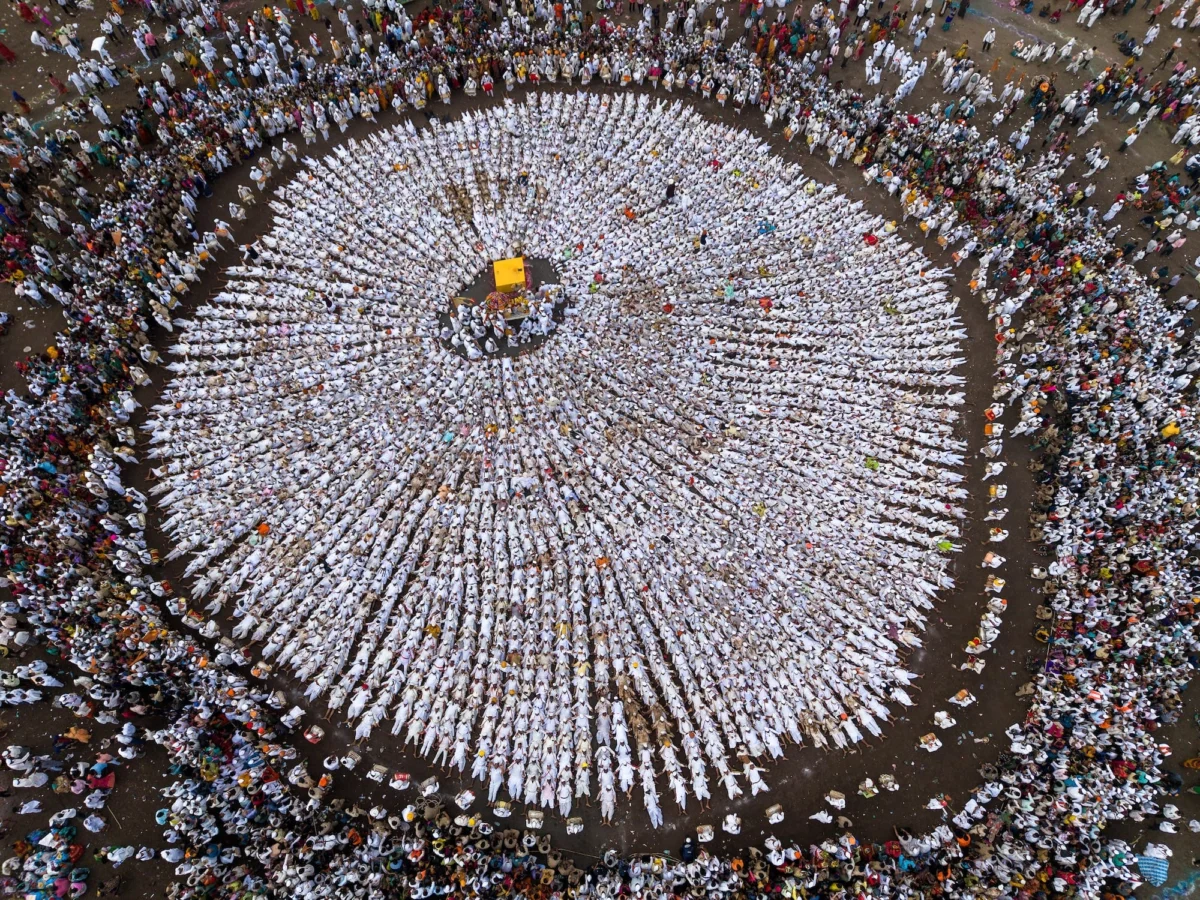
Photography is at its most potent when it captures human interaction with the environment. Sanghamitra Sarkar’s Wari captures the annual pilgrimage in India, where hundreds of devotees lay in unison around a shrine. This image, along with Ronnie’s winning shot, emphasizes the scale of human connectivity, often lost at eye level.
4. The Natural World
Wildlife and climate-driven phenomena round out the collection. Vitaly Golovatyuk (Russia) presents a serene image of a bird centered within a red-foliaged pond, while Paolo Lazzarotti (Italy) achieved a rare capture of a full-circle rainbow in Complete Rainbow, a phenomenon usually reserved for the high-altitude observer.

Official Responses and Juror Perspectives
The competition organizers have noted that the judging process for 2026 was the most difficult in the contest’s short history. "The increase in technical proficiency among applicants has been staggering," noted one juror in the official post-competition report. "We are no longer looking for ‘interesting’ shots from the air. We are looking for narrative, for emotional resonance, and for the ability to use the sky as a canvas to reframe reality."
Azim Khan Ronnie, upon receiving the top prize, noted the unique responsibility of the aerial photographer. "When you fly a drone, you are looking at the world as a witness. You see the patterns of how we live, how we work, and how the earth breathes. My goal is always to bring the viewer closer to a truth that is invisible from the ground."

The judges emphasized that while drones have made the sky accessible, the art remains firmly in the hands of the human operator. The winners were chosen not for their equipment, but for their vision.
Implications: The Future of the Medium
The success of the 2026 International Aerial Photographer of the Year competition suggests that the "aerial gaze" is becoming a standard language in modern art. This has several implications for the future:

Environmental Awareness
By showing the beauty and fragility of the earth from above, these photographers are becoming silent ambassadors for conservation. Images of drying rivers or shifting volcanic plates provide an undeniable, visceral record of climate change and geological evolution.
Artistic Evolution
The line between painting and photography is blurring. Aerial shots of agricultural patterns, irrigation systems, and urban grids are increasingly indistinguishable from abstract expressionist art. This evolution encourages photographers to focus on form, color, and texture rather than just capturing a "pretty place."

The Democratization of Discovery
As entry-level drones become more affordable, we are witnessing a new era of exploration. Locations that were once considered inaccessible—or simply too expensive to film—are now being documented by hobbyists and professionals alike. This leads to a richer, more diverse global archive of human and natural history.
Conclusion: Looking Up and Looking Down
As we look forward to the 2027 cycle, the legacy of this year’s competition remains clear: our world is much larger, much more complex, and infinitely more beautiful than our daily horizontal view allows us to see. By stepping back and looking down, we gain the perspective necessary to appreciate the intricate design of our existence.

To view the full gallery of the 101 finalists and explore the stories behind each capture, visit the International Aerial Photographer of the Year website. Whether it is the rhythmic harvesting of chilies in Bangladesh or the silent, frozen majesty of a desert in Poland, these photographs invite us to rise above the horizon and see the world anew.