Brazilian artist Ana Elisa Egreja has long been fascinated by the friction between the mundane and the impossible. In her latest body of work, a suite of 15 immersive oil paintings, she dismantles the traditional boundaries of the still life, transforming the canvas into a theater of migration, cultural hybridity, and the porous nature of domestic space. Her current exhibition, The Flight of Color, which marks her inaugural solo showcase in the United States, is currently on view at Jessica Silverman in San Francisco through September 5, 2026.
Main Facts: A Convergence of Eras and Aesthetics
At the heart of Egreja’s practice is a rejection of the static. While her work pays clear homage to the Dutch Golden Age—a period defined by its hyper-realistic depictions of opulence, flora, and the fleeting nature of life (vanitas)—she complicates this legacy with the jarring, contemporary sensibilities of collage.
In these new compositions, the classical arrangement of fresh flowers and artisanal produce is interrupted by the debris of modern global consumption: cellophane-wrapped snacks, mass-produced canned goods, and everyday household clutter. Egreja describes the unexpected companions within her paintings as "improbable but not impossible." By integrating architectural motifs from her native São Paulo with eclectic elements gathered from abroad, she positions the home not as a fortress, but as a site of constant transformation and cross-cultural pollination.

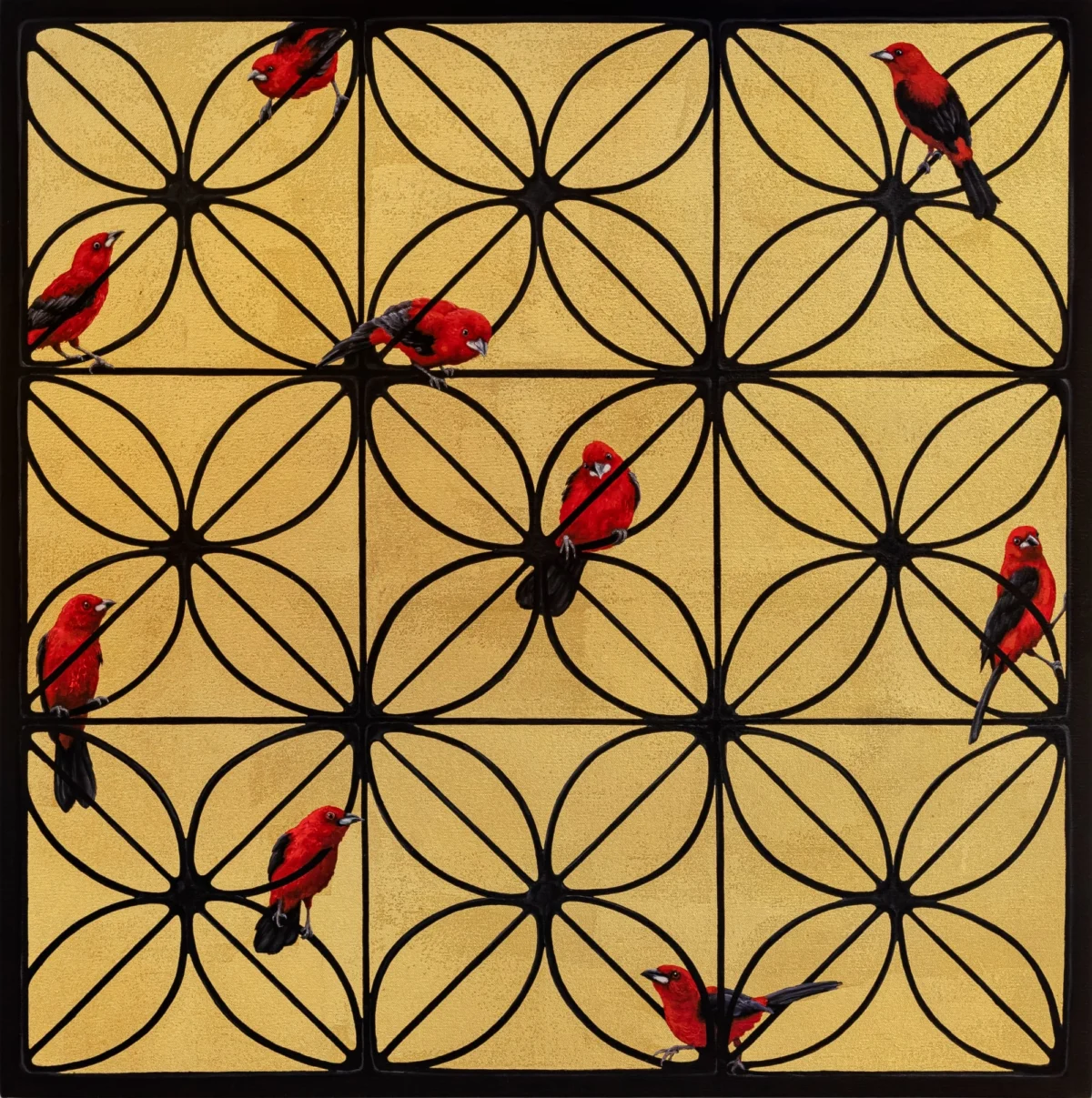
The exhibition features not only traditional oil on canvas but also mixed-media installations. Some pieces incorporate 24-karat gold leaf, providing an ethereal, celestial backdrop to the domestic scenes, while others feature tactile elements like beaded curtains that physically extend the painting into the viewer’s space.
Chronology: The Evolution of a Vision
The development of The Flight of Color reflects a years-long meditation on the movement of people, objects, and animals.
- Early Conceptualization (2023–2024): Egreja began experimenting with the juxtaposition of "high" art (Dutch Golden Age still life) and "low" culture (convenience store packaging), exploring how these objects reflect the transient nature of modern migration.
- The Residency and Research Phase (2025): The artist spent significant time analyzing the intersection of wildlife and urbanization in South American metropolises. During this time, she began incorporating birds as central metaphors for freedom, displacement, and the fluidity of borders.
- The Production Suite (Early 2026): Over the course of six months, Egreja finalized the 15 oil paintings that comprise the current show. This period saw the integration of sculptural elements, such as the beaded curtain seen in Interior with Five Cats at Sunset, marking a shift from two-dimensional representation to environmental engagement.
- U.S. Debut (July 2026): On July 16, 2026, the exhibition opened at Jessica Silverman in San Francisco, introducing a wider North American audience to her unique brand of "magical realist" still life painting.
Supporting Data: The Symbolism of the In-Between
The works in The Flight of Color are anchored by a sophisticated visual language. Egreja utilizes specific motifs to bridge the divide between disparate worlds:

The Sunsets and Gradient Shifts
The lighting in the exhibition is a character in its own right. Bold, saturated gradients—shifting from deep, melancholic crimson to electric amber—are splashed across living rooms and kitchen tables. These light studies serve as the backdrop for subjects like Interior with a Jaguar and Sun Conure. The choice of a "forlorn feline" on an Art Deco sofa, silhouetted against a dramatic, glowing sky, emphasizes the isolation that often accompanies the migratory experience.
The Window as Interstitial Space
Perhaps the most potent symbol in the exhibition is the window. Egreja frames these portals with decorative wrought-iron grilles and blankets them in 24-karat gold leaf. By doing so, she elevates the window from a mere architectural feature to a sacred, "interstitial spot." This is where the birds—the true agents of migration in her work—pause as they transit between the interior (the private, domestic sphere) and the exterior (the wild, the unknown, the public).
Materiality and Texture
The artist’s use of materials is intentionally disorienting. In Still Life with Embroidered Fabric, the canvas is not merely a surface for paint but a substrate for textile. By layering fabric onto the canvas, Egreja forces the viewer to question where the representation of an object ends and the object itself begins.

Official Perspectives: The Artist’s Intent
In her discourse regarding the exhibition, Egreja highlights the "illegibility" of boundaries. She argues that the rigid lines drawn by human society—between private and public, wild and domestic, or even international borders—are entirely invisible to the natural world.
"I am interested in how the non-human perspective challenges our definitions of home," Egreja suggests. By painting creatures like jaguars, macaws, and parrots within the confines of domestic interiors, she does not portray them as captives, but as explorers. She posits that there is an "ongoing organic exchange" between the entities we categorize as separate. Her work functions as an invitation to view our own homes through this lens: as places that are constantly being visited, inhabited, and transformed by forces outside of our control.
The gallery space at Jessica Silverman acts as a staging ground for these conversations, where the physical layout of the show mimics the transitions between rooms in a house, guiding the visitor through a domestic journey of color and light.

Implications: A New Era for Contemporary Still Life
The implications of The Flight of Color extend beyond the immediate aesthetic appeal of Egreja’s work. By reclaiming the still life—a genre often relegated to the history books or dismissed as purely decorative—she reclaims the power of the domestic interior as a political space.
The Political Dimension of the Domestic
Migration is rarely discussed in the context of the "still life." Usually, the subject is reserved for large-scale portraiture or documentary photography. By bringing the themes of displacement, environmental change, and the "flight" of color into the living room, Egreja makes the global struggle of the migrant intimate and palpable. The presence of canned goods and consumer packaging alongside exotic birds suggests that our daily consumption habits are inextricably linked to the global movement of resources and people.
The Future of the Genre
Egreja’s success in this exhibition suggests a shifting tide in contemporary art, where the "magical realist" approach is being utilized to bridge the gap between traditional technique and modern discourse. Her ability to blend the rigidity of 24-karat gold leaf with the chaotic, messy reality of a beaded curtain or a plastic bag demonstrates a mastery over the medium that allows for a complex, layered narrative.

As the exhibition continues its run through September 5, it serves as a critical checkpoint for those interested in how the domestic space will continue to evolve in an era of hyper-mobility. For viewers in San Francisco, the show is an opportunity to engage with a body of work that is as intellectually rigorous as it is visually arresting.
Ana Elisa Egreja does not merely paint objects; she paints the invisible currents of energy that move through our lives, proving that even in the most static of scenes, there is a constant, vibrant flight toward something new.
For those unable to visit the Jessica Silverman gallery in person, the artist’s process and further insights into the development of this collection can be explored through her official social media channels, where she frequently shares behind-the-scenes footage of her studio practice and the evolution of these complex, layered compositions.