Reynand Wu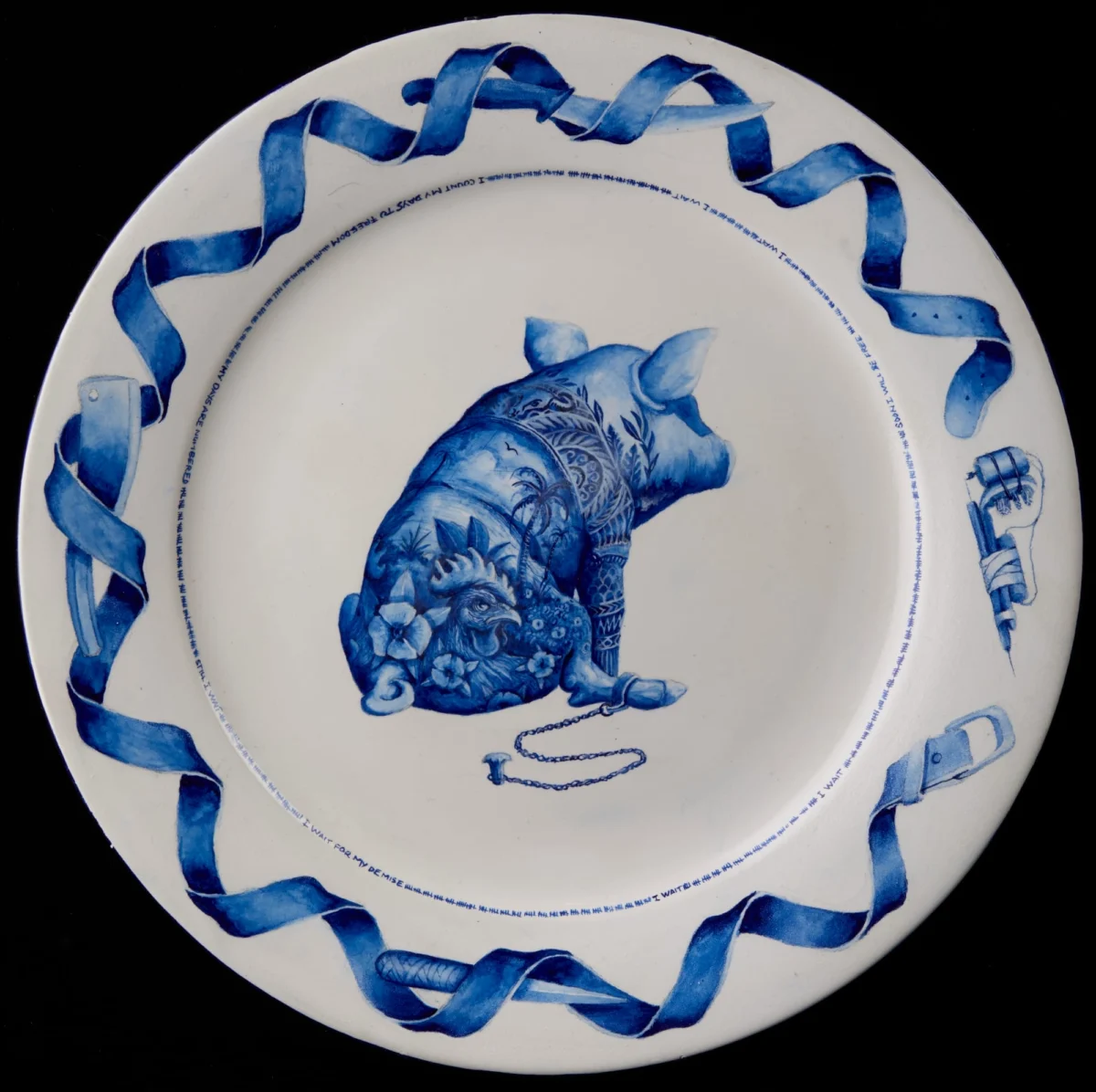
Introduction: The Fragility of Freedom
In the quiet corners of a contemporary New York gallery, a series of white porcelain plates sits, each one a canvas for a haunting, monochromatic blue narrative. These are not mere decorative objects; they are the vessels of a life spent behind bars, now finding a new, surreal geography in the lush landscapes of the Philippines.
The artist, Gil Batle, has emerged as a singular voice in the world of outsider art. His latest exhibition, Double Life, currently on view at the Ricco/Maresca gallery through August 21, serves as a visceral intersection between the raw, brutal reality of California’s maximum-security prison system and the vibrant, breathing flora and fauna of his ancestral Filipino homeland. By choosing the delicate medium of porcelain, Batle forces a confrontation between the domestic "civility" of the plate and the savage, indelible scars of a quarter-century of incarceration.
Chronology: From Cell Blocks to the Canvas
To understand the gravity of Batle’s work, one must trace the arc of his life—a trajectory marked by isolation, self-discovery, and eventual transition.

The Decades of Confinement
Gil Batle’s artistic education did not occur in the hallowed halls of an academy, but within the rigid, unforgiving confines of the California state prison system. For 25 years, he lived in a world defined by concrete, steel, and a constant, low-humming threat of violence. In this environment, where conventional art supplies were forbidden, Batle honed his skills through clandestine methods. He began by drawing, eventually moving into the illicit world of prison tattooing—an act of self-expression that was as dangerous as it was necessary for his psychological survival.
The Transition
Following his release, Batle made the profound decision to leave the United States, immigrating to the Philippines, the land of his parents. This migration was more than a change of address; it was a fundamental shift in his environment. The transition from the sterile, monochromatic aesthetic of a cell block to the dense, organic chaos of the Filipino jungle provided the thematic scaffolding for his current body of work.
The Emergence of Double Life
In recent years, Batle has distilled his memories into the series Double Life. The work represents a maturation of his style, moving away from the ephemeral nature of tattoos toward the permanence of ceramic. By 2024 and 2025, these pieces began to take their current form, blending the iconography of his past—barbed wire, shivs, and cages—with the natural symbols of his present life.

Supporting Data: The Iconography of Double Life
The exhibition at Ricco/Maresca showcases a variety of pieces that demonstrate Batle’s unique visual language. His work is characterized by a "blue-ink" aesthetic, reminiscent of the traditional prison tattoos that once covered the skin of his peers.
Key Works and Motifs
- "Barbirusa" (2025): A 9 x 12-inch ceramic plate featuring two boars, their tusks grotesquely intertwined with barbed wire. The piece serves as a metaphor for the entanglement of animal instinct and human cruelty.
- "The Butcher" (2025): Perhaps the most visceral piece in the collection, this work depicts a headless figure interacting with a headless pig. The pig, in a grotesque reversal of roles, hands the man his own severed head. It is a commentary on the dehumanization inherent in violent environments, where the line between the victim and the perpetrator is blurred beyond recognition.
- "Bird Catcher" (2026): A soldier, rendered in blue acrylic, stands surrounded by birds and cages. The cage—a recurring motif in Batle’s work—is not just a symbol of the prison cell, but a symbol of the mental entrapment that often persists long after the physical bars are gone.
- "Tethered" (2024): A tree, cut at the base, is tied to the ground with a rope and surrounded by a moat. The image speaks to the futility of growth when one is anchored to a past that refuses to let go.
Official Responses and Curatorial Context
Ricco/Maresca, a gallery globally recognized for its commitment to "outsider," self-taught, and folk artists, has positioned Double Life as a significant contribution to the discourse on restorative justice and artistic survival.
"Gil Batle occupies a space that few artists ever reach," says a representative from the gallery. "He is an artist who didn’t ‘learn’ to paint; he learned to survive through his work. When he puts that work on porcelain—a medium that is as fragile as the human psyche—he is asking the viewer to consider how we categorize ‘barbarism’ versus ‘civilization.’ Is the violence in his paintings truly ‘outside’ of society, or is it a reflection of the society that put him in that cage for 25 years?"

Critics have noted that the use of porcelain is particularly subversive. By placing scenes of shivs, chains, and decapitated figures on a plate—an object intended for the dinner table—Batle forces the viewer to digest the reality of his trauma while engaging in the daily ritual of eating.
Implications: The Sociology of the "Outsider"
The significance of Batle’s work extends far beyond the aesthetic. It raises critical questions regarding the intersection of the carceral state and creative output.
The Prison as an Artistic Incubator
Sociologists have long studied the way art functions in extreme environments. For many incarcerated individuals, art is a method of reclaiming agency in a system designed to strip it away. Batle’s 25-year tenure in the California system is a testament to the resilience of the human spirit. His work proves that even when the body is restrained, the mind can travel, observe, and eventually translate those observations into a critique of the system that contained it.

The Duality of the Immigrant Experience
By moving to the Philippines, Batle has created a unique "third space." He is no longer a prisoner of the state, but he is also not a native of the jungle. He exists in the "double life" of the half-man, half-beast; half-prisoner, half-free; half-American, half-Filipino. This duality is the engine of his creativity. The Filipino landscape, while lush and teeming with life, becomes a mirror for his internal struggles. The "Rice Field Rocker"—a bull with hooves nailed to a rocker—is a perfect encapsulation of this: a creature meant to roam, now fixed and stagnant, rocking in place but going nowhere.
The Ethics of Viewing
There is an inherent tension in displaying "prison art" in high-end New York galleries. Does the aestheticization of trauma serve to sanitize it? Batle’s work avoids this trap by refusing to offer catharsis. There is no resolution in his plates. The shivs do not disappear; the chains do not break. The viewer is left with the uncomfortable task of witnessing the permanence of the artist’s experience.
Conclusion: A Lingering Reflection
As Double Life continues its run, it remains a powerful reminder of the hidden talent currently locked away within the world’s penal institutions. Gil Batle is more than a survivor of a brutal system; he is an archivist of its horrors. Through his porcelain plates, he serves the contents of a life spent in the shadows to the light of the public eye.

The exhibition is not merely a display of technical skill or an exploration of cultural identity. It is a demand for recognition. By transforming the mundane into the monstrous, and the domestic into the traumatic, Batle forces us to ask what we truly value. Is it the porcelain, or is it the life that had to be shattered before it could be pieced back together?
For those who visit the Ricco/Maresca gallery before August 21, the experience will be one of profound discomfort. But in that discomfort, there is a rare, crystalline clarity. Gil Batle, through his blue-inked scenes of misery and survival, has created a body of work that is as enduring as the porcelain upon which it is painted. He has successfully taken the most harrowing moments of his life and turned them into a mirror—one that forces us to look not just at his past, but at the societal structures that allow such "Double Lives" to exist in the first place.

 Nana
Nana
 Nana Wu