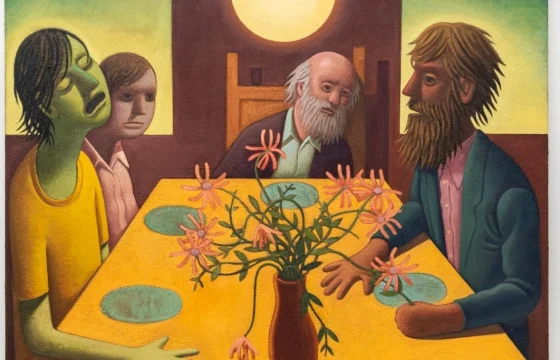
NEW YORK, NY — HESSE FLATOW is proud to announce the opening of Franklin, a profound new exhibition featuring the latest paintings and works on paper by Nat Meade. Marking the artist’s third solo presentation with the gallery, the exhibition invites viewers into a complex, allegorical landscape where the personal intersects with the universal. Open to the public through April 18, 2026, the collection serves as a poignant meditation on the roles we inhabit: father, son, partner, and the ghosts we inherit along the way.
I. The Core Narrative: Painting as Existential Mirror
Nat Meade has long been recognized for his ability to translate the messy, visceral reality of contemporary existence into figurative works that feel at once intimate and detached. In Franklin, Meade moves beyond the literal representation of individual subjects to craft a series of timeless archetypes. These figures do not serve as portraits of specific people, but rather as vessels for the human condition.
The exhibition functions as an emotional arc, mapping the topography of life’s struggles—grief, aging, and the weight of legacy—against its triumphs—renewal, wonder, and the quiet resilience of the next generation. By utilizing an "allegorical distance," Meade creates a safe harbor for the viewer to confront difficult truths. Whether depicting a solitary traveler seeking existential validation or illustrating the tension of intergenerational dynamics, Meade employs a visual language that oscillates between the absurd, the somber, and the darkly humorous. It is within this friction that the work finds its resonance, echoing the complexities of navigating life in the modern era.
II. Chronology: The Evolution of a Visual Language
To understand the weight of Franklin, one must look at the trajectory of Meade’s career. His previous bodies of work often depicted figures struggling against, or becoming victims of, violent forces of nature. His characters were frequently seen being overtaken by turbulent winds or swallowed by crashing waves—a direct metaphor for the feeling of being powerless against the currents of one’s own life.
The Turning Point
The thematic shift in Franklin is significant. Following the passing of his own father, Meade entered a period of intense reevaluation. This personal loss, combined with the profound responsibility of his own parenthood, served as a catalyst for the transition seen in these new works. Where once there was chaos and turbulence, there is now an emerging sense of stillness.
- Pre-2024: Meade’s work focused heavily on the struggle of the individual against external, insurmountable forces.
- 2024-2025: The period of mourning and reflection. The introduction of younger, more harmonious figures begins to appear in his sketches and preliminary studies.
- 2026 (Present): The debut of Franklin. The exhibition marks a synthesis of these experiences, showing a deliberate pivot toward calm seas and the possibility of reconciliation.
III. Supporting Data: Symbolism and the Anatomy of Trauma
Meade’s work is densely packed with semiotic markers that invite deep investigation. His visual vocabulary is informed by both the history of art and the dark corners of popular culture.
The "Franklin" Reference
The exhibition’s title, Franklin, is a deliberate and unsettling nod to the 1974 horror classic The Texas Chainsaw Massacre. The character of Franklin Hardesty, trapped in a wheelchair and caught in the grip of a deranged, patriarchal family, serves as a dark mirror for the exhibition’s exploration of familial trauma. Meade uses this reference to probe the "inner turmoil of contending with one’s violent and antagonistic impulses."
Key Visual Motifs
- The Ascending/Descending Figure: In the painting Poise, a pair of legs dangles from a cloud. This imagery forces the viewer to grapple with the interchangeability of life and death. Is the figure leaving this world, or arriving in it?
- Ghostly Specters: These ethereal shapes hover over figures, representing the inherited trauma passed down through generations. They function as a visual manifestation of what is "carried" but not "owned."
- Classical Allusions: Meade frequently calls upon art history to ground his contemporary anxieties. A vulture picking at a corpse evokes the eternal, agonizing punishment of Prometheus, while a figure on hands and knees references William Blake’s Nebuchadnezzar, a potent image of the madness that follows a lust for power.
IV. Official Perspectives: The Artist’s Intent
While the gallery has provided the formal introduction to the show, the substance of the exhibition lies in the artist’s own philosophy of creation. Meade has noted in discussions surrounding the exhibition that the act of painting is a process of "sublimation." By putting his characters in their place—whether through the physical containment of the canvas or the symbolic justice of his narratives—he is effectively processing his own relationship with his father and the patriarchal structures he now navigates as a parent.
The gallery notes, "Vulnerability, pain, and mortality are themes Meade does not shy away from, yet the introduction of younger males in this body of work casts a sense of hope, acceptance, reconciliation, and renewal." This official stance underscores the importance of the youth figures, who act as a counterweight to the "heaviness" of the adult figures.
V. Implications: A New Era of Reconciliation
The most striking implication of Franklin is the departure from the "storm-tossed" figure toward the "guided" figure. The contrast between the adults—who are often burdened by their histories—and the children—who are portrayed with a sense of harmonious wonder—is the exhibition’s emotional core.
The Future-Forward Perspective
In one of the most poignant sequences of the show, Meade depicts a young boy steering a boat with a radiant torch. Unlike the adults, this figure is unclouded by societal or familial pressures. In another piece, a father and son are seen in a shallow pool; the father is tenderly guiding the child, reversing the traditional power dynamic of the "tormented patriarch."
This focus on calmer seas signals a fundamental change in Meade’s outlook. He is no longer just documenting the struggle; he is documenting the recovery. The implication is that by acknowledging one’s "rocky histories," it is possible to break the cycle. By healing his own relationship with the past, Meade suggests that we can release future generations from the same burdens.
Resilience as a Central Theme
Ultimately, Franklin is a testament to the "stubborn resilience of human nature." Despite the dark, sometimes grotesque imagery—the vultures, the ghosts, the horror-movie references—the exhibition does not leave the viewer in a state of despair. Instead, it offers a path forward. It suggests that progress is attainable, even if it is incremental, and that the act of looking back at our traumas is the only way to eventually look forward with clarity.
VI. Conclusion: Why Franklin Matters
Nat Meade’s Franklin is more than an exhibition of paintings; it is a clinical and emotional dissection of the male experience in the 21st century. By bridging the gap between the internal, often violent, impulses of the ego and the external, tender realities of fatherhood, Meade has created a show that feels urgent and necessary.
The exhibition challenges viewers to examine their own "ghosts" and to consider what they are passing on to those who follow them. As the exhibition remains on view at HESSE FLATOW through April 2026, it invites us all to step into the shallow, clear waters of Meade’s cove, to look at the starfish and anemones, and to recognize that while the history of the father may be heavy, the path of the child can be illuminated by a torch of our own making.
For more information on the exhibition, visit the HESSE FLATOW gallery website or schedule an appointment to view the collection.