Introduction: A Synthesis of Eras
PPOW Gallery is currently host to a monumental homecoming of sorts. Through April 25, 2026, the gallery presents Orchid Rain on the Underground, the third solo exhibition by the seminal New York artist Chris “Daze” Ellis. The exhibition serves as a profound meditation on the evolution of New York City, bridging the gap between the gritty, high-octane spontaneity of the 1970s and 80s graffiti movement and the refined, meticulous studio practice Daze has cultivated over the subsequent five decades.
Spanning a diverse array of media—including large-scale canvas paintings, a site-specific mural, and an immersive multimedia installation—the exhibition is more than a retrospective. It is a vital, living document that asserts the continued relevance of the city’s underground creative spirit. While the New York of Daze’s youth may be viewed by many as a vanished landscape, Orchid Rain on the Underground argues that the foundational energy of that era is not merely a memory; it is the bedrock upon which the city’s current cultural identity rests.
The Chronology of a Street Pioneer
To understand the weight of Daze’s latest work, one must trace his trajectory from the subway tunnels of Brooklyn to the global stage. Born in 1962, Daze came of age in a city defined by economic turbulence and unparalleled creative explosion. As a student at the High School of Art and Design in the mid-1970s, he found himself at the epicenter of a cultural shift.
The Education of a Writer
During his formative years, Daze looked toward the vanguard of the graffiti movement—figures such as Blade, Lee Quiñones, and PHASE 2. These artists were not merely vandalizing transit; they were pioneering a new visual language that demanded public engagement. For Daze, the subway car was a rolling canvas, a way to reclaim the public sphere through color and calligraphy.
The Nightlife as a Crucible
By the early 1980s, Daze’s practice began to transition from the transitory nature of train writing to the permanence of the canvas. This shift was fueled by the city’s legendary nightlife. Daze was a fixture at institutions that functioned as the de facto laboratories of New York’s creative class:
- The Lit Lounge: A subterranean hub in the East Village.
- Danceteria: The legendary multi-floor venue on West 21st Street.
- The Mudd Club: A Tribeca epicenter of artistic and social experimentation.
These venues were not just dance floors; they were cross-pollination sites where painters, musicians, and poets collided. This generative environment became the bedrock of Daze’s early studio work, providing him with a network of peers and a philosophy of "urban improvisation" that remains central to his practice today.
Supporting Data: The Artistic Synthesis
Orchid Rain on the Underground reveals a sophisticated layering of influences. Daze does not merely replicate the graffiti aesthetic; he interprets it through the lens of art history.
The Ashcan Legacy and Lyrical Abstraction
The exhibition highlights Daze’s deep appreciation for early 20th-century urban realists, particularly the Ashcan School’s John Sloan and WPA-era painter Reginald Marsh. Like them, Daze treats the streets, subways, and crowded corners of New York as worthy subjects of high art.
However, this realism is tempered by the influence of Abstract Expressionism. Daze incorporates the gestural, emotive brushwork associated with Joan Mitchell and Willem de Kooning. By combining the raw, spray-painted textures of his roots with the lyrical, sweeping strokes of abstraction, he creates a visual tension that captures the chaotic rhythm of the city.
The Gem Spa Narrative
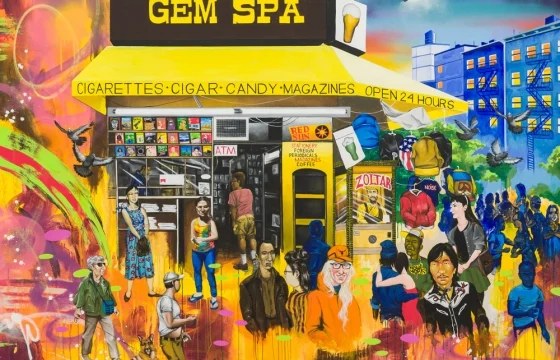
A centerpiece of the show, the 2025 painting Gem Spa In the 80s, serves as a poignant anchor for the exhibition. The now-shuttered Gem Spa, once located at the corner of St. Mark’s Place and Second Avenue, was more than a candy store; it was, as poet Allen Ginsberg described it, a "nerve center" of the city.
In the painting, Daze captures the density of this social crossroads. The composition is inhabited by figures of immense cultural significance—including the critic and curator Carlo McCormick and the late artist Martin Wong. By populating the canvas with these figures, Daze elevates the everyday urban encounter to a historical event, memorializing the people who built the city’s cultural infrastructure.
Implications: Nature, Ruin, and Resilience
A recurring motif throughout the exhibition is the juxtaposition of tropical flora against the backdrop of urban decay. Technicolor orchids and blossoms appear to erupt from piles of rubble and subway infrastructure. This imagery serves as a powerful metaphor for Daze’s outlook on the city: a belief that optimism and inequality are inextricably linked, and that beauty is often found in the wake of destruction.
These floral elements, which include species found near the artist’s current home in upstate New York, act as a bridge between his past and present. They are memorials to the aspects of New York that have been lost to gentrification, yet they also stand as hopeful testaments to the enduring creativity that permeates the city’s corners.
Official Perspective: The Multimedia Experience
PPOW’s presentation is underscored by an immersive environment that pushes the boundaries of gallery display. The inclusion of a site-specific mural, which physically guides the viewer from the gallery space into a final, enclosed installation, creates a narrative arc.
The Installation as a Time Capsule
The final room of the exhibition is a fully realized sensory experience. By integrating:
- Authentic Subway Car Seating: Recontextualizing the harsh reality of transit into a domestic setting.
- Audio Curations: A soundscape fusing house, disco, hip-hop, and club tracks that defined the early 80s.
- Light and Motion: A dance floor and disco ball that mirror the sensory overload of his youth.
This installation emphasizes that for Daze, the "underground" was never just a location; it was a state of mind. It was a space where creative freedom was prioritized above all else. By forcing the gallery environment to accommodate these tactile, auditory, and historical elements, Daze effectively forces the viewer to confront the "creative spirit" he argues is still very much alive in New York today.
Conclusion: The Enduring Beat
As the exhibition runs through April 2026, it invites a reassessment of the graffiti movement’s place in the canon of contemporary art. Chris “Daze” Ellis has spent five decades evolving alongside the city, never losing the foundational passion that drove his first subway tags.
Orchid Rain on the Underground is not a nostalgic exercise. It is a rigorous, deeply felt examination of a city that is constantly erasing itself, and the artist’s role in preserving the heartbeat of those transitions. By honoring the people, the transit, and the nightspots that shaped him, Daze provides a roadmap for the next generation of urban creators. The exhibition affirms that while the landmarks may change and the stores may close, the "Orchid Rain"—the unexpected, beautiful, and resilient growth of culture—will continue to flourish in the most unexpected urban spaces.
For critics, historians, and art lovers alike, this exhibition stands as a crucial dialogue between the New York that was and the New York that continues to be, proving that Daze’s influence on the creative spirit of the city is as potent as ever.