Layla Zulfa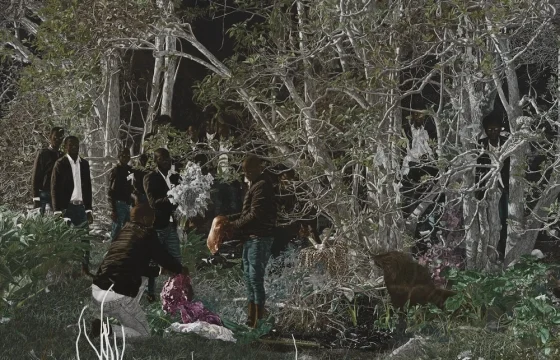
South African artist Cinga Samson invites viewers into a profound, shadowed landscape with his latest exhibition, Ukuphuthelwa. Translating from his native isiXhosa as "unable to sleep," the title serves as the thematic anchor for a collection of oil paintings that redefine the nocturnal experience. Far from the medicalized, pejorative associations of "insomnia," Samson’s Ukuphuthelwa positions sleeplessness as a state of heightened spiritual receptivity—a deliberate, sacred alertness that flourishes only in the absence of daylight. The exhibition, which marks a significant evolution in the artist’s inquiry into the nature of reality and representation, will remain on public view through April 18, 2026.
The Architecture of the Unseen: Main Facts
At the heart of the exhibition is an exploration of the "unnameable." Working with a signature, somber palette—comprised of near-blacks, dense carbon, and deep, atmospheric Prussian blues—Samson populates his canvases with ambiguous figures, watchful dogs, and indigenous South African flora. These are not merely paintings of subjects; they are studies in existential gravity.
Samson grapples with a fundamental paradox: how does an artist create a "true and honest" painting when the act of representation is, by its very nature, a simplification? He contends that there exists an unbridgeable gulf between the static, physical sign of a painting and the fluid, chaotic reality it attempts to mirror. His work does not pretend to close this gap; instead, it highlights the limit of the image, suggesting that the canvas can only ever function as a relative symbol—a finger pointing toward a moon it cannot touch.
Chronology and Evolution of the Series
The trajectory of Samson’s work has long moved toward this mastery of the "occluded palette." However, in the 2026 series, this approach has reached a new level of philosophical maturity.
- Early 2026: Development of the central motifs, specifically the recurring figures in forest clearings and the integration of ritualistic objects like bouquets and textiles.
- March 2026: The curation of the Ukuphuthelwa exhibition, emphasizing the tension between the knowable and the unknowable through specific titling in isiXhosa.
- April 18, 2026: The scheduled conclusion of the exhibition’s run, marking a milestone in the artist’s career as he attempts to bridge the linguistic and visual interstices between isiXhosa concepts and global existential inquiry.
The series is punctuated by works such as Umlindo (Watcher), Imfihlo (Secret), and Intsingiselo (Meaning), all completed in 2026. These titles are not merely labels; they are essential components of the viewing experience. As Samson notes, the instability of these words when translated into English mirrors the instability of the painted image itself. The meaning exists in the "interstice," the slippage between two languages, just as it exists between the painted stroke and the living subject.
The Ritual of the Canvas: Supporting Data and Technique
Samson’s technique is a rigorous exercise in light management. He describes his process of marshalling light as a "magic trick," one that involves a flickering application of paint that seems to emerge and dissipate across the surface.
The Aesthetics of Transparency
A hallmark of this exhibition is the deliberate exposure of the under-drawing. In works like Isiganeko (2026), Samson applies thin layers of glaze, only to wipe them back, creating a brooding chromatic density. Where the brushwork reveals the raw canvas beneath, the painting achieves a sense of transparency. This is most visible in the bird-in-flight motifs and the delicate rendering of undergrowth.
The Pupilless Gaze
Perhaps the most striking feature of Samson’s figures is the absence of painted pupils. By leaving the eyes as voids, the figures are rendered porous. They do not "look" at the viewer in a traditional, confrontational sense; rather, they circulate the light and atmosphere of the scene. They are not individuals with distinct identities, but "human" forms entirely enmeshed with the landscape. This erasure of the gaze forces the viewer to acknowledge that the figure has no mastery over the environment, nor does the environment possess the figure—both are participants in a singular, vast reality.
Official Perspectives and Artistic Intent
In discussing the recurring figure of the dog—a motif seen prominently in Intsingiselo II—Samson highlights the subjectivity of interpretation. A Western observer might read the dog as a symbol of loyalty, whereas an amaXhosa understanding might identify the animal as a spiritual guardian, a protective principle linked to the ancestors.
Samson acknowledges that while his technical mastery invites interpretation, his work is designed to confront the failure of representation. "The ritual itself is not the important thing," he explains, referring to scenes of gathering and ceremony in his work. "It’s an opening to what exists beyond." He views the painting not as a static record of a ritual, but as a gateway to the sublime.
For the artist, the "divine" is not a separate, transcendent entity located in the heavens. Instead, it is found in the "vernacular of all things"—in the bowing of foliage, the posture of a dog, or the cold, majestic weight of a rocky crag, as seen in Sithini ngelilitye (2026).
Implications: The Sublime in the Ordinary
The implications of Ukuphuthelwa extend beyond the art world’s formal critique. By championing a state of "hypersensitivity," Samson suggests a new way of engaging with the modern world. In an era defined by distraction and the rapid consumption of images, his paintings demand a slow, contemplative engagement.
The Shift in Existential Perception
Samson’s work suggests that the "darkness" of the night is not a void, but a field of potential. The moonwashed clouds in Tshee (2026) act as a destabilizing force against the eerie, cold atmosphere of the night, reminding us that the sky can be simultaneously friendly and terrifying. This oscillation is the essence of the sublime.
By stripping his figures of the ability to "look" outwards, Samson forces the viewer to look inwards—or rather, to look with the painting. The knowledge in his works is not something to be acquired through analysis; it is a "shared knowledge" that exists between the elements of the composition.
A Theology of the Mundane
Ultimately, Ukuphuthelwa serves as a profound meditation on the "immanent magic" of ordinary forms. Samson’s quest to create a "true and honest painting" concludes not with a perfect representation of reality, but with a confession of its limitations. By priscing apart what the image cannot contain, Samson succeeds in creating something that links the viewer to what he calls "everything."
His work suggests that if we are willing to stay awake—to embrace the ukuphuthelwa—we might find that the divine is not found in the distant or the grand, but in the quiet, mysterious, and deeply connected vernacular of the world around us. Through his deliberate, painstaking brushwork, Cinga Samson has curated a space where the limit of the image becomes the threshold of the infinite. As the exhibition continues through April 2026, it stands as a testament to the power of painting to act as a bridge between the visible, the invisible, and the vastly, beautifully unknowable.


 Jia Lissa
 Muslim