

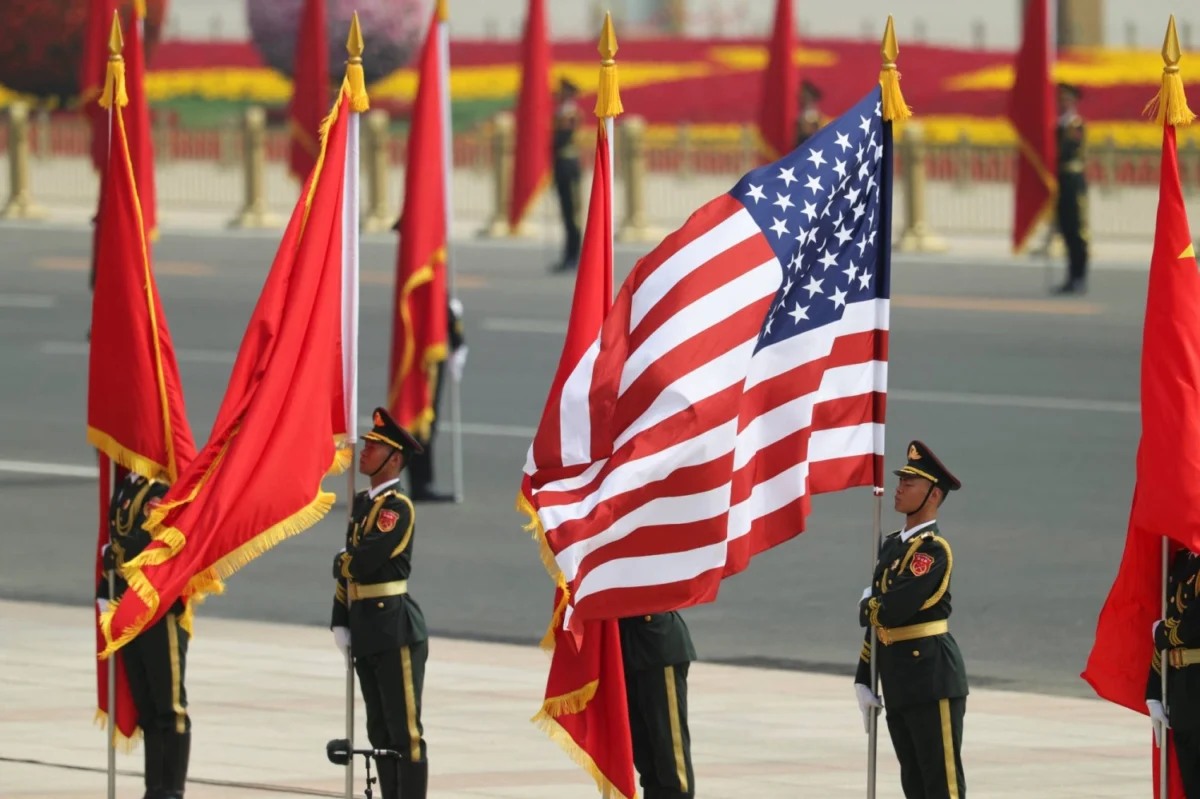
BEIJING — The summit held this past May between U.S. President Donald Trump and Chinese President Xi Jinping marked a pivot point in modern geopolitics. After years of accelerating friction characterized by trade wars, technology blockades, and localized military posturing, the two leaders have signaled an intent to steer the Sino-American relationship away from the precipice of open confrontation and toward a framework of "strategic stability."
While the geopolitical chasm between the world’s two largest economies remains vast, the consensus emerging from the Beijing summit suggests that both capitals have reached a sobering realization: the trajectory of unmitigated escalation has become economically ruinous, militarily dangerous, and diplomatically unsustainable.
The Strategic Shift: From Confrontation to Managed Competition
The core of the recent diplomatic shift lies in the mutual acknowledgment that while competition is inevitable, it must be governed by guardrails. The terminology used by both administrations—"a constructive relationship of strategic stability"—is a deliberate departure from the zero-sum rhetoric that defined the preceding years.
For policymakers in both Washington and Beijing, the logic is rooted in the hard lessons of 20th-century history. Just as the doctrine of "Mutually Assured Destruction" (MAD) provided a grim but effective framework for peace during the Cold War, today’s leaders are exploring a modern iteration of that balance. The understanding is clear: in an era of integrated global supply chains and advanced nuclear arsenals, a kinetic or systemic collapse would yield no victors.
Chronology of the Reset: The Road to Beijing
The path to the May summit was not linear. It was the culmination of months of quiet, high-level diplomatic back-channeling designed to de-escalate tensions that had reached a fever pitch by late 2025.
- January 2026: Informal trade envoys begin meeting in neutral territories to discuss the unsustainable nature of current tariff regimes.
- February 2026: Both nations announce a mutual easing of rhetoric regarding regional security in the South China Sea, signaling a tacit agreement to "freeze" certain aggressive maneuvers.
- March 2026: President Trump and President Xi hold a series of encrypted virtual summits to establish a framework for the upcoming face-to-face meeting.
- April 2026: Preliminary working groups identify "non-negotiable" areas of concern, including semiconductor supply chains and Taiwan, effectively creating a "no-go zone" for impulsive policy shifts.
- May 14, 2026: The Beijing Summit. President Trump arrives in the Chinese capital, where he is greeted with a full military honor guard—a symbolic gesture of state-level respect intended to reset the narrative of hostility.
Supporting Data: The Cost of Disengagement
The economic imperatives for this cooling-off period are supported by stark data. The "decoupling" efforts that defined the early 2020s resulted in significant inflationary pressure for the American consumer and a manufacturing stagnation for the Chinese export market.
According to global trade indices, the bilateral trade volume between the U.S. and China had contracted by nearly 18% in the two years leading up to the summit. This contraction forced a reassessment in both Washington and Beijing. For the U.S., the cost of domestic production of critical technology components surged, while for China, the loss of access to Western capital markets hampered its internal innovation goals.
The "Stability Framework" agreed upon in May aims to reverse this trend by establishing "green lanes" for essential technology trade while maintaining strict controls on dual-use military technologies. It is an exercise in surgical economic separation rather than a blunt, total severance of ties.
Official Responses and Diplomatic Rhetoric
The public-facing response from both administrations has been carefully calibrated to avoid appearing "soft" on the other, while emphasizing the necessity of the current pivot.

From the White House:
Press Secretary briefings have emphasized that President Trump’s approach is one of "Peace through Strength," arguing that the current stability is a result of the U.S. demonstrating its resolve in previous years. The administration characterizes the move not as a retreat, but as a "strategic calibration" that allows the U.S. to focus on long-term competitive advantages.
From the Ministry of Foreign Affairs (Beijing):
Chinese officials have framed the summit as a victory for "multipolar cooperation." Through state media outlets, the narrative is that China is willing to cooperate with the U.S. so long as its "core interests" and right to development are respected. The Beijing line emphasizes that the world is too small for a new Cold War and that global crises—ranging from climate change to public health—require Sino-American cooperation to solve.
Implications: A New Era of "Managed Rivalry"
The implications of this reset extend far beyond the borders of the two nations. For the European Union, Southeast Asian nations, and the Global South, the cooling of U.S.-China tensions offers a reprieve from the pressure to choose sides.
The End of "Either-Or" Diplomacy
For many years, smaller nations were caught in the crossfire of forced alignment. A more stable U.S.-China relationship allows these countries to pursue independent foreign policies, reducing the risk of regional conflicts being triggered by proxy-state tensions.
The Technology Divide
One of the most complex implications remains the "Technological Iron Curtain." While the summit promised stability, it did not resolve the fundamental competition over Artificial Intelligence, quantum computing, and space exploration. The world is likely entering a phase where the two powers agree to coexist in the physical economy while continuing to battle for dominance in the digital and cognitive spheres.
The Domestic Political Risk
For both President Trump and President Xi, the greatest threat to this new status quo is domestic political pressure. In the U.S., populists across the political spectrum remain wary of any perceived "appeasement" of China. In China, nationalistic sentiment, fueled by years of state-sponsored rhetoric regarding Western containment, makes it difficult for the leadership to show flexibility without appearing to yield.
Conclusion: A Fragile Peace
The May summit between Donald Trump and Xi Jinping should not be viewed as a final resolution, but rather as the beginning of a complex, high-stakes experiment. The two powers are attempting to build a system where they can remain systemic rivals while avoiding the catastrophe of open conflict.
The success of this endeavor will depend on whether both sides can adhere to the "rules of the road" they have tentatively established. If the current momentum holds, the world may be entering a period of "managed rivalry"—a state of affairs that is neither a return to the friendly engagement of the early 2000s nor a descent into the chaos of a full-scale conflict.
As history has shown, however, the bridge between stability and volatility is often narrow. The world will be watching closely as these two giants navigate the delicate balance of the coming months, waiting to see if this new détente is the foundation for a sustainable future or merely a temporary pause in a much longer, more turbulent competition.











