

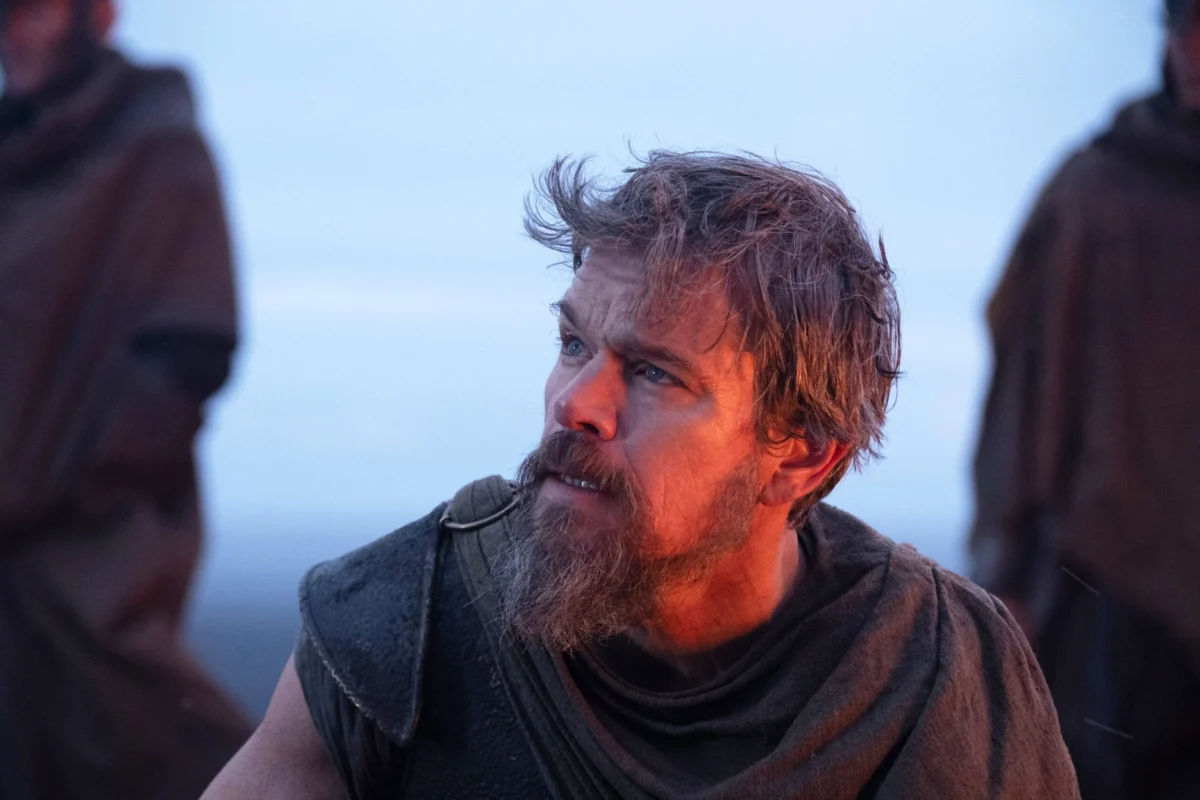
In the landscape of modern cinema, few filmmakers possess the audacity to tackle the foundational texts of Western literature. Yet, Christopher Nolan, the architect of Inception and Oppenheimer, has set his sights on the ultimate endurance test: Homer’s The Odyssey. With a sprawling, multi-generational cast and a signature non-linear narrative structure, Nolan’s adaptation is not merely a retelling—it is a deconstruction of memory, trauma, and the crushing weight of divine expectation.
Clocking in at nearly three hours, the film eschews the traditional chronological retelling of Odysseus’s return to Ithaca. Instead, Nolan opts for a framing device rooted in the ancient tradition of oral storytelling. The narrative is filtered through the eyes of a bard—portrayed by musician Travis Scott—who weaves together the fragmented recollections of the titular hero, played with weathered intensity by Matt Damon. As Odysseus reflects on his decadelong homecoming, the audience is thrust into a labyrinth of shifting timelines, mythic beasts, and the brutal reality of a soldier returning to a home that has fundamentally changed.
The Genesis of Conflict: The Trojan War
To understand the scope of Nolan’s vision, one must first look at the prologue that sets the stage for the carnage. Before the sea claimed his fleet, Odysseus was the King of Ithaca, a ruler defined by his adherence to the laws of Zeus. His palace was a sanctuary where hospitality was paramount, and his mastery of his own great bow served as a symbol of his singular authority.
However, the peace was shattered by the abduction of Helen (Lupita Nyong’o), the Queen of Sparta, by Prince Paris of Troy. This catalyst mobilized King Menelaus (Jon Bernthal) and his brother, the High King Agamemnon (Benny Safdie), into a brutal, decade-long siege. Nolan characterizes this conflict not as a romantic crusade, but as a grueling attrition.
Crucially, the film highlights the internal politics of the Greek army. Before departing for Troy, Odysseus institutes a lottery for his soldiers, a move that introduces the character of Sinon (Elliot Page) and his rival, Antinous (Robert Pattinson). By weaving the fate of these men into the pre-war narrative, Nolan establishes the moral debt Odysseus carries—a weight that eventually forces him into the underworld. The climax of the Trojan arc, the invention of the wooden horse, is presented as a masterstroke of psychological warfare, culminating in the tragic betrayal of Sinon, who is sacrificed by the Trojans, unaware that he was a pawn in Odysseus’s larger strategy.
The Odyssey: A Chronology of Divine Retribution
The second act of the film chronicles the harrowing journey home—a path fraught with the intervention of vengeful deities. The desecration of Zeus’s laws during the sacking of Troy leaves the Ithacan fleet vulnerable to the wrath of Poseidon.
The Trials of the Sea
Odysseus’s journey is a catalog of mythic encounters, each rendered with Nolan’s trademark focus on tactile, grounded spectacle. The encounter with the cyclops Polyphemus (Bill Irwin) is treated as a turning point in the hero’s sanity. By blinding the son of Poseidon, Odysseus cements his fate as an outcast.
Following the decimation of his fleet by the Laestrygonian giants, the survivors wash upon the shores of Aeaea. The sorceress Circe (Samantha Morton) serves as a psychological mirror, transforming his men into swine—a metaphor for the loss of humanity that accompanies prolonged warfare. Her instruction to seek the prophet Tiresias (James Remar) in the underworld serves as the film’s narrative pivot, where the ghost of Sinon confronts Odysseus, demanding retribution for his betrayal.
The Prophecy and the Sacrifice
In the underworld, the film deepens its exploration of regret. Agamemnon’s warning to Odysseus—a cautionary tale of his own homecoming and subsequent murder by his wife, Clytemnestra (also played by Nyong’o)—serves as a harbinger of the paranoia that will plague Odysseus upon his return.
The subsequent challenges—the sirens, the whirlpool Charybdis, and the monster Scylla—are presented as a series of impossible choices. Nolan emphasizes the hero’s hubris: Odysseus’s attempt to circumvent the prophecy by withholding information from his crew. The tragedy of the cattle of Apollo is the ultimate breaking point, leading to the destruction of the final ship and the loss of all men, leaving Odysseus a sole survivor adrift in the Mediterranean.
The Lotus and the Exile
The seven-year interlude on Ogygia with Calypso (Charlize Theron) represents the film’s most meditative segment. Here, the lotus flowers serve as a pharmacological anchor, trapping Odysseus in a state of amnesia. It is only when the hero confronts his repressed trauma—the acknowledgment that his reluctance to return stems from his own guilt regarding the war—that he is able to break the cycle and return to his kingdom.
Supporting Data: The Anatomy of a Mythic Adaptation
The film’s production notes reveal an obsessive commitment to the "oral tradition" aesthetic. By utilizing a bard as the primary narrator, Nolan justifies the subjective nature of the film’s timeline.
| Character | Portrayed By | Narrative Significance |
|---|---|---|
| Odysseus | Matt Damon | The embodiment of post-war PTSD and strategic hubris. |
| Penelope | Anne Hathaway | The stabilizing force of Ithaca; a mirror to Odysseus’s growth. |
| Antinous | Robert Pattinson | The antagonist representing the rot within Ithaca’s walls. |
| Calypso | Charlize Theron | The orchestrator of the hero’s final psychological breakthrough. |
The technical approach to the film also marks a departure for Nolan. While he remains committed to practical effects—as seen in the rendering of the cyclops and the storms—the film employs a color-grading shift between the "memory" of Troy (saturated, chaotic) and the "reality" of the return to Ithaca (muted, cold, and claustrophobic).
Official Responses and Creative Intent
In a recent roundtable discussion, Nolan addressed the decision to cast Travis Scott as the bard. "We wanted a voice that felt ancient yet contemporary," Nolan noted. "The bard acts as the bridge between the audience and the myth. By having him recount the story, we allow for the inconsistencies and exaggerations that define the epic genre."
Critics have pointed to the film’s pacing as a potential point of contention, specifically the deliberate, slow-burn tension of the final act in Ithaca. However, the production team maintains that the weight of the film is necessary to reflect the exhaustion of the characters. The collaboration between the screenwriters and classicists was intended to strip away the "storybook" veneer of the Odyssey to reveal the raw, human consequences of prolonged conflict.
Implications: The Hero’s Final Voyage
The conclusion of the film serves as a subversion of the typical "hero’s homecoming." After successfully infiltrating his own palace, dealing with the suitors, and reuniting with Penelope, Odysseus is not granted a peaceful retirement.
Instead, the final act emphasizes the burden of leadership and the lingering trauma of war. By killing Antinous in Sinon’s name, Odysseus attempts to achieve a form of closure, yet the film’s final imagery suggests otherwise. As Telemachus is crowned King of Ithaca, Odysseus prepares for a final voyage into the West.
In mythology, the West is the direction of the setting sun and, by extension, the land of the dead. For Nolan’s Odysseus, this is not a retreat, but an act of penance. The implications are profound: the hero’s journey does not end with a return home, but with the realization that the man who left for Troy never truly came back. The Odyssey remains a harrowing look at the cost of victory, suggesting that the most difficult battle is not against monsters or gods, but against the memories that refuse to let the soldier rest.
Through this ambitious adaptation, Christopher Nolan has successfully transformed an ancient poem into a modern reflection on the cyclical nature of human violence and the elusive nature of peace. It is, quite literally, one hell of a journey.










