

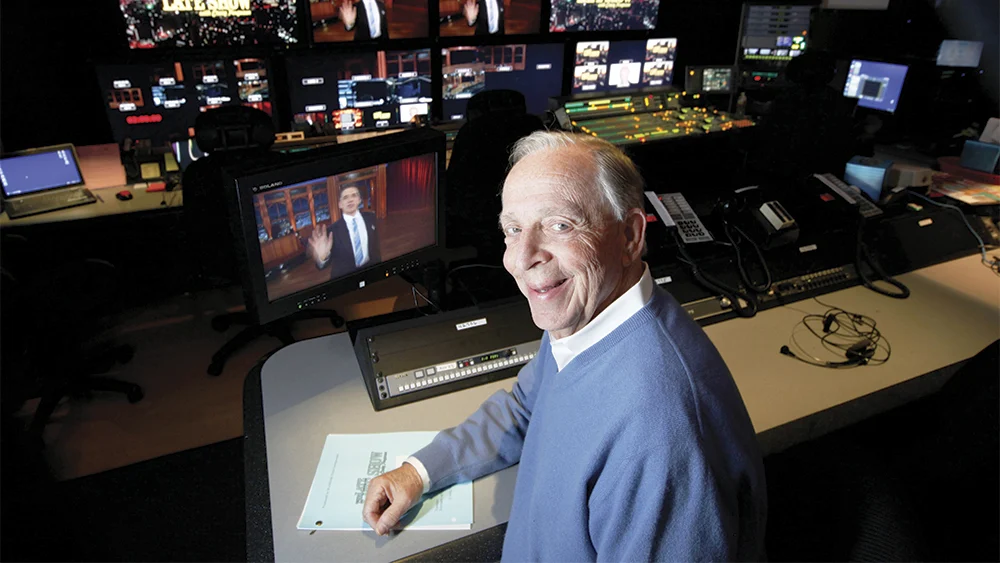
Peter Lassally, a titan of television who defined the rhythm, tone, and evolution of American late-night talk shows for over half a century, has passed away at the age of 93. Known affectionately throughout the industry as the “Host Whisperer,” Lassally served as the steady, behind-the-scenes hand guiding the most iconic figures in the genre—from the legendary Johnny Carson to the sharp-witted David Letterman and the irreverent Craig Ferguson. His death marks the end of a foundational era in television, leaving behind a legacy that transformed the way millions of Americans end their days.
The Man Behind the Curtain: A Life of Resilience
Born in Hamburg, Germany, in 1932, Lassally’s life began in the shadow of historical trauma. As a Jewish child during the rise of the Third Reich, his family fled to the Netherlands. There, the young Lassally experienced the unimaginable horrors of the Holocaust, eventually being imprisoned at the Westerbork transit camp and later the Theresienstadt concentration camp. During his time in the Netherlands, his sister even attended school with Anne Frank.
After surviving the war, Lassally and his family immigrated to New York in 1947. This harrowing childhood—marked by survival, displacement, and an intimate acquaintance with the extremes of human behavior—is often cited by colleagues as the source of his profound empathy and his "ego-less" approach to production. He arrived in America with nothing, yet he would go on to build an empire of laughter.
Chronology: A Career Built on Television History
Lassally’s entry into the entertainment industry was as humble as it was fortuitous. At the age of 19, he joined the NBC page program. During those early days, he worked as an usher at Radio City Music Hall, where he formed a lifelong friendship with a young Regis Philbin. He cut his teeth in radio before transitioning to television on the popular Arthur Godfrey program, a role that sharpened his understanding of the medium’s intimacy.
The Carson Era
In the 1970s, Lassally joined The Tonight Show Starring Johnny Carson. It was here that he cemented his reputation as a master producer. He served as an executive producer through the peak of Carson’s influence, helping to refine the monologue, the desk banter, and the guest selection process that made Carson the undisputed king of late night. Lassally remained a steadfast advisor to Carson until the host’s retirement in 1992.
The Letterman Transition
The post-Carson landscape was a period of immense industry tension. When David Letterman—who had long assumed he would inherit the Tonight Show desk—was passed over for the gig in favor of Jay Leno, the late-night landscape was primed for a seismic shift. Lassally, demonstrating his uncanny ability to navigate corporate politics, became the primary architect of Letterman’s departure from NBC. By joining Letterman’s Worldwide Pants production shingle, Lassally was instrumental in the high-stakes gamble of launching a brand-new franchise, the Late Show, on CBS. This move effectively split the late-night audience and created a competitive, high-quality environment that pushed the entire genre forward.
The Late-Night Outpost
Lassally’s genius was not limited to the flagship hour. Through Worldwide Pants, he helped program the 12:37 a.m. slot, serving as executive producer for Tom Snyder’s The Late Late Show. After a period of semi-retirement following Craig Kilborn’s tenure, Lassally returned to the helm in 2005 to mentor a relatively unknown Scottish comedian named Craig Ferguson. Recognizing a unique, unpolished talent in Ferguson, Lassally helped transform him into a critically acclaimed host, fostering a format that prioritized experimental, surreal, and deeply personal television.
Supporting Data: The Craft of "Surgical Precision"
Lassally’s methodology was distinct from the typical bombastic personality of television executives. Nina Tassler, the former CBS Entertainment chairman, famously described him in a 2015 Variety profile as the "strong, silent type."
"He’s kind of ego-less," Tassler noted. "There’s a comfort he derives from not wanting or needing to be in the spotlight."
His approach was marked by:
- Surgical Diagnosis: He possessed an innate ability to identify why a segment was failing or why a host wasn’t connecting with the audience, addressing these issues with quiet efficiency.
- Talent Nurturing: Unlike producers who sought to mold talent into a specific, pre-existing image, Lassally’s gift was in identifying what made a performer unique and honing that specific "extraordinary talent" to be its most effective version.
- Consistency: Whether it was his daily habit of eating a sliced apple or his patient demeanor during high-pressure production crises, Lassally provided a sense of calm that allowed creative teams to take risks.
Over the course of his career, his efforts were recognized with two Emmy Awards, though his true impact was measured in the success of the shows he helmed and the generations of producers he mentored.
Official Responses and Reflections
The outpouring of grief from the entertainment community highlights the vacuum his passing leaves. Michael Naidus, who worked alongside Lassally as a showrunner on Ferguson’s Late Late Show, offered a poignant tribute:
"Peter had two loves in his life that lasted more than a half-century, the first with his lovely wife, Alice, and the second with the world of talk television," Naidus said. "Each of those love affairs was a two-way street. Quite literally, hundreds of millions of people owe their late-night smiles and laughs to this beautiful soul, whose gift for finding extraordinary talent and honing it is unmatched and unrivaled."
Naidus added a sentiment that captured the essence of Lassally’s influence on his staff: "Whatever little I gave to the format is because he was kind and patient enough to teach it to me. It’s traditional to say ‘he will be missed’ in these circumstances, but the truth is Peter was and is irreplaceable."
The Implications: A Legacy of "Late Night"
The passing of Peter Lassally serves as a poignant reminder of the "human element" in television. In an age of algorithmic content and data-driven programming, Lassally’s career stands as a testament to the power of intuition and personal connection. He was a bridge between the golden age of broadcast radio/television and the modern, fragmented digital landscape.
His influence extends far beyond the credits on a screen. By helping to create the Late Show on CBS, he helped secure a long-term home for the late-night format, a franchise that continued to thrive under Stephen Colbert. By championing Craig Ferguson, he proved that a "unique outpost" could thrive in the shadow of major talk-show giants.
Lassally retired in 2015, just as James Corden prepared to take over the Late Late Show. Even in his departure, he left the industry in better shape than he found it, having mentored dozens of producers, writers, and hosts who continue to shape the industry today.
He is survived by his daughter, Andrea Gibbin; his son, Tom Lassally; and four grandchildren. While his passing marks the end of an era, the "host whisperer" leaves behind a blueprint for excellence, kindness, and humility that will continue to guide the next generation of television makers. He may have avoided the spotlight in life, but his influence remains the light that continues to illuminate the late-night screen.










