

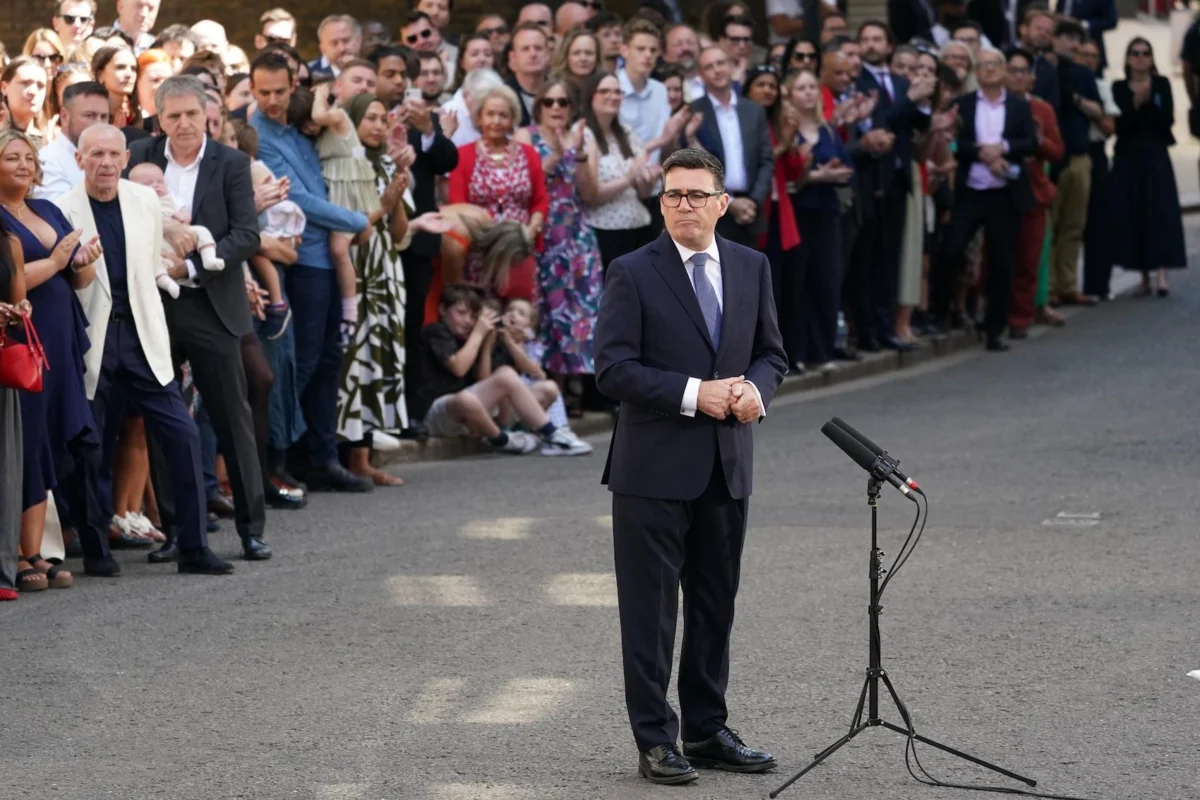
TOKYO/LONDON – The geopolitical landscape of the Northern Hemisphere underwent a significant shift this week as Andy Burnham, the former Mayor of Greater Manchester, officially assumed the office of Prime Minister of the United Kingdom. His inauguration, following a swift leadership transition within the Labour Party, has been met with immediate and strategic outreach from Tokyo. Japanese Prime Minister Sanae Takaichi has signaled a desire to accelerate the existing "global strategic partnership" between the two island nations, underscoring the vital role the UK plays in Japan’s vision for a stable Indo-Pacific.
The Dawn of the Burnham Era: A Summary of Events
The transition of power in London follows a period of intense political volatility. Prime Minister Burnham ascended to the premiership after securing the leadership of the Labour Party in an uncontested race last Friday. His victory came on the heels of the resignation of his predecessor, Keir Starmer, who stepped down in late June following a catastrophic performance by the Labour Party in the May local elections.
Burnham, a seasoned political figure known for his "robust leadership" during his tenure as the Mayor of Greater Manchester, brings a focus on public service reform and regional devolution to the national stage. His return to Westminster, solidified by a decisive by-election win in June, marks a pivot point for a British government seeking to redefine its international standing in the post-Brexit era.
Prime Minister Takaichi, quick to recognize the importance of the new administration, took to the social media platform X on Monday evening. In a message directed at the new British leader, Takaichi expressed her anticipation for a deepened bilateral relationship, emphasizing that the two nations are "enhanced global strategic partners" prepared to collaborate across a wide range of economic, defense, and technological fields.
Chronology: From Election Defeat to 10 Downing Street
The path to the current Anglo-Japanese diplomatic outreach is marked by a rapid sequence of domestic British events that necessitated a high-stakes transition:
- May: The Labour Party suffers a historic defeat in local elections, prompting widespread internal calls for a change in party direction.
- Late June: Keir Starmer announces his resignation as party leader and Prime Minister, citing the need for new leadership to address the party’s electoral woes.
- June (Late): Andy Burnham, capitalizing on his reputation for effective governance in the north of England, wins a critical by-election, securing his seat back in the House of Commons.
- Friday: Following the closure of the leadership race, in which he stood as the sole candidate, Burnham is officially declared the new leader of the Labour Party.
- Monday: Andy Burnham is formally inaugurated as Prime Minister of the United Kingdom.
- Monday Evening: Prime Minister Sanae Takaichi issues a formal statement via X, welcoming Burnham and calling for a deepening of bilateral ties.
- Tuesday: Chief Cabinet Secretary Minoru Kihara hosts a press conference in Tokyo, outlining Japan’s expectations for the new British administration.
The Indo-Pacific Strategy and Global Security
The core of the burgeoning partnership between Tokyo and London rests on the "Free and Open Indo-Pacific" (FOIP) vision. On Tuesday, Chief Cabinet Secretary Minoru Kihara—the Japanese government’s top spokesman—elaborated on how Japan views the incoming Burnham administration as a critical ally in maintaining regional order.
Countering Regional Hegemony
The FOIP vision is widely interpreted by geopolitical analysts as a strategic framework designed to balance the growing economic and military influence of the People’s Republic of China. Japan, concerned by increased naval activity in the East and South China Seas, has long sought to internationalize its security posture. By aligning closely with the United Kingdom, Japan is not only bolstering its own defense capabilities but is also encouraging a greater European "tilt" toward the Indo-Pacific.
The GCAP Initiative: A Technological Imperative
Perhaps the most tangible manifestation of this partnership is the Global Combat Air Programme (GCAP). This trilateral project, which includes Japan, the United Kingdom, and Italy, aims to develop a next-generation fighter jet by 2035.
Chief Cabinet Secretary Kihara reiterated on Tuesday that the Japanese government remains fully committed to this joint venture. The project represents more than just a military procurement contract; it is a long-term industrial and diplomatic tether. By integrating the supply chains and engineering expertise of three major economies, the GCAP ensures that the UK and Japan remain permanently linked in the development of cutting-edge aerospace technology, effectively insulating the program from minor political fluctuations in either capital.
Supporting Data: Why the UK-Japan Bond Matters
The relationship between Tokyo and London is underpinned by substantial economic and strategic data points that necessitate continued cooperation:
- Trade Connectivity: The UK-Japan Comprehensive Economic Partnership Agreement (CEPA) provides the legal framework for billions in annual trade, spanning automotive, pharmaceutical, and financial services.
- Investment Flows: Japan remains one of the largest foreign investors in the United Kingdom, with major Japanese firms (including Toyota, Nissan, and Hitachi) maintaining significant manufacturing footprints in British territory.
- Defense Spending: Under recent guidelines, both nations have signaled an intent to increase defense spending as a percentage of GDP, aligning their long-term security objectives in a way that was unthinkable a decade ago.
- Diplomatic Alignment: The two nations consistently vote in tandem on major G7 policy initiatives, particularly regarding the war in Ukraine and the management of global supply chains.
Official Responses and Diplomatic Implications
The rhetoric emanating from Tokyo this week has been carefully calibrated to signal continuity and ambition. By emphasizing Burnham’s "strong track record" in Manchester, Prime Minister Takaichi is attempting to build personal rapport with a leader whose background is rooted in local government and pragmatic problem-solving rather than purely traditional Whitehall politics.
The "Robust Leadership" Expectation
Takaichi’s characterization of Burnham’s leadership as "robust" serves a dual purpose. Domestically, it reassures the Japanese public that the UK remains a stable and predictable partner despite the recent turmoil in British politics. Internationally, it signals to other G7 nations that Japan expects the UK to remain a proactive player on the world stage, resisting the temptation of isolationism.
The Challenge of the Transition
However, the path forward is not without challenges. Prime Minister Burnham inherits a British economy grappling with stagnant growth and the lingering effects of the post-pandemic inflationary environment. His ability to prioritize international security and defense procurement—such as the GCAP program—will depend heavily on his success in addressing domestic budgetary constraints.
Tokyo is keenly aware that while the strategic alignment is strong, the "political bandwidth" of the new British government will be initially consumed by domestic issues. Therefore, the Japanese diplomatic strategy is currently focused on "institutionalizing" the relationship, ensuring that the working-level ties between ministries—particularly defense and trade—remain unaffected by the change in the Prime Minister’s office.
Conclusion: Looking Toward 2035 and Beyond
As the international community watches the new British administration settle into its responsibilities, the message from Tokyo is clear: the partnership between Japan and the United Kingdom is a cornerstone of the post-2020s geopolitical architecture.
Whether it is the realization of a secure and stable Indo-Pacific or the ambitious collaborative engineering required for the 2035 fighter jet program, the two nations have signaled a mutual dependency that transcends the individual political careers of their leaders. Prime Minister Takaichi’s swift engagement with Prime Minister Burnham marks not just a greeting between two heads of state, but a firm commitment to a strategic vision that will define the security and economic landscape for the next decade.
For the Japanese government, the arrival of Andy Burnham is not seen as a period of uncertainty, but as an opportunity to cement a partnership that is as vital to London as it is to Tokyo. As the diplomatic calendar continues, the world will be observing how this "enhanced global strategic partnership" navigates the complex challenges of the 21st century.











