

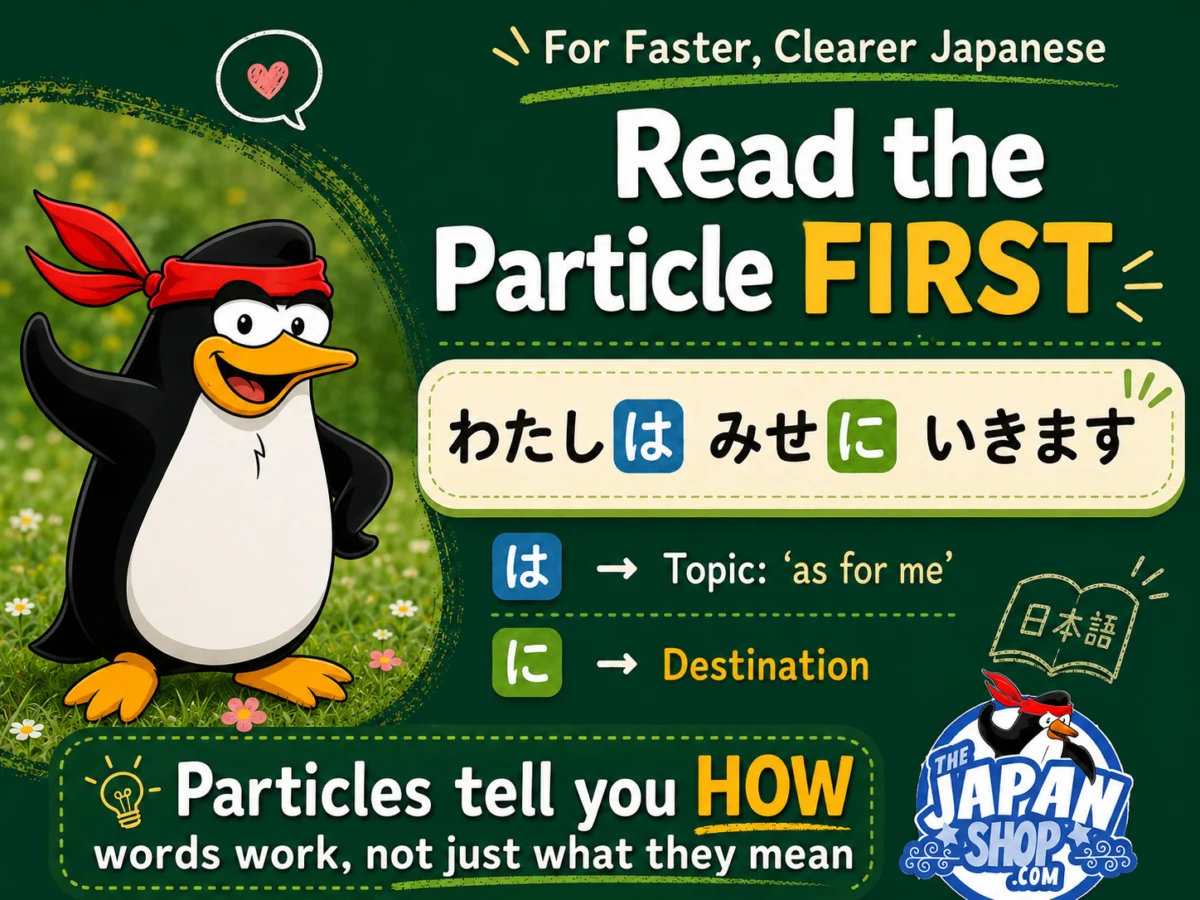
In the landscape of Japanese language acquisition, the barrier to fluency is rarely the vocabulary itself. Instead, it is the invisible, structural glue that holds the language together: particles (joshi). While many students treat these as secondary suffixes to be memorized after learning nouns and verbs, the most effective path to mastery involves a radical shift in perspective. To truly grasp the nuance of Japanese, one must learn to view the language "particle-first."
The Anatomy of Nuance: Why Particles Matter
To understand the profound impact of particles, consider a simple reflection on a day well-spent. In Japanese, the difference between a neutral observation and a joyous, consistent state of being can hinge on a single character.
Take the sentence: Kyou mo tanoshikatta (今日楽しかった). This translates roughly to "Today, too, was fun." The particle mo (も) acts as an additive, implying that yesterday was fun, the day before was fun, and the trend is likely to continue. It suggests a state of sustained happiness—a "dog-level enlightenment," as many enthusiasts put it—where the subject is living in a state of consistent joy.
Contrast this with: Kyou wa tanoshikatta (今日は楽しかった). By replacing mo with the topic marker wa (は), the emotional weight shifts entirely. "As for today, it was fun." This sentence subtly isolates the day, creating a contrastive effect that implies other days might not have been as pleasant.
This is not merely a grammatical technicality; it is a fundamental difference in worldview. The particle dictates the relationship between the speaker and the reality they are describing. Understanding this distinction is the difference between translating words and understanding intent.
The Chronology of Learning: From Rote to Intuition
The traditional pedagogical approach to Japanese often mirrors the structure of English: prioritize the subject, then the object, then the action. However, because Japanese is a head-final language where the verb—the engine of the sentence—always comes last, this "subject-first" approach often leads to cognitive fatigue.
The Developmental Arc of a Language Learner
- The Novice Phase (Vocabulary Acquisition): The learner focuses on discrete nouns and verbs. They see mise (store) and iku (to go) and attempt to bridge them with English logic.
- The Intermediate Pivot (The Particle Realization): The learner realizes that nouns are essentially "floating" until a particle attaches to them. They begin to see that a word’s role—whether it is the agent, the destination, or the recipient—is defined only by the particle that follows it.
- The Fluent Integration (The Particle-First Mindset): The learner stops translating word-for-word. They train their brain to process the function (the particle) before they even fully register the noun. This allows the brain to prepare for the type of information that is coming next.
Supporting Data: The Cognitive Efficiency of Function-First Parsing
Linguistic research into how the brain processes Japanese supports the "particle-first" methodology. When a listener or reader encounters a particle, their brain immediately receives a set of instructions regarding the grammatical landscape.
For instance, if one encounters the particle ni (に), the brain instinctively knows to look for a destination or a point in time. If one encounters ga (が), the brain knows a subject is being identified. By processing the particle first, the reader reduces the amount of "re-parsing"—the act of going back to the beginning of a sentence to figure out who did what to whom after reaching the verb at the end.
Case Study: Parsing "Mise e ikimasu"
Consider the sentence: Mise e ikimasu (店へ行きます – I will go to the store).
- Traditional Approach: "Mise… okay, that’s store. E… okay, that’s a particle. Ikimasu… go. So, store to go."
- Particle-First Approach:
- Mise + e (Target/Direction) = Destination established.
- Ikimasu (Verb) = Motion toward that destination.
By identifying the function first, the brain builds a scaffolding. When the verb finally arrives, the information simply slides into the pre-constructed slot. This reduces cognitive load, increases reading speed, and creates a smoother transition into listening comprehension.
Official Perspectives: The Rhythm of Native Speech
Language experts and educators often point to a "hidden" rhythm in Japanese that is frequently overlooked by foreigners: the native pause.
In English, we tend to pause at the end of logical thought groups or after nouns. In Japanese, native speakers naturally pause after particles. These particles act as structural "breathing points" in a sentence. When a speaker says Kyou wa (pause), mise ni (pause), ikimasu, they are creating a rhythmic delivery that helps both the speaker and the listener organize the data.
By training oneself to listen for these pauses, the learner can mimic the cadence of a native speaker, significantly improving their oral fluidity. The particle, in this sense, is not just a grammatical marker; it is the metronome of the Japanese language.
Implications for Global Communication
The implications of mastering particles extend beyond mere test scores or classroom performance. It facilitates a deeper cultural empathy. Because particles encode the relationship between the speaker and the subject—whether through contrast, addition, or specific focus—using them correctly is a way of showing respect for the complexity of Japanese social and logical structures.
For the international business person, the student of literature, or the casual traveler, the "particle-first" mindset offers a path to genuine clarity. It removes the guesswork that leads to "translationese"—that clunky, unnatural way of speaking that signals an outsider.
Strategies for Adoption
To transition to this mindset, learners should practice the following techniques:
- The Particle Scan: When reading, force your eyes to identify the particle before the noun. If you see wa, ga, ni, or o, acknowledge the role of the preceding word immediately.
- Rhythmic Reading: Read aloud, specifically pausing after every particle. This will feel awkward at first, but it will eventually mirror the natural cadence of the language.
- Contextual Comparison: Whenever you learn a new particle, compare it to its peers. Ask yourself: "How does wa change the meaning compared to ga?" "What does mo add that wa does not?"
Conclusion
The path to Japanese fluency is paved with these tiny, seemingly insignificant particles. While they may seem like a burden at the start, they are actually the most efficient tool in the learner’s arsenal. They are the keys that unlock the true meaning of a sentence, the map that guides the brain through complex grammar, and the rhythm that defines a native speaker’s voice.
By shifting your focus from the "what" (the vocabulary) to the "how" (the particles), you transform the way you interact with the language. You stop fighting the structure and start working with it. After all, the difference between a good day and a consistently good day—or the difference between a language student and a language master—often comes down to one tiny, deliberate choice. Start with the particle, and the rest of the sentence will follow.











