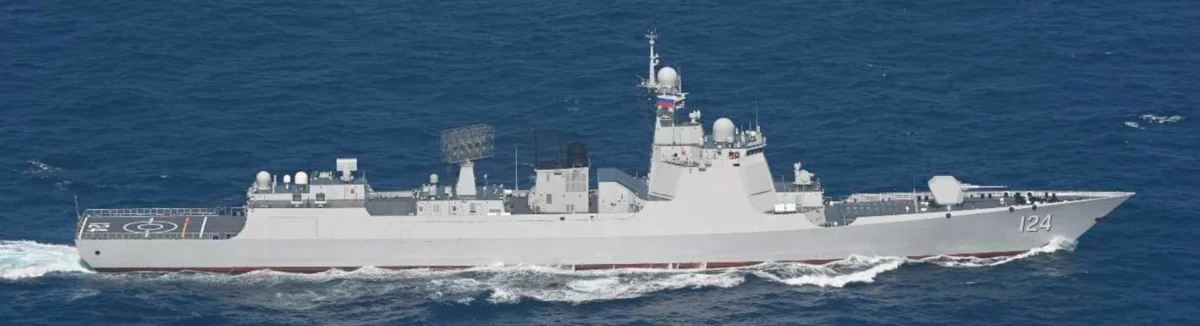
TOKYO – The strategic landscape of the Indo-Pacific has shifted into a more precarious phase this week as Japan formally lodged protests against Beijing following a provocative series of live-fire naval exercises conducted by a Chinese guided-missile destroyer within Japan’s Exclusive Economic Zone (EEZ). The incident, which occurred off the remote island of Okinotori, marks a significant escalation in the increasingly synchronized military posturing between China and Russia near Japanese waters.
The Incident: A Breach of Maritime Norms
On Sunday, the Japanese Joint Staff reported that a Luyang III-class guided-missile destroyer—a formidable asset in the People’s Liberation Army Navy (PLAN)—engaged in live-fire maneuvers approximately 180 kilometers (110 miles) southwest of Okinotori. The drill was not an isolated event; it occurred shortly after Japanese Maritime Self-Defense Force (JMSDF) vessels identified the destroyer operating in tandem with two additional Chinese warships and a Russian frigate.
The timing and location of these drills have drawn sharp rebukes from Tokyo. While the exercises took place outside of Japan’s immediate territorial waters, they occurred within the nation’s EEZ, an area where Japan maintains sovereign rights over the exploration and exploitation of marine resources. The Japanese government noted that while a notice was provided to nearby vessels shortly before the firing commenced, the sudden nature of the drill posed a clear safety risk to commercial and civilian traffic in the region.
Chronology of Escalation
To understand the gravity of the weekend’s events, one must look at the broader timeline of naval activity in the Philippine Sea and surrounding waters:
- Early July: China announced the conclusion of joint naval exercises with Russia, claiming the maneuvers were focused on regional stability.
- Mid-July: A fleet comprising four Chinese and Russian vessels was tracked sailing southward through the critical maritime corridor between the Japanese islands of Okinawa and Miyako.
- Late July: The fleet continued its trajectory into the Pacific, eventually positioning itself near Okinotori.
- Sunday: The Luyang III-class destroyer initiated live-fire drills, marking the first time the Japanese Joint Staff has publicly disclosed such an event within its EEZ.
- Tuesday: Chief Cabinet Secretary Minoru Kihara and other senior Japanese officials held emergency briefings to address the threat and reaffirm Japan’s commitment to surveillance and airspace integrity.
Official Responses: A Clash of Perspectives
The diplomatic fallout has been immediate. Chief Cabinet Secretary Minoru Kihara was firm during a Tuesday press conference, characterizing the maneuvers as a source of "grave concern." Kihara emphasized that the government is operating under a posture of heightened vigilance, stating, "We will continue to watch China-Russia operations around Japan with concern, while doing utmost for the warning and surveillance of the Japanese airspace and territorial waters."
Japan’s Defense Minister, Shinjiro Koizumi, speaking from London, contextualized the incident as part of a larger trend. Koizumi pointed to a disturbing pattern of cooperation, including the recent ballistic missile launch from a Chinese submarine and at least 10 instances of joint aerial patrols involving Chinese and Russian bombers circumnavigating the Japanese archipelago.
Beijing, however, has dismissed these concerns as "groundless speculation." Chinese Defense Ministry spokesperson Jiang Bin issued a statement late last week, framing the military cooperation as a necessary measure for safeguarding national sovereignty. "We hope that relevant parties can view China-Russia military cooperation objectively and rationally, and stop making groundless speculation and cease smearing and hyping," Jiang stated.
Adding a layer of legal complexity to the dispute, Beijing has long contested Japan’s classification of Okinotori. China maintains that the landmass is an "atoll" rather than an "island," and therefore does not entitle Japan to the surrounding EEZ. By conducting exercises in these waters, China is not only testing Japan’s military response but also asserting its own interpretation of maritime geography.
Strategic Implications: The "Sino-Russian" Nexus
The joint operation of Chinese and Russian naval assets is no longer a theoretical concern for Tokyo; it is a recurring reality. The implications of this partnership are profound, suggesting a concerted effort by both Moscow and Beijing to challenge the post-World War II security architecture in the Pacific.
The Expansion of the PLA Navy
For years, Japan has been alarmed by the rapid blue-water expansion of the Chinese Navy. The sight of two Chinese aircraft carriers operating simultaneously near the island of Iwo Jima last year served as a wake-up call to the Japanese defense establishment. Beijing’s ability to project power far beyond its littoral borders—and into the deep Pacific—is viewed in Tokyo as an attempt to establish a "second island chain" defensive perimeter, effectively pushing U.S. and Japanese influence back.
The Russia Factor
Russia’s inclusion in these drills adds a layer of global geopolitical friction. Moscow, seeking to pivot toward Asia amidst its ongoing conflict in Ukraine, has found a willing partner in Beijing. For Japan, this "two-front" pressure—facing a modernized Chinese fleet and a Russian navy that remains highly capable in undersea and missile warfare—requires a fundamental rethink of its defense spending and maritime strategy.
Domestic and Regional Security Concerns
Japan is currently in the midst of a historic shift in its defense posture. Moving away from a strictly pacifist, defensive-only doctrine, the government of Prime Minister Fumio Kishida has moved to significantly increase defense spending, aiming to reach 2% of GDP by 2027. This move is largely driven by the scenarios being played out this week in the Philippine Sea.
The proximity of these drills to Okinotori is particularly sensitive. As a remote island, its status as a cornerstone of Japan’s EEZ is vital for the nation’s energy security, particularly regarding potential seabed resources. If Japan cannot deter unauthorized military exercises within its EEZ, it risks losing control over the economic and strategic benefits of its vast maritime territory.
The Path Forward: Deterrence and Diplomacy
The incident on Sunday has set a precedent that Japanese authorities find difficult to ignore. While the Joint Staff noted that the live-fire exercises did not technically violate international law—as they took place in international waters within the EEZ—the political and security ramifications are severe.
The international community is watching closely. Japan’s allies, particularly the United States, view the deepening military ties between China and Russia as a direct threat to the "Free and Open Indo-Pacific" (FOIP) vision. With the Japanese defense ministry vowing to increase surveillance and warning activities, the risk of a miscalculation or a tactical error in the air or at sea is higher than it has been in decades.
As China continues to insist that its naval movements are peaceful and routine, the discrepancy between Beijing’s rhetoric and its tactical maneuvers in the Pacific continues to widen. For Japan, the challenge remains clear: maintaining the integrity of its borders and the security of its economic zones in an era where the rules-based international order is being systematically tested.
The coming months will likely see a significant increase in Japanese naval patrols and potentially more frequent joint exercises between Japan and its regional partners, including the United States, Australia, and the Philippines, as Tokyo seeks to balance the scales of power in a region defined increasingly by the shadows of its two largest neighbors.
Reported by the Associated Press. Contributing reporting by Ken Moritsugu from Beijing.
© Copyright 2026 The Associated Press. All rights reserved. This material may not be published, broadcast, rewritten or redistributed without permission.