In the high-stakes arena of artificial intelligence, where the demand for compute power grows exponentially, a singular, wafer-scale vision has emerged as the industry’s most daring disruptor. Cerebras Systems, an AI hardware startup based in Sunnyvale, California, has spent the better part of a decade challenging the established hegemony of traditional GPU architectures. By moving away from the conventional practice of dicing silicon wafers into individual chips, Cerebras has pioneered the Wafer-Scale Engine (WSE)—a massive, singular processor that represents a fundamental shift in how we approach massive-scale machine learning.
The Genesis of the Wafer-Scale Engine: Breaking the Conventional Mold
For decades, the semiconductor industry has operated on the principle of the "reticle limit." Since the inception of modern lithography, silicon wafers have been meticulously sliced into smaller, discrete dies—CPUs, GPUs, and SoCs—to maximize yield and manage the complexity of fabrication. If a single defect occurred on a wafer, it would only ruin a small chip, not the entire substrate.
Cerebras shattered this paradigm by choosing to embrace the entire wafer. Instead of cutting it, they designed a system that treats the entire 300mm wafer as a single, gargantuan processing unit. The logic is simple yet audacious: by keeping the data on a single piece of silicon, they eliminate the "bottleneck of the board." In traditional data centers, AI models are spread across thousands of individual GPUs linked by complex, latency-prone interconnects. The Cerebras WSE, by contrast, keeps the entire neural network resident on a single piece of silicon, communicating at the speed of light within the wafer itself.
A Chronology of Innovation: From WSE-1 to WSE-3
The journey to the current iteration of the Wafer-Scale Engine has been marked by staggering leaps in transistor density and processing capability.
- 2019: The Dawn of WSE-1. When Cerebras unveiled its first-generation engine, the tech world was skeptical. With 1.2 trillion transistors and 400,000 AI-optimized cores, it was unlike anything ever built. It proved that the cooling and power delivery challenges of a massive wafer could indeed be solved.
- 2021: The WSE-2 and the CS-2 System. The second iteration moved to the 7nm process node. This jump allowed Cerebras to pack 2.6 trillion transistors onto the wafer, doubling the core count to 850,000. It cemented the company’s reputation as a serious player for enterprises training massive models like GPT-3.
- 2024: The WSE-3 Era. The latest iteration, built on the 5nm process, features a staggering 4 trillion transistors. It provides 125 petaflops of peak AI performance, marking a near-vertical trajectory in capabilities that rivals the most advanced cluster-based solutions from industry giants like NVIDIA.
Supporting Data: By the Numbers
To understand the scale of the Cerebras WSE-3, one must look at the raw specifications that differentiate it from the standard H100 or Blackwell-based data center architectures:
| Feature | Cerebras WSE-3 |
|---|---|
| Transistor Count | 4 Trillion |
| Process Node | 5nm |
| AI Cores | 900,000 |
| On-Chip Memory | 44GB (SRAM) |
| Memory Bandwidth | 21 Petabytes/s |
| Fabric Bandwidth | 21 Petabytes/s |
The most critical metric here is the memory bandwidth. In standard GPU setups, memory is stored in HBM (High Bandwidth Memory) stacks physically separated from the compute die. This physical distance creates a "memory wall." The Cerebras architecture places the memory directly adjacent to the compute cores (SRAM), effectively removing the latency associated with fetching data from off-chip storage.
The Infrastructure Challenge: Cooling and Power
It is one thing to design a wafer-scale chip; it is quite another to keep it from melting. A 4-trillion-transistor processor generates an immense amount of heat, far exceeding the capabilities of traditional air cooling.
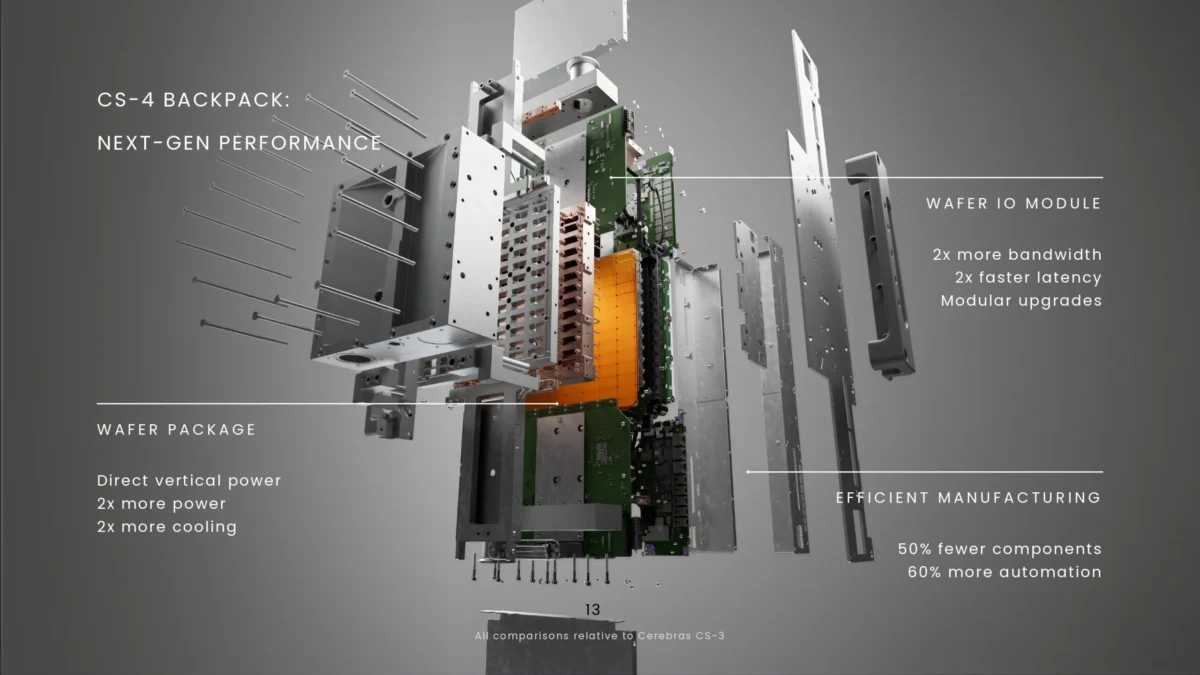
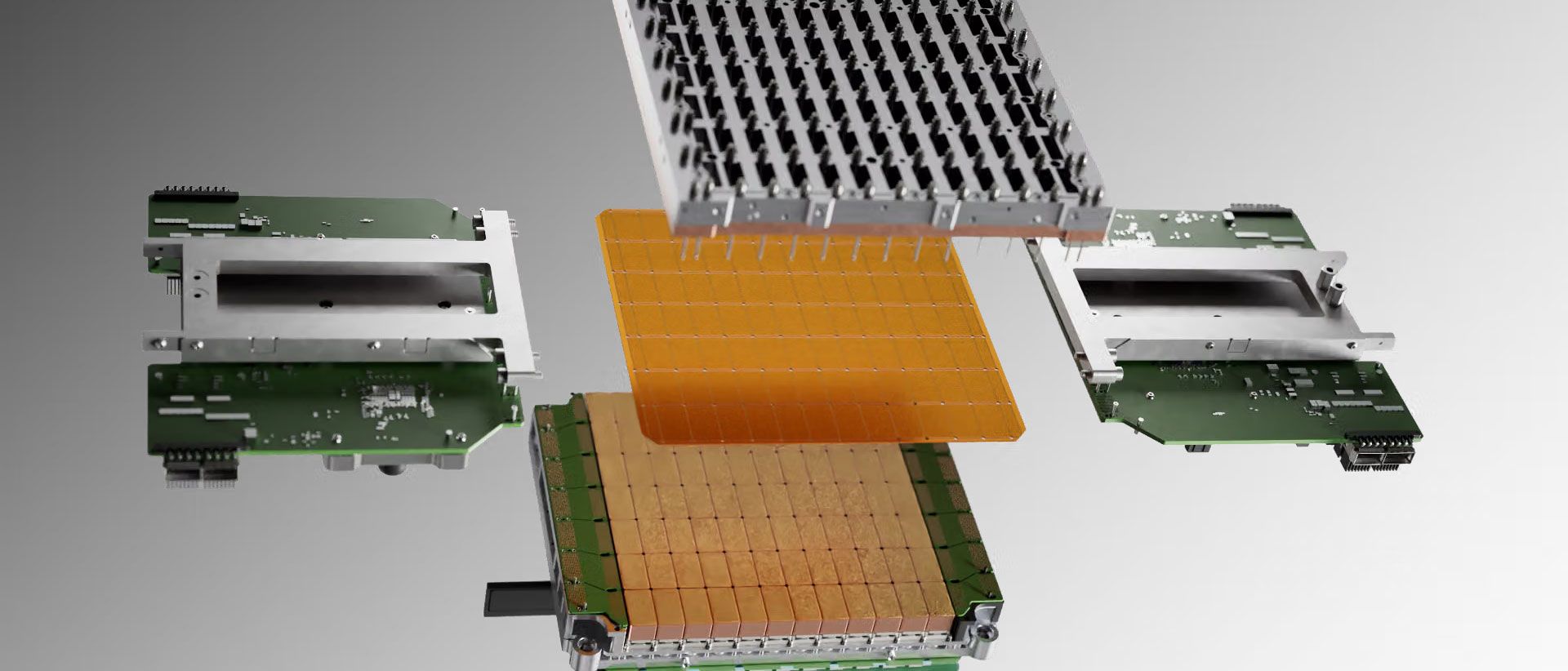
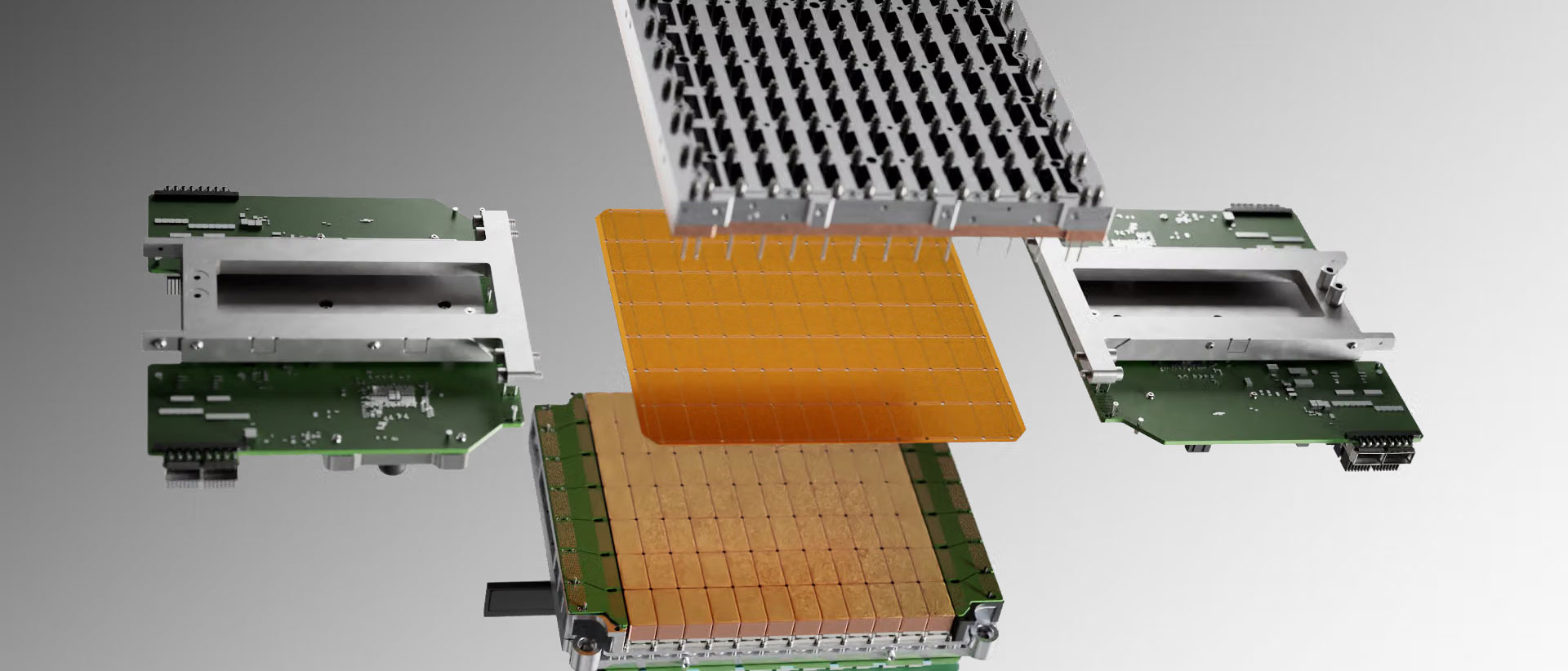
Cerebras engineers developed a custom-designed chassis, the CS-3, which incorporates sophisticated liquid-cooling technology. The system uses a cold plate that sits flush against the back of the wafer, with a proprietary distribution system ensuring uniform thermal management across the entire surface area. This allows the system to operate at high clock speeds without the thermal throttling that would plague a smaller chip under similar workloads.
Furthermore, power delivery is handled through a custom-built power supply unit capable of delivering tens of thousands of amps to the wafer. Managing this level of current requires engineering precision that bridges the gap between traditional IT infrastructure and high-end industrial power distribution.
Official Perspectives and Industry Impact
Cerebras CEO Andrew Feldman has been a vocal critic of the "cluster-first" approach to AI. In various keynote addresses and industry forums, Feldman has argued that the complexity of connecting thousands of GPUs—the software overhead, the networking latency, and the energy inefficiency—is the primary bottleneck preventing the next leap in AI capabilities.
"We are not trying to build a better GPU," Feldman stated during the launch of the WSE-3. "We are trying to build the engine that makes the GPU obsolete for the specific, massive-scale tasks of training foundational models. When you have the memory and the compute on the same fabric, the neural network doesn’t have to wait for the data. It just runs."
Competitors, while largely focusing on interconnected GPU clusters, have acknowledged the technical feat of wafer-scale computing. However, critics point to the "all-your-eggs-in-one-basket" risk. If a single component on a server rack fails, the rest of the cluster keeps running. If a wafer-scale engine has a catastrophic failure, the entire system is effectively offline until it can be serviced or replaced. Cerebras mitigates this through extensive redundancy—if a core on the wafer is defective, it is mapped out and bypassed during the manufacturing and boot process.
Implications for the Future of AI
The implications of Cerebras’ success are far-reaching. As models like GPT-4, Llama-3, and their successors grow, the physical footprint of training them has become a primary constraint. Large AI clusters now consume entire power grids and require specialized data centers.
If Cerebras can continue to scale—moving perhaps to a 2nm process or integrating optical interconnects for even faster communication—they may change the definition of what constitutes a "supercomputer." Instead of needing a warehouse full of GPUs, a company might eventually be able to train an LLM on a single, refrigerator-sized appliance.
Moreover, the software ecosystem is the final frontier. Cerebras has invested heavily in the "Cerebras Software Platform," which allows developers to run standard PyTorch and TensorFlow models on the WSE with minimal modification. By abstracting the complexity of the wafer-scale hardware, they are removing the biggest barrier to adoption: the need for developers to learn custom, low-level programming languages.
Conclusion: A Paradigm Shift in Progress
Cerebras Systems represents the "moonshot" mentality of Silicon Valley. By refusing to accept the traditional constraints of semiconductor design, they have built a system that is fundamentally faster, more efficient, and more elegant than the current industry standard for AI training.
Whether or not they can capture significant market share from the entrenched incumbents remains to be seen. The AI landscape is defined as much by software ecosystems and vendor relationships as it is by raw hardware performance. However, in a world where speed is the only currency that matters, the Wafer-Scale Engine stands as a testament to the idea that sometimes, the only way to move forward is to stop slicing the world into smaller pieces and start seeing the big picture—or in this case, the entire wafer.
As we look toward the future of generative AI and the quest for artificial general intelligence, the technical achievements of Cerebras remind us that we are still in the early innings of computing history. The "reticle limit" was a barrier of our own making, and companies like Cerebras are proving that with enough engineering ingenuity, the only real limits are the ones we choose not to challenge.