Asep Darmawan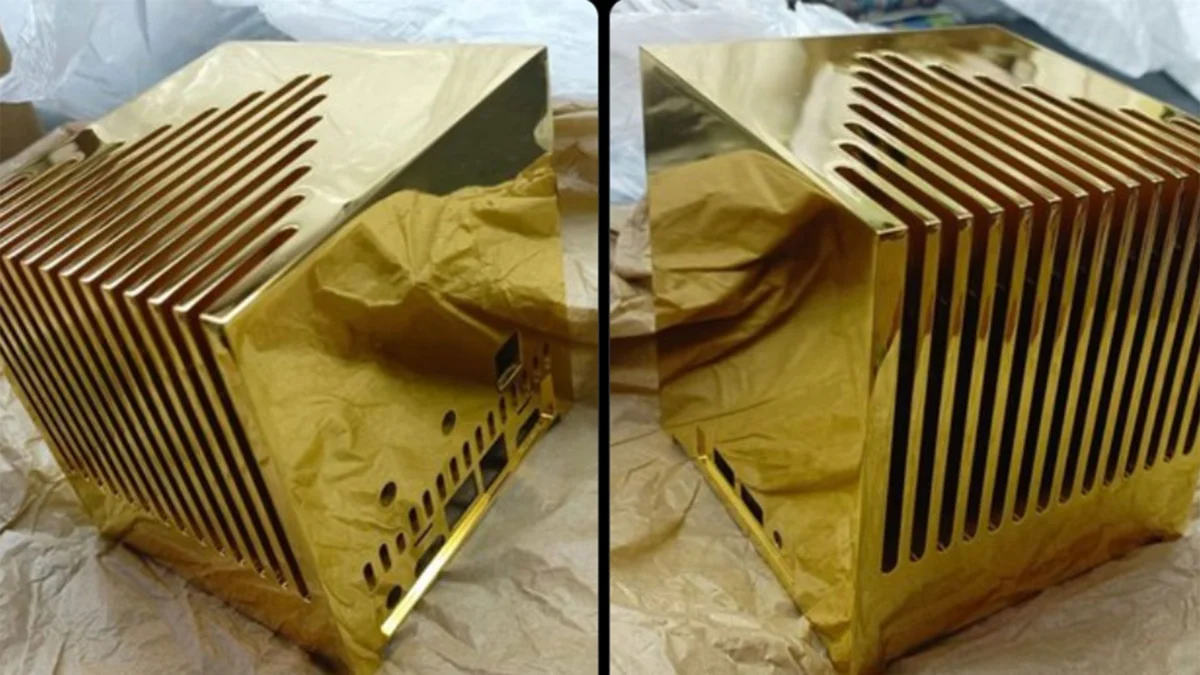
In an era where personal computing is defined by miniaturization, efficiency, and the pursuit of sleek aesthetics, one buyer has taken the concept of "premium" to a level that borders on the geological. A report from Fanless Tech has confirmed that a private collector—a self-described chrysophile, or lover of gold—has commissioned a bespoke version of the Kubb Fanless PC, encased entirely in 24-carat gold.
The resulting machine, a compact cube measuring approximately 120 x 120 x 120mm, serves as a startling intersection of high-end metallurgy and computing hardware. With a price tag hovering around $1.7 million, this device transcends the category of "consumer electronics," positioning itself instead as a functional art piece. While the standard Kubb PC is a boutique item for those seeking silent, reliable performance, this gilded iteration has become a symbol of extreme luxury, pushing the boundaries of what it means to build a personal computer.
The Architecture of Opulence: Main Facts
At its core, the Kubb Fanless PC is celebrated for its minimalist design and silent operation. By utilizing a passive cooling chassis, the system dissipates heat through the structure of the case itself, eliminating the need for noisy, dust-collecting fans.
The standard Kubb chassis is typically crafted from high-grade aluminum, a material chosen for its lightweight nature and its respectable thermal conductivity. However, the client behind this custom commission requested a complete material swap. By substituting aluminum for solid 24-carat gold, the manufacturer had to fundamentally alter the engineering of the chassis.
The weight disparity is perhaps the most visceral indicator of the change. While the standard aluminum model weighs a manageable 2.1 kilograms (4.6 pounds), the gold-encased version tips the scales at a staggering 13 kilograms (28.7 pounds). This density is a direct result of the specific gravity of gold, which is significantly higher than that of the aluminum alloys traditionally used in PC manufacturing. Moving this "mini" PC is no longer a casual task; it is a physical commitment.
A Chronology of Extravagance
The path to this $1.7 million machine was not a simple transaction. According to industry insiders, the project began as an inquiry into custom finishes for the Kubb line. What started as a request for gold-plating quickly evolved into a demand for a chassis forged from pure precious metal.
- Phase I: Consultation and Material Sourcing: The engineering team had to determine if a passive cooling system could function effectively with the specific thermal profile of 24-carat gold. Unlike aluminum, which is ductile but rigid enough for structural integrity, pure gold is exceptionally soft. This necessitated a complex internal framework to ensure the delicate motherboard and components were not crushed under the weight of the gold casing.
- Phase II: Metallurgical Engineering: Because pure gold is too soft to maintain the structural tension required for a precision-fit chassis, the artisans had to develop a proprietary casting method. This allowed the gold to maintain its aesthetic purity while providing the structural support necessary to act as a functional heatsink.
- Phase III: Assembly and Thermal Validation: The final assembly was conducted in a clean-room environment, ensuring that not a single grain of dust or impurity could be trapped between the processor’s heat spreader and the gold chassis. Thermal testing was conducted to ensure that the heat transfer—aided by gold’s superior conductivity—would not damage the precious metal structure over time.
- Phase IV: Delivery: The unit was completed and delivered to the client in late 2026, marking what is believed to be the most expensive desktop PC ever built for a single private user.
The Science of Heat: Why Gold?
Beyond the obvious vanity of the project, there is a legitimate, albeit eccentric, engineering argument for the use of gold. In the world of thermodynamics, materials are judged by their thermal conductivity—their ability to transfer heat away from the CPU and out into the environment.
Aluminum, the industry standard for heatsinks, has a thermal conductivity of approximately 205 W/mK (watts per meter-kelvin). Gold, by contrast, boasts a thermal conductivity of approximately 318 W/mK. This means that, in theory, the gold chassis is significantly more efficient at drawing heat away from the internal components than an aluminum counterpart.
However, the practical benefits are mitigated by the "law of diminishing returns." Because the gold chassis is so dense and acts as a massive thermal reservoir, it takes longer to heat up, but it also takes significantly longer to cool down. In a passive system, the goal is to balance heat dissipation with the surface area of the case. While the gold is a better conductor, the overall cooling performance is largely dictated by the ability of the ambient air to strip heat from the surface of the box. Thus, while the user has paid millions for better conductivity, the actual cooling performance increase is marginal compared to a high-quality aluminum heatsink.
Official Responses and Industry Skepticism
The announcement of the gold Kubb has sparked a fierce debate among hardware enthusiasts. Fanless Tech, the publication that broke the story, noted that while the craftsmanship is undeniable, the utility is questionable.
Industry analysts have expressed a mix of awe and bewilderment. A spokesperson for a major PC hardware manufacturer, speaking on condition of anonymity, remarked: "We see custom paint jobs, custom acrylic panels, and even gold-plated internal connectors all the time. But a solid gold chassis is a different beast. From a manufacturing standpoint, you aren’t building a computer anymore; you’re building a vault. The challenge wasn’t the CPU speed; the challenge was the metallurgy."
The makers of the Kubb, while proud of their ability to execute such a difficult commission, have remained tight-lipped regarding the specific client. They have, however, noted that they are open to "bespoke material requests" for high-net-worth clients, provided the client understands the structural limitations of the materials involved.
Implications for the PC Market
This $1.7 million machine raises interesting questions about the direction of the "luxury" PC market. For years, the industry has focused on RGB lighting, high-frequency RAM, and aggressive industrial design. This project signals a shift toward "material-first" luxury, where the value of the device is derived not from its silicon processing power, but from the raw value of the materials used in its construction.
The Collector’s Market
This purchase signals the entry of the PC into the realm of "blue-chip" collectibles. Just as investors buy vintage Ferraris or rare watches, the gold Kubb represents a trend where functional technology is repurposed as an asset class. The gold itself provides a hedge against inflation, while the custom engineering ensures the item remains a one-of-a-kind artifact.
The Future of Passive Cooling
Ironically, the project highlights the untapped potential of passive cooling. By exploring exotic materials, engineers are reminded that silent, fanless computing is not just for low-power office work. As high-efficiency chips become more common, the industry may see a resurgence in premium, passive-chassis desktops that utilize high-density, highly conductive materials to eliminate the need for mechanical cooling altogether.
Conclusion
The 24-carat gold Kubb Fanless PC is an extreme outlier, a piece of technology that defies the logical constraints of the mass market. It is a device that weighs as much as a small dog, costs more than a luxury home in many parts of the world, and performs the same basic functions as a $500 laptop.
Yet, for the individual who ordered it, the value is not in the performance benchmarks or the pixel counts. It lies in the fusion of art, science, and the sheer audacity of the commission. As we look toward the future of hardware, this machine serves as a reminder that the personal computer remains a canvas—one that can be as simple as a plastic box or as elaborate as a million-dollar monument to precious metal. Whether this represents the height of innovation or the peak of excess remains a matter of perspective, but one thing is certain: the bar for "premium" has been raised to an altitude that few will ever reach.


 Jia Lissa
 Layla Zulfa