

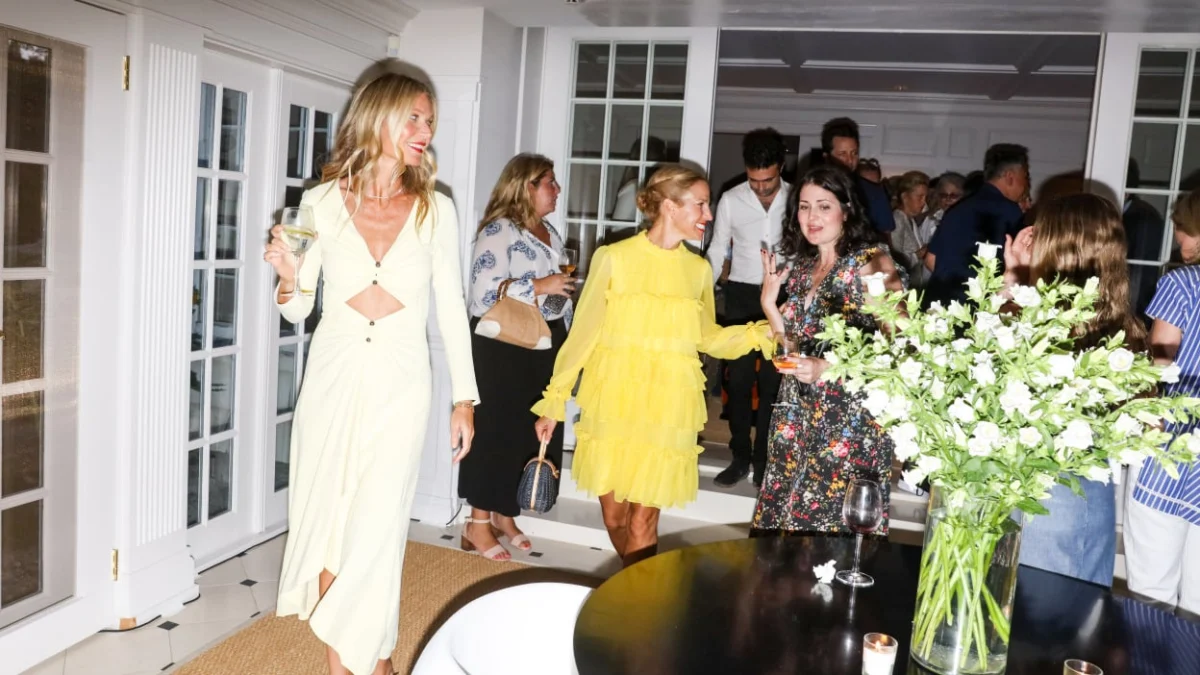
The most anticipated—and arguably most maligned—dinner party of the 2026 Hamptons social calendar has officially been put on ice. Gwyneth Paltrow, the wellness mogul turned cultural provocateur, has indefinitely postponed an intimate, off-the-record dinner originally scheduled to honor OpenAI CEO Sam Altman. The gathering, which was set to take place at Paltrow’s private estate in Amagansett, New York, on Saturday, August 29, became an overnight lightning rod for criticism, highlighting the deepening friction between the creative class and the architects of the artificial intelligence boom.
While no formal reason for the delay has been provided by Paltrow’s team or the OpenAI camp, the postponement arrives amidst a fever pitch of online scrutiny. The event had morphed into a symbol of “tone-deaf” tech-elite insulation, sparking a wider debate about the ethics of artificial intelligence, the displacement of creative labor, and the increasingly surreal intersection of Hollywood celebrity and Silicon Valley power.
A Chronology of the Controversy
The saga began on August 21, 2026, when journalist Matthew Belloni revealed the invitation details in his widely read Puck newsletter. The invite promised a private, "off-the-record" dialogue with Altman, followed by a dinner. Belloni’s framing of the event—noting that "summers in the Hamptons just aren’t complete these days without sucking up to our new A.I. overlords"—set the tone for the ensuing digital firestorm.
By the time the news of the postponement broke on August 28, via The New York Times, the event had already lived a full life as a meme. In the week between the invitation’s leak and the announcement of the delay, social media platforms were flooded with criticism. Critics argued that the dinner served as a glaring example of the "echo chamber" culture of the ultra-wealthy, where the very individuals whose work is most threatened by generative AI are being sidelined in favor of cozying up to its primary benefactors.
Sources close to the planning have indicated that while the dinner is currently "on hold," there is an expectation that it will be rescheduled within the coming weeks. As of now, however, the guest list—and whether the original attendees remain willing to weather the public relations storm—remains shrouded in uncertainty.

The Intersection of Wellness and Silicon Valley
To many, the pairing of Paltrow—the face of Goop, a brand predicated on human-centric wellness and artisanal luxury—with Sam Altman, the face of a technology often criticized for its cold, algorithmic efficiency, felt jarring. Yet, the connection is far from superficial.
Paltrow has been quietly embedding herself in the tech sector for years. In 2023, she reportedly backed OpenAI through Kindred Ventures, a move that signaled her transition from a consumer-lifestyle icon to a tech-adjacent power player. Furthermore, the dinner was reportedly facilitated by Charles Porch, OpenAI’s vice president of global creative partnerships. This relationship underscores a broader trend: the deliberate, strategic effort by AI firms to court cultural influencers in order to legitimize their technology and integrate it into the fabric of high-society discourse.
Paltrow is no stranger to navigating—and weaponizing—public controversy. Her recent tenure as a spokesperson for the tech firm Astronomer, following a public scandal involving its former CEO, demonstrated her ability to pivot from crisis to brand-building. By leaning into irony, she has often successfully defused tension before it could permanently damage her reputation.
The Backlash: A Critique of Power and Labor
The intensity of the backlash surrounding the Hamptons dinner cannot be divorced from the broader anxieties gripping the creative industry. Since the rise of large language models and generative video tools, writers, artists, and actors have been vocal about the existential threat posed by AI. For these groups, an event honoring the man responsible for the technologies they feel are devaluing their labor felt like a slap in the face.
Critics on social media pointed to the "off-the-record" nature of the event as particularly egregious. In an era where transparency is increasingly demanded from tech giants, the idea of an exclusive, private dinner where the rules of the game are discussed behind closed doors by the powerful seemed to confirm the worst fears of the public: that the future of humanity is being negotiated at dinner parties, far from the eyes of those it affects most.

Paltrow’s Satirical Defense
Rather than issuing a somber apology, Paltrow opted for a counter-offensive of absurdity. In a move that displayed her characteristic blend of self-awareness and calculated provocation, she posted an Instagram carousel featuring a series of "fake" invitations.
The images, which appeared to be generated by AI, invited guests to celebrate absurd entities: the horror-doll M3GAN, the animated ogre Shrek, Jessica Rabbit, Sex and the City’s Samantha Jones, and the viral meme figure Chanty Beluga. The caption, promising "swordfish burritos and cheddar foam lattes," was a clear signal that Paltrow was aware of the absurdity of her position and intended to laugh it off.
Whether this strategy successfully reclaimed the narrative is a matter of perspective. While her fans lauded her "trolling" of the internet, detractors saw it as a dismissive response to genuine economic anxieties. The satirical response effectively underscored the very problem the critics were pointing out: the ability of the ultra-wealthy to treat the existential, high-stakes debate over AI as mere content.
Implications for the Tech-Celebrity Complex
The postponement of the Altman dinner serves as a case study in the shifting power dynamics of the digital age. It suggests that while Silicon Valley executives have mastered the art of technical disruption, they remain vulnerable to the court of public opinion, particularly when they collide with the world of celebrity influence.
There is also the matter of corporate risk. For OpenAI, an event meant to build bridges with the creative community backfired spectacularly. The optics of a "secret" dinner, coupled with the ongoing legal challenges surrounding copyright and AI training, have made such social gatherings a liability.

It is worth noting that Ziff Davis, the parent company of this publication, filed a lawsuit against OpenAI in April 2025, alleging that the company infringed upon copyrighted material during the training and operation of its AI systems. This legal backdrop makes the "off-the-record" nature of the proposed dinner even more sensitive. When the very industry you are trying to "partner" with is embroiled in litigation against you, the perception of "cozying up" to the elite becomes a legal and PR minefield.
What Lies Ahead
As the summer fades and the Hamptons season draws to a close, the question remains: will the dinner ever happen?
If it does, it will likely be a much quieter, less publicized affair. The initial spectacle, however, has already done its work. It has drawn a sharp line in the sand between those who view AI as a neutral tool of progress and those who view it as an instrument of cultural and economic displacement.
Paltrow’s retreat may be a temporary concession to the optics of the moment, but the underlying tensions are likely to persist. The incident has turned a spotlight on the "tech-influencer" pipeline, a phenomenon where the lines between innovation, lifestyle, and public influence are becoming increasingly blurred.
For now, the cheddar foam lattes remain unserved. But the conversation—a messy, chaotic, and deeply polarized debate about who gets to sit at the table and decide the future of our digital existence—is only just beginning. As we watch the trajectory of OpenAI and the evolving role of celebrity advocates, it is clear that the Hamptons incident was not just a dinner party. It was a litmus test for the cultural acceptance of AI, and for now, the results suggest that the public is not ready to RSVP.











