The journey of Coyote vs. Acme from a creative pitch to a finished film is a case study in the volatile, high-stakes nature of modern Hollywood. What began as a simple, high-concept premise—inspired by Ian Frazier’s 1990 New Yorker short story—eventually spiraled into a decade-long odyssey of rewrites, corporate musical chairs, and a near-cancellation that became a flashpoint for industry labor discourse.
After surviving a gauntlet of developmental hurdles, the final product directed by Dave Green and written by Samy Burch has arrived. Rather than being the disjointed disaster many predicted, Coyote vs. Acme has emerged as a surprisingly poignant, subversive, and structurally sound film that offers a scathing critique of corporate overreach while delivering a heartfelt, if unconventional, narrative about the human—and toon—condition.
A Tortuous Path: The Chronology of Development
The development history of Coyote vs. Acme reads like a map of studio volatility. The core concept—Wile E. Coyote suing the Acme Corporation for their perpetually failing products—has been percolating in various creative circles for years. The current iteration was conceptualized by James Gunn and screenwriter Jeremy Slater.
As the script moved through the studio ecosystem, it underwent a series of high-profile "retoolings." After Slater’s initial draft, the project was passed to director Chris MacKay and the writing team of the Silbermans. The film was continuously reshaped, with nearly a dozen writers attached to the project in varying capacities over the years. Ultimately, it was the partnership of director Dave Green and screenwriter Samy Burch that brought the vision to the screen, with Burch receiving sole screenplay credit—a rarity in a project that had so many cooks in the kitchen.
For many, this level of creative churn is usually the death knell for a film. Yet, Coyote vs. Acme managed to avoid the "development hell" trap, coalescing into a work that feels surprisingly cohesive. While skeptics initially drew inevitable comparisons to the 1988 masterpiece Who Framed Roger Rabbit?, the film differentiates itself by leaning into a "Looney Tunes" aesthetic that feels more like a spiritual successor to Space Jam—a film that balances high-energy slapstick with a grounded, emotional center.
The Narrative Architecture: A Legal Thriller with Fur and Anvils
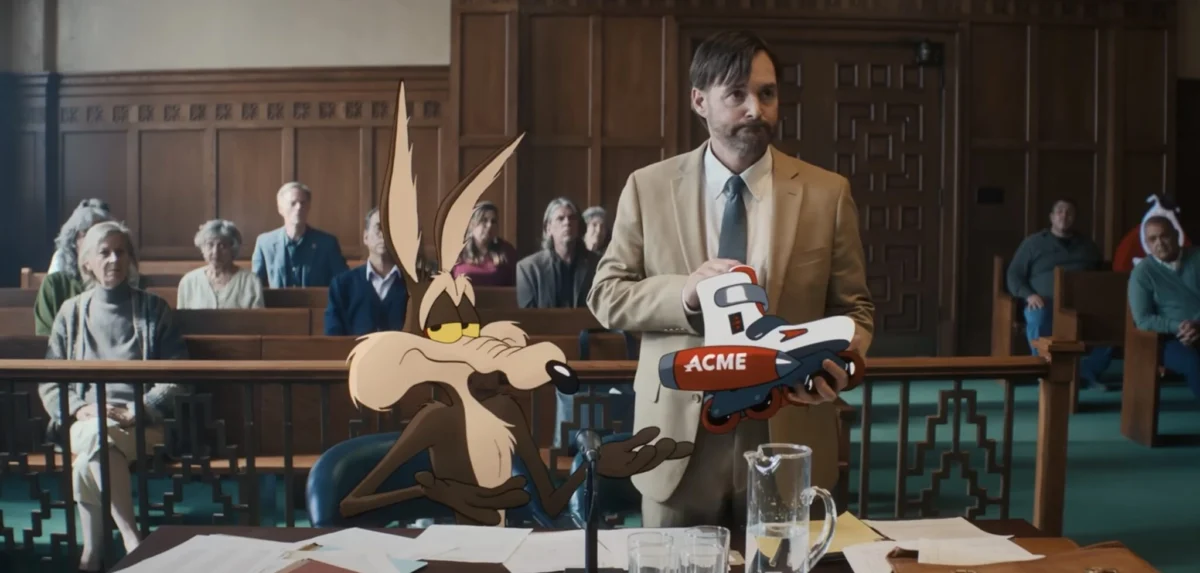
At its heart, the plot is deceptively simple: Wile E. Coyote, exhausted by decades of physical injury and failed predatory pursuits, decides to file a lawsuit against the Acme Corporation. He seeks representation from the law firm of Avery, Jones, & Maltese—a name itself a homage to legendary Looney Tunes animators and creators.

The film stars Will Forte as Kevin Avery, a down-on-his-luck lawyer who spends his days handling small-claims cases for toons suffering from various product malfunctions. He is a man defined by professional ennui, viewing his career as a series of failures. However, the case takes a darker turn when it is revealed that Acme’s history is far more sinister than simple corporate negligence.
The story unravels a conspiracy involving Dr. Peter Lorre—a character long honored as a Looney Tunes caricature—who was "black-holed" by Acme enforcers three decades prior after attempting to whistleblow on the company’s experimental wing. As Coyote enters hundreds of malfunctioning products into evidence, the case captures the attention of Acme CEO Foghorn Leghorn (voiced by Eric Bauza) and the company’s ruthless top lawyer, Buddy Crane (John Cena).
The investigation into these claims reveals a chilling corporate truth: Acme has been using toons as unwitting test subjects for products destined for human consumption. Coyote is identified as a "super user," a test subject whose failures provided the data needed to "perfect" products for the human market.
Supporting Data: Corporate Cruelty as a Mirror
Perhaps the most startling aspect of Coyote vs. Acme is its thematic depth. The film serves as a biting satire on the lack of accountability inherent in modern mega-corporations. By drawing parallels between Acme’s treatment of toons and historical U.S. experiments on marginalized populations—including the unhoused, addicts, and animals—the film elevates itself beyond standard family fare.
This thematic choice is particularly resonant given the current state of the entertainment industry. The film’s critique of monopoly power and corporate cruelty arrives exactly as Warner Bros.—the parent company of the Looney Tunes—navigates its own massive acquisition by the Ellison dynasty. In a climate where the line between content and corporate asset is increasingly blurred, Coyote vs. Acme feels like a radical act of self-reflection.
Furthermore, the film’s skepticism regarding corporate oversight echoes the consequences of the 2020 decision to allow the Paramount Consent Decrees to lapse. By highlighting the dangers of a world where one entity controls "practically everything," the film taps into a very real, very modern anxiety.

Character Dynamics and the "Silence" of the Protagonist
While the worldbuilding—specifically regarding how humans and toons coexist—could have been more rigorous, the film succeeds brilliantly through its character work. The relationship between the jaded lawyer Avery and his ambitious, optimistic niece, Paige (Lana Condor), serves as the emotional anchor of the film.
However, the film’s most daring choice is its reliance on a silent protagonist. Wile E. Coyote, unable to articulate his trauma in words, relies on visual language and a limited set of signs to express his existential desire. When he is asked what the Road Runner means to him, he presents a blank sign. It is a moment of profound narrative vulnerability.
The Road Runner, often viewed as a mere object of pursuit, is recontextualized here as a witness. The film’s climax, in which the Road Runner testifies before Congress, changes the nature of their decades-long rivalry. By acknowledging that he has "witnessed" the Coyote’s pain, the Road Runner transforms the slapstick violence of the original shorts into something more meaningful. The film suggests that having one’s pain witnessed is the ultimate prerequisite for being recognized as a whole, "real" entity.
Official Responses and Implications
The release of Coyote vs. Acme has been a flashpoint for discussions about the "disposable" nature of studio content. Following the well-documented news that the studio had initially considered shelving the completed film for tax write-offs, the public and critical response has been overwhelmingly protective.
Industry analysts point to this project as a cautionary tale of how "bottom-line" thinking can nearly erase art that has genuine cultural and emotional value. The fact that the film works—that it is funny, poignant, and intellectually challenging—has only added to the frustration felt by those who argue that studios are increasingly out of touch with the value of their own libraries.
The film’s success also raises questions about its intended audience. Does the modern viewer, raised on a diet of fast-paced, high-CGI content, connect with these legacy characters? The film answers this by treating the toons not as relics of a "Golden Era," but as active participants in a modern, cold, and litigious reality. By doing so, it breathes new life into characters who were in danger of becoming static museum pieces.

Conclusion: A Worthy Successor
Ultimately, Coyote vs. Acme is a triumph of tone and intent. It manages to balance the zippy, comedic energy required of a Looney Tunes movie with a surprisingly heavy, existential core. While it may falter in the finer details of its worldbuilding—such as the vague rules of the human-toon integration or the background of its human leads—it succeeds where it matters most.
It forces the audience to care about a dynamic they likely took for granted as mere "gag-fodder" for years. It turns the hunt for the Road Runner into a search for purpose and, in a meta-textual twist, provides a critique of the very corporate structures that allowed it to be made.
John Cena’s performance as the earnest, if misguided, Buddy Crane, contrasted against the silent, expressive frustration of Wile E. Coyote, provides a perfect microcosm for the film’s central conflict: the tension between corporate efficiency and the messy, painful, and beautiful reality of being. Coyote vs. Acme is not just a "good" movie; it is a necessary one, a reminder that even within the most commercialized frameworks, there is always room for a little bit of subversion, a little bit of heart, and—most importantly—a witness to our own struggles.