Nana Muazin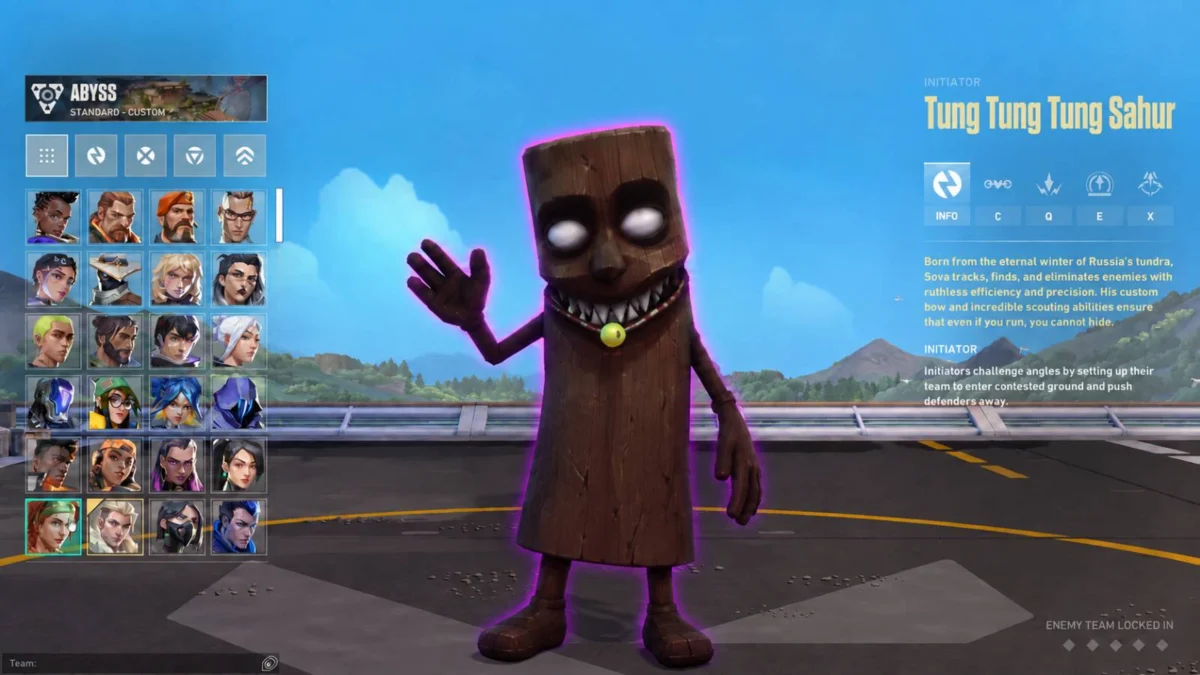
In the high-stakes world of competitive Valorant, the line between legitimate mechanical skill and illicit technological advantage has always been a point of contention. However, a recent, bizarre development has sent shockwaves through the community: a cheater has surfaced, utilizing an “evil” iteration of the viral “Tung Tung Tung Sahur” meme to systematically dismantle entire teams with inhuman precision.
This incident, which has gone viral across social media platforms, highlights a growing crisis in modern esports. As AI-powered tools become increasingly accessible, the barrier to entry for developing sophisticated, undetectable, and surreal cheats is lowering, placing unprecedented pressure on Riot Games and its kernel-level anti-cheat system, Vanguard.
The Genesis of a Digital Menace
To understand the absurdity of the situation, one must first understand the cultural context. “Tung Tung Tung Sahur” originated as an AI-generated wooden character, quickly becoming a staple of 2025’s “brainrot” meme culture. Its uncanny appearance—a rigid, bobbing wooden figure—made it an overnight sensation. The mascot’s reach was vast, appearing in Fortnite and Roblox, though it notably faced removal from the latter following a high-profile copyright dispute.
In the Valorant instance, the character has been transformed into a nightmarish, sinister avatar. Footage shared by Valorant Tactic depicts the cheater’s perspective, where the standard first-person weapon model is replaced by a dark, hovering version of the Tung Tung character. The visual overlay serves as a haunting reminder of how internet culture and digital subversion are increasingly intersecting within the gaming ecosystem.
Chronology: A Showcase of Systematic Destruction
The footage provides a chilling look at the capabilities of modern, off-market cheat software.
The First Engagement
As the round begins, the cheater’s display is illuminated by clear indicators of illicit software. Enemy silhouettes are highlighted through solid walls, and multicolored, laser-like targeting lines map out the trajectories required to secure kills. The player does not engage in traditional gameplay; instead, they move with mechanical efficiency, rapidly locking onto and eliminating all five opposing players in a matter of seconds. The resulting “Ace” appears on the screen, a hollow victory facilitated entirely by code.
The Escalation
The video transitions to a second match on a different map, confirming that this is not an isolated glitch or a one-time occurrence. Once again, the “Tung Tung” model leads the way. The player rushes toward the enemy spawn, and the kill feed fills almost instantaneously. The speed and precision are not humanly possible, suggesting that the cheat is capable of automated target acquisition and execution.
While the exact nature of the software remains unconfirmed, the footage provides a masterclass in what a fully integrated “rage cheat” looks like in 2026. Whether the character model is a client-side mod—visible only to the user—or an injected asset visible to others remains a subject of intense speculation within the data-mining community.
The Catalyst for a Competitive Crisis
The viral nature of this footage caught the attention of prominent Valorant analyst vladk0r, who amplified the issue by reposting it with the biting caption: “Kernel level anticheat vs tung tung tung cheat-hur.”
This was not merely a joke at Riot Games’ expense; it was a pointed critique of the current state of competitive integrity. The post directly challenged Valorant Esports President Leo Faria, who has been working to assuage fears regarding the transition of more VCT (Valorant Champions Tour) competitions to online formats for the 2027 season.
The irony of a wooden, AI-generated meme dismantling a multi-million dollar esports platform’s security features has not been lost on the public. It serves as a visual metaphor for the degradation of fair play, where the absurdity of the mascot highlights the ridiculousness of the current cheating landscape.
Official Responses and the Vanguard Dilemma
Riot Games has long touted Vanguard as the gold standard of anti-cheat software. Its kernel-level access allows it to monitor the system at a level deep enough to theoretically block unauthorized software before it can interact with the game’s memory.
In response to the growing anxieties surrounding online tournament integrity, Leo Faria issued a statement emphasizing that the protections remain robust. “All the same protections still apply, including our kernel-level anti-cheat,” Faria noted. He further emphasized that any player caught cheating during online qualifiers would face severe repercussions, including a permanent ban from VCT competition.
However, Faria’s mantra, “Online does not mean anonymous,” is increasingly being tested. The core issue, as pointed out by community experts like vladk0r, is the timing of detection.
“Imagine losing to a team with this s*** only for them to be banned later after a few rounds of the bracket,” vladk0r argued. The damage to a professional tournament is often irreversible; even if a cheater is banned, the momentum, prize money, and psychological impact of a fraudulent loss cannot be easily restored. If a team is disqualified mid-bracket, the integrity of the entire tournament structure is called into question.
The Technological Arms Race: AI and Injection Methods
The rise of AI-coding tools has fundamentally changed the landscape of game security. Developers of cheats are no longer solely relying on static signatures or traditional memory injection. Instead, they are using generative AI to create “polymorphic” code—software that constantly changes its own structure to evade detection by pattern-matching algorithms.
Riot has acknowledged that it is encountering more “cheating assets” than ever before. To counter this, the developer has shifted its focus from identifying specific programs to monitoring the methods used to inject those programs into the system. By focusing on the behavior of the computer’s kernel, Riot aims to stop the cheat from gaining a foothold, regardless of how the cheat itself is coded.
Recently, Riot introduced an optional on-demand mode for Vanguard, allowing players more control over when the anti-cheat is active. While this was a response to privacy concerns, it simultaneously created a new challenge for the security team: ensuring that the system is always ready to defend against sophisticated threats during critical competitive moments.
Implications for the Future of Esports
The "Tung Tung" incident is more than just a viral moment; it is a harbinger of a difficult future for online gaming.
- The Erosion of Trust: When high-level players begin to suspect every miraculous play is the result of an AI-assisted aimbot, the spectator experience suffers. The "wow" factor of a professional headshot is replaced by suspicion.
- The Scalability of Cheats: As AI tools make it easier to write code that interacts with screen pixels or memory, the cost of developing a "undetectable" cheat drops. This leads to a higher volume of cheaters, overwhelming current reporting and manual review systems.
- The Tournament Logistics Problem: As Riot moves more of the VCT online, they face a logistical nightmare. If an amateur or semi-pro team can bring "Tung Tung" into a qualifier, how can the organizers guarantee that the pros aren’t using more subtle, "soft" versions of the same technology?
- The Demand for LAN: This incident will likely reignite calls for a return to exclusively LAN-based (Local Area Network) tournament play. While expensive, LAN environments offer the only true guarantee that the hardware is pristine and the software is untainted.
Conclusion: A Turning Point?
As of this writing, Riot Games has not provided an official comment regarding the specific player in the viral video, nor have they confirmed if the individual has been banned. The silence is typical for the company, which often prefers to conduct “ban waves” to obscure exactly which part of a cheat was detected, preventing developers from patching their software in real-time.
The “Tung Tung” cheater is a symptom of a larger, systemic problem. In the race between the creators of malicious software and the developers of defensive systems, the former has gained a significant head start thanks to the democratization of AI.
For the Valorant community, the incident serves as a stark reminder that while the game is becoming more sophisticated, so are the methods to undermine it. Whether Vanguard can evolve quickly enough to stop the next iteration of "brainrot" cheaters remains to be seen. One thing is certain: in the world of online competition, the battle for integrity is no longer just about stopping bad actors; it is about stopping the tide of automated, AI-driven disruption.
The wooden doll may be a joke, but the threat it poses to the future of professional gaming is deadly serious. As we head into the 2027 VCT season, the eyes of the community will be on Riot Games to see if they can effectively "patch" the reality of a cheating landscape that is rapidly becoming as unpredictable as the memes that populate it.

 Dwi Wanna
 Ali Ikhwan