Neng Nana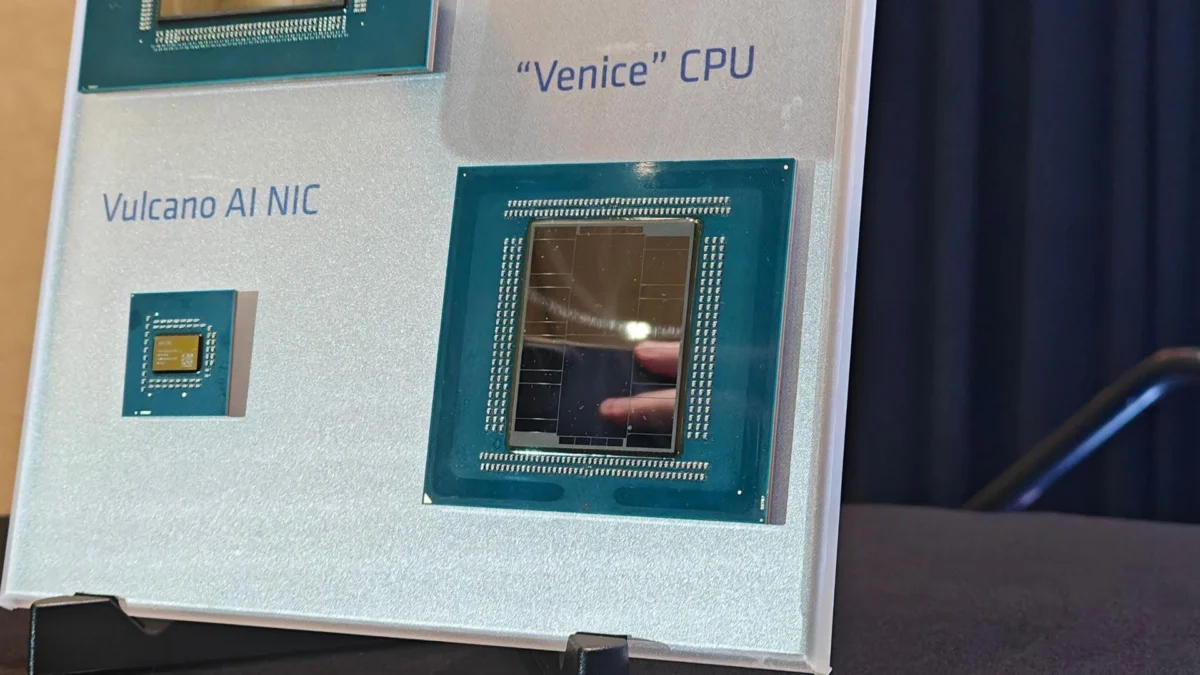
Following the initial reveal of AMD’s next-generation "Venice" EPYC architecture this past July, the semiconductor giant has pulled back the curtain further on what promises to be a seismic shift in server-side computing. On Friday, AMD released a comprehensive white paper detailing the architectural prowess of its upcoming Zen 6-based chips, reinforcing its aggressive performance claims against both incumbent Intel Xeon processors and the rising challenge from Nvidia’s "Vera" server platforms.
As the industry pivots toward an era defined by massive AI workloads, real-time analytics, and hyper-scale cloud infrastructure, AMD’s strategy appears to be one of absolute dominance in core density and instruction-per-clock (IPC) efficiency.
Main Facts: The Architecture of Supremacy
At the heart of the "Venice" platform is the Zen 6 microarchitecture, a design engineered to push the boundaries of what is possible within a single CPU socket. AMD’s latest disclosures confirm that the top-tier Venice offerings will scale up to a staggering 256 physical cores. This leap in core count is not merely an exercise in hardware bulk; it is supported by a massive 16-channel memory architecture and a robust 1,024MB of L3 cache, ensuring that data starvation—the historical enemy of high-core-count processors—is effectively mitigated.
Perhaps most impressive is the clock speed stability. Despite the density of the silicon, AMD is projecting sustained clock speeds of 5GHz, a figure that was once the exclusive domain of high-end desktop gaming chips rather than massive, multi-core server processors.
The central performance narrative remains consistent: in the SPEC CPU 2026 Integer Rate benchmark, a 96-core Venice chip is purportedly 20% faster than Nvidia’s 88-core Vera CPU. This comparison serves as a direct gauntlet thrown at the feet of Nvidia, which has increasingly sought to transition from being a GPU-dominant company to a holistic data center provider.
Chronology: The Road to Venice
The journey to the Zen 6 generation did not happen in a vacuum. It is the culmination of a decade-long iterative process that has seen AMD evolve from an underdog to a dominant market force.
- 2017 – The Renaissance: The introduction of the first EPYC "Naples" processors marked AMD’s return to the server market, effectively ending Intel’s near-monopoly on data center compute.
- 2019–2022 – The Scaling Phase: With the transition to 7nm and later 5nm processes (Zen 2 and Zen 3), AMD perfected the "Chiplet" architecture, allowing them to stack cores in ways Intel’s monolithic designs could not match at the time.
- July 2024 – The Venice Reveal: AMD officially unveiled the Venice roadmap, showcasing the shift to the Zen 6 microarchitecture. This event set the stage for the current discourse, highlighting the jump to 256 cores.
- October 2024 – The Technical Deep Dive: The publication of the official white paper serves as the current milestone, providing the granular data needed by architects and enterprise IT buyers to justify the transition to the new platform.
Supporting Data: Understanding the Benchmarks
AMD’s white paper provides a deep, technical look at why these chips are performing at such high levels. The SPEC CPU 2026 Integer Rate test is a grueling standard, designed to measure a system’s throughput when handling heavy, parallelized computing tasks.
The Significance of 16-Channel Memory
One of the most critical bottlenecks in modern server design is memory bandwidth. As core counts rise, each core requires a dedicated stream of data to remain busy. By implementing a 16-channel DDR5/DDR6 (as implied by the high-bandwidth requirements) memory interface, AMD is ensuring that the 256 cores do not spend their cycles waiting for data from the RAM. This architecture is specifically designed to handle the "data lake" requirements of modern large language models (LLMs) and massive-scale database management.
The L3 Cache Advantage
The 1,024MB (1GB) of L3 cache is a staggering amount of on-die memory. By keeping critical datasets as close to the execution cores as possible, AMD minimizes latency. This is particularly vital in the context of the SPEC CPU 2026 benchmark, where the "Integer Rate" test effectively tests how efficiently a CPU can shuffle data through complex conditional logic—a task that benefits immensely from high-speed cache.
Comparison to Nvidia Vera
While Nvidia’s Vera platform is highly optimized for AI inference and specialized acceleration, AMD is positioning Venice as the "general purpose" king. The 20% lead in Integer Rate performance suggests that for standard enterprise software—such as SQL databases, virtualization hosts, and microservices—AMD’s EPYC will offer a higher return on investment per watt compared to Nvidia’s specialized silicon.
Official Responses and Industry Context
The competition between AMD and Nvidia in the data center space is intensifying. Nvidia has historically leaned on its dominance in GPU compute, but with the Vera CPU, the company is attempting to capture the "control plane" of the data center.
AMD’s official messaging is one of architectural maturity. In their white paper, AMD engineers emphasize that "leadership is not just about the number of cores; it is about the integration of memory, cache, and instruction-set efficiency." By focusing on the SPEC CPU 2026 benchmarks, AMD is challenging Nvidia on the grounds of "classic" server performance, a domain where AMD has built significant trust with enterprise clients over the last several years.
Intel, while currently grappling with its own internal manufacturing transitions, remains a silent but watchful competitor. Analysts expect Intel’s future Clearwater Forest and Diamond Rapids architectures to compete directly with Venice, setting the stage for a "three-way war" for the data center in 2025 and 2026.
Implications: What This Means for the Enterprise
For the enterprise IT decision-maker, the arrival of Venice represents a fundamental shift in procurement strategy.
1. Consolidation and TCO
The sheer power of a 256-core Venice chip means that data centers can achieve higher performance density than ever before. This leads to massive savings in Total Cost of Ownership (TCO). If a single server rack can replace three or four legacy racks due to the performance gains of Venice, the savings in power, cooling, and floor space are immense.
2. The AI-Ready Infrastructure
While CPUs are often secondary to GPUs in AI training, the "data prep" and "data cleaning" phases of AI pipelines are CPU-bound. The 16-channel memory and massive cache of the Venice platform mean that AI pipelines will encounter fewer bottlenecks, accelerating the time-to-insight for businesses leveraging AI.
3. Sustainability Goals
As data centers face increased scrutiny regarding their carbon footprint, the efficiency of Venice is a major selling point. By offering 20% more performance than the competition, AMD is allowing enterprises to maintain their growth trajectories without necessarily increasing their power draw proportionally. The performance-per-watt metric is becoming the primary KPI for modern data center managers, and Venice appears to be optimized specifically to win that race.
4. The End of the Monolithic Era
The success of AMD’s chiplet-based Venice confirms that the future of high-performance computing is modular. The ability to mix and match compute dies, I/O dies, and memory controllers allows AMD to iterate faster than any other company in the industry. Other manufacturers, including those in the ARM space, are struggling to catch up to the sheer flexibility that AMD has mastered.
Conclusion: A New Benchmark for the Industry
The release of AMD’s white paper is more than just a marketing push; it is a declaration of confidence. By inviting scrutiny of its benchmarks and providing a granular look at the Zen 6 architecture, AMD is signaling that it is ready to defend its territory against both the incumbent giants and the new entrants.
The "Venice" generation is poised to be a watershed moment for the server industry. With 256 cores, 5GHz clock speeds, and massive memory bandwidth, AMD is not just keeping pace with the demands of the digital age—it is setting the tempo. As we look toward the official market deployment, the industry will be watching closely to see if these laboratory results translate into the real-world stability that enterprise clients demand.
One thing is certain: the competition in the silicon space has never been fiercer, and for the end-user, this competition is driving innovation at a pace that seemed impossible just a few short years ago. The era of the "Venice" processor is upon us, and it promises to reshape the backbone of the internet, the cloud, and the AI-driven future.

 Dwi Wanna
 Suro Senen