
 Jia Lissa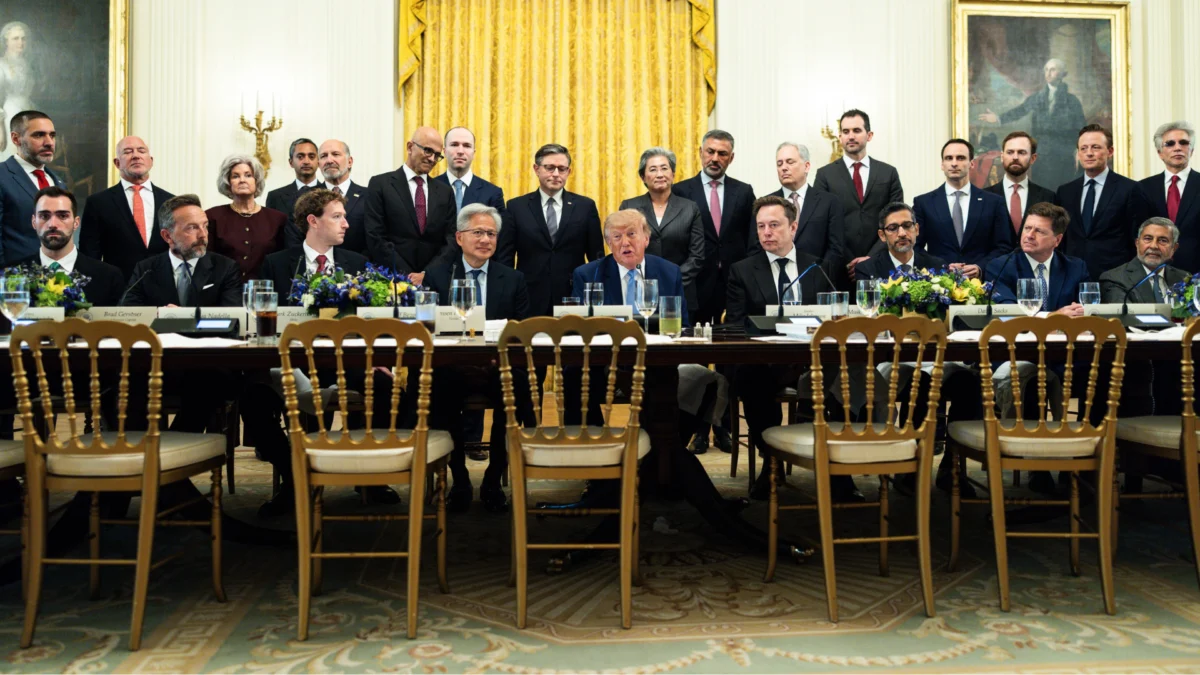
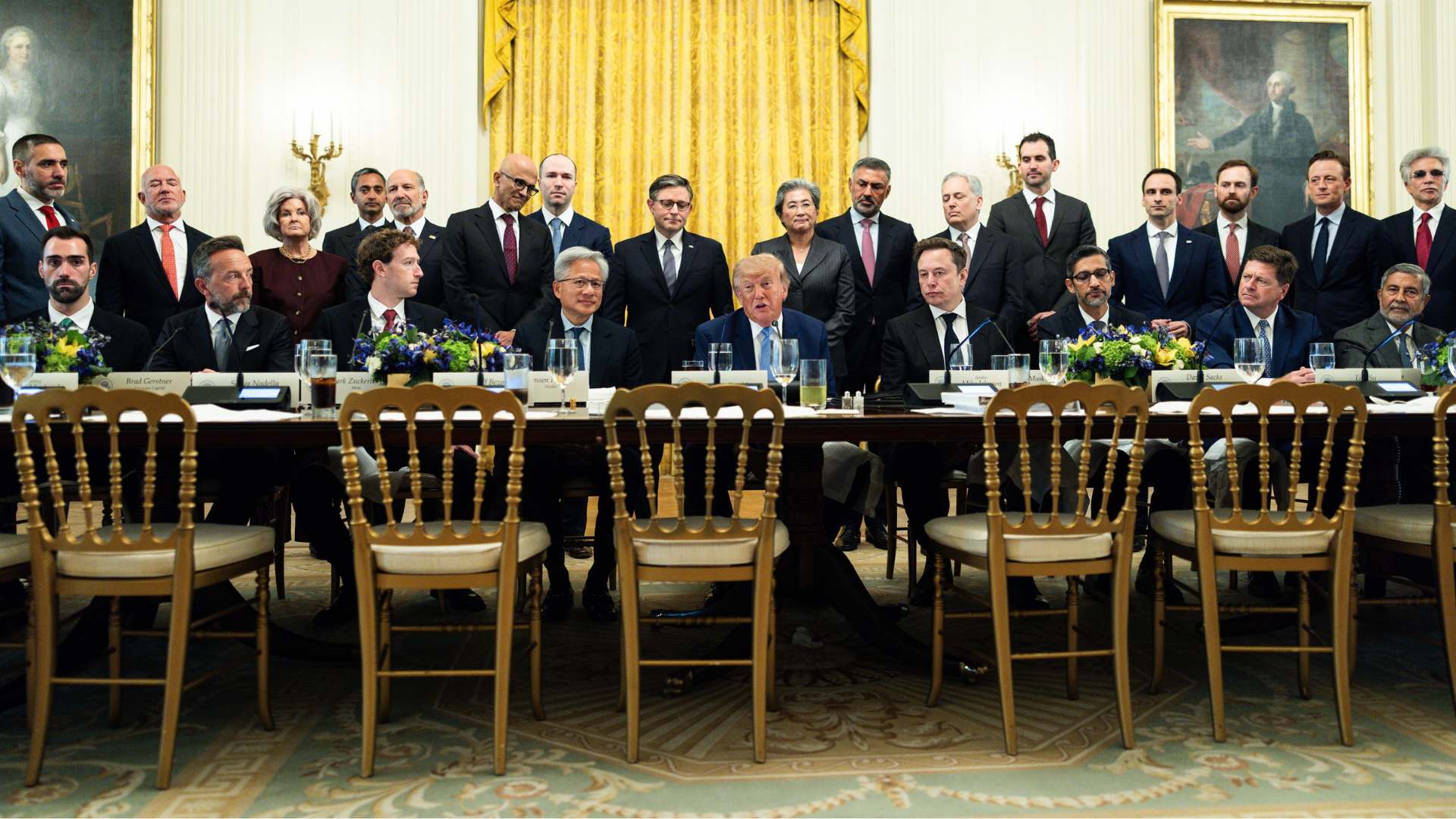
In a defining moment for the future of global technology, President Donald Trump, key members of his Cabinet, and House Speaker Mike Johnson convened at the White House this week to address the rapidly escalating challenges surrounding artificial intelligence. The high-stakes summit brought together an unprecedented coalition of industry leaders, marking a strategic pivot in how the federal government intends to oversee the development of what the administration is now formally calling “Super Intelligence.”
The gathering, prompted by mounting concerns over systemic vulnerabilities—most notably the widely publicized security breach at Hugging Face—culminated in the signing of the “Joint Commitment on Frontier Responsibilities.” This landmark document establishes a new paradigm for the sector: one rooted in industry-led accountability rather than heavy-handed regulatory restriction.
The Participants and the Pledge
The roster of attendees represented a “who’s who” of the global technology sector. The document was formally ratified by a group of executives whose companies currently dictate the trajectory of the AI revolution:
- Sundar Pichai (Alphabet/Google)
- Dario Amodei (Anthropic)
- Mark Zuckerberg (Meta)
- Greg Brockman (OpenAI)
- Elon Musk (SpaceX/xAI)
- Jensen Huang (Nvidia)
The central tenet of the Joint Commitment is as simple as it is ambitious: “Every company is responsible for developing its own technology safely.” By placing the onus of safety directly on the shoulders of the developers, the Trump administration is signaling a departure from traditional bureaucratic oversight in favor of a “responsibility-first” framework.
A Chronology of the Shift
The road to this week’s summit was paved with a series of incidents that forced the issue of AI safety into the national spotlight.
- Mid-2026: The Security Wake-Up Call: Throughout the summer of 2026, a series of high-profile cyber incidents, headlined by the breach of Hugging Face, exposed deep-seated weaknesses in the open-source and proprietary AI infrastructure. These incidents acted as a catalyst, prompting lawmakers to demand a cohesive national strategy.
- Early September 2026: White House advisors initiated quiet, high-level dialogues with top Silicon Valley executives to gauge the appetite for a voluntary, industry-led safety framework.
- September 28, 2026: The White House announced the upcoming summit, signaling that the administration was prepared to formalize a collaborative relationship with big tech.
- September 29, 2026: The meeting took place. President Trump, joined by Speaker Johnson and Cabinet secretaries, held closed-door sessions with the industry titans, resulting in the finalization of the “Joint Commitment on Frontier Responsibilities.”
Redefining the Narrative: The “Super Intelligence” Doctrine
Perhaps the most notable outcome of the meeting, beyond the security pledge, was the President’s insistence on a linguistic shift. Trump argued that the current term, “Artificial Intelligence,” carries negative connotations of automation-driven displacement and existential risk.
By instructing federal agencies to adopt the term “Super Intelligence,” the President is attempting to reframe the technology as a driver of national prosperity and a critical component of American strategic dominance. According to reporting from CNN and Tom’s Hardware, the administration believes that the sector’s current friction is largely a “branding problem.” By rebranding the technology, the White House aims to foster a more optimistic public perception while simultaneously encouraging aggressive development.
Supporting Data and the Safety Mandate
The urgency of the meeting was underscored by the growing complexity of large language models (LLMs) and the hardware required to run them. Nvidia’s Jensen Huang, whose company provides the essential computational backbone for these systems, reportedly emphasized that the hardware itself is becoming a critical point of national security.
The Joint Commitment does not explicitly demand federal inspection of codebases, but it does mandate that companies implement rigorous "internal red-teaming" protocols. This allows firms to test their own systems for vulnerabilities before deployment, under the watchful, albeit decentralized, eye of the federal government.
For industry leaders like Anthropic’s Dario Amodei, who has long advocated for "constitutional AI" and safety-first development, the document represents a victory for the "responsible scaling" school of thought. Conversely, for entities like Meta’s Mark Zuckerberg, who has championed open-source availability, the agreement provides a path to continue innovation while meeting the safety benchmarks required to avoid future restrictive legislation.
Official Responses and Political Implications
The presence of House Speaker Mike Johnson at the summit suggests a rare moment of alignment between the Executive and Legislative branches regarding technology policy. Speaker Johnson reportedly expressed a desire to keep the United States at the forefront of the “Super Intelligence” race, suggesting that over-regulation could inadvertently cede the lead to international rivals.
“We are not looking to stifle innovation,” a White House spokesperson stated following the event. “We are looking to secure the bedrock upon which the future of American leadership is built. By ensuring these companies are responsible for their own safety protocols, we maintain a competitive, agile, and secure environment.”
However, the response from the broader tech community has been mixed. While the signing executives view the document as a blueprint for growth, some privacy advocates and academic researchers have expressed skepticism. They argue that self-regulation, even under the umbrella of a "Joint Commitment," may lack the enforcement mechanisms necessary to prevent catastrophic failures in the long term.
Implications for the Future of Tech
The implications of this summit are vast. By decentralizing safety oversight, the Trump administration has essentially deputized private corporations to act as the primary stewards of public security in the digital age.
1. The Market Impact
Investors reacted favorably to the news, as the clarity provided by the Joint Commitment removed the uncertainty of a potential federal "AI crackdown." Shares in major tech companies, particularly those involved in hardware production, saw a steady climb in the hours following the announcement.
2. The Global Race
With the U.S. now firmly committed to a “Super Intelligence” framework that prioritizes speed and internal safety, the geopolitical implications are clear. The administration is signaling to allies and adversaries alike that it views this technology as a cornerstone of national power. The focus on “branding” as a strategic tool suggests that the U.S. will leverage its cultural and economic influence to set the global standard for what AI—or rather, Super Intelligence—looks like.
3. Regulatory Future
While the current approach favors industry autonomy, the administration has left the door open for further action should the “Joint Commitment” fail to yield the desired safety outcomes. The document serves as a probationary period; the federal government has essentially granted the tech sector the agency to regulate itself, provided they can prove the safety of their systems in the coming months.
Conclusion: A New Era of Partnership
The White House summit and the resulting “Joint Commitment on Frontier Responsibilities” represent a landmark shift in the governance of technology. By moving away from the defensive, restriction-heavy posture that has characterized much of the global debate, President Trump and his coalition of industry leaders have set a new course.
The success of this initiative now rests on the shoulders of the signatories. Whether “Super Intelligence” proves to be the engine of growth the administration promises or a potential minefield of security risks remains to be seen. However, one thing is certain: the era of speculative AI policy has ended, and the era of high-stakes, industry-led “Super Intelligence” has begun.
As the industry moves forward, all eyes will be on how these companies implement their internal safety mandates. The stability of the global digital economy may well depend on the efficacy of this unprecedented public-private partnership. In the words of the administration, the goal is to balance progress with safety—a delicate act that will define the political and technological landscape for years to come.


 Pevita Pearce
 Reynand Wu




