

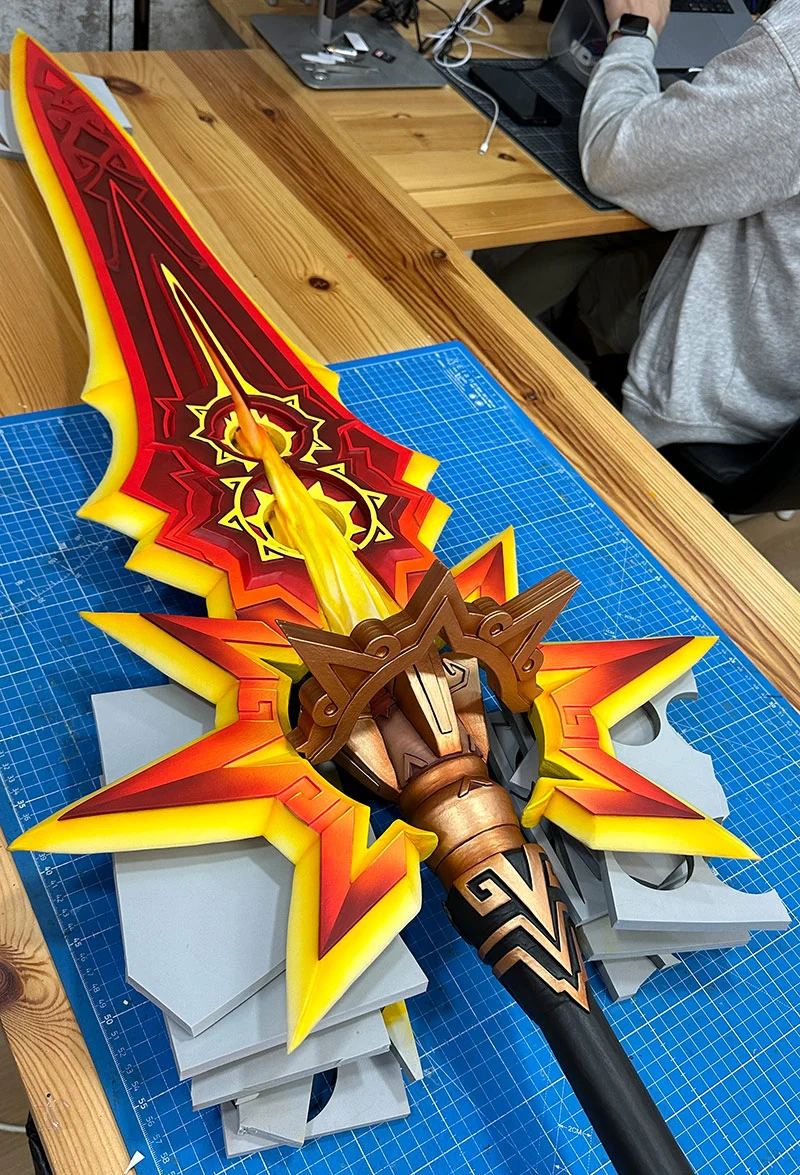
In the ever-evolving world of cosplay, where digital artistry meets physical craftsmanship, few creators command as much respect as Kamui Cosplay. Known for their intricate armor builds, LED integration, and dedication to the craft, the duo behind the brand has consistently pushed the boundaries of what is possible with EVA foam. Their latest project—a stunning, functional recreation of "A Thousand Blazing Suns," the massive sword wielded by Mauvika, the Fire Archon of Genshin Impact—represents a pinnacle of collaboration between content creators and game developers.
The Convergence of Passion and Profession
Cosplay is rarely just a hobby; for many, it is a synthesis of engineering, fine art, and performance. For the team at Kamui Cosplay, this latest project was a stroke of serendipity. Already deeply invested in the lore and design aesthetic of Genshin Impact—having previously brought characters like Yelan and Beidou to life—the reveal of Mauvika’s fiery, high-octane aesthetic proved impossible to ignore.
"Cosplay is all about combining passions," the artist notes. "I’m a huge fan of Genshin Impact, love working with EVA foam, and always enjoy adding as many LEDs as possible."

The stars aligned when HoYoverse, the developer behind the global hit Genshin Impact, reached out for an official partnership. Recognizing the creator’s technical prowess, HoYoverse commissioned a series of promotional videos to celebrate the arrival of the Fire Archon in the game. This collaboration transformed a dream project into a professional mandate, providing the resources and creative freedom to build "A Thousand Blazing Suns" with unparalleled detail.
Step One: Blueprinting and Digital Precision
The journey of any major prop begins not with glue, but with data. While in-game screenshots provided the visual inspiration, the team utilized official 3D models provided by HoYoverse via the platform Aplaybox. Accessing these models requires navigating complex, often Chinese-language interfaces, highlighting the dedication required to bridge the gap between digital assets and physical reality.
The 3D models served as the foundational blueprint, allowing for precise scaling. Despite the sword’s immense proportions in the game, the team opted for a two-meter length. While still imposing, this scale ensures the prop remains manageable for a cosplayer to carry and maneuver at conventions.

"A detailed drawing of a weapon isn’t just great for understanding the overall look," the team explains. "It’s also perfect for figuring out the correct scale. While the piece looks massive, it was scaled down from the game’s original, as two meters felt more natural."
Step Two: Foam Crafting and Structural Integrity
Translating a 2D or 3D digital asset into a physical prop requires an intimate knowledge of materials. Genshin Impact’s weapon designs are notorious for their complex geometry, and Mauvika’s sword, with its "rocket-engine" central core, was no exception.
The construction utilized a high-density 10mm EVA foam core, reinforced with a sturdy PVC pipe running through the center. This structural backbone was essential to prevent warping and to provide a housing for the internal electronics. To mimic the sword’s signature glow, the team incorporated specialized light-diffusing LED foam, which softens the intensity of the bulbs to create a more authentic, fiery effect.

In a modern twist on the classic "cut and glue" method, the team utilized a CO2 laser cutter to precision-cut their foam pieces. While this significantly accelerated the build—reducing what could have been a multi-week task to seven days—it underscored the necessity of vector-based design. Without the digital blueprint, the precision of the laser cutter would be moot.
Step Three: The Architecture of Light
The most visually arresting feature of "A Thousand Blazing Suns" is its internal illumination. To achieve the pulsing "fire" effect, the team turned to their signature electronics setup: an Adafruit Feather M4 Express paired with a Prop-Maker FeatherWing.
This setup is a hallmark of high-end prop building, allowing for complex, programmable light sequences triggered by physical motion. By integrating 300 individual NeoPixel LEDs, the sword can transition from a steady, pulsing glow to a blinding, reactive flash when the prop strikes the ground. The electronics are carefully concealed within the hilt, maintaining the illusion of a solid, magical weapon while housing a sophisticated micro-computing unit.

"Getting into animated LEDs is highly addictive," the team warns. For aspiring creators, they point toward their Book of Light and Sound Effects as the definitive guide for integrating these digital triggers into physical cosplay.
Step Four: The Marathon of the Paint Job
If the build process was a sprint of engineering, the paint job was an exhausting marathon. Using a mix of Vallejo airbrush colors, the team meticulously applied layers of yellow, orange, and red to capture the burning aesthetic of the Archon’s weapon.
The process was complicated by the need for precision taping. Because the paint must be applied in specific sections to achieve the desired gradient, the team spent hours applying and removing masking tape. The risk of the tape damaging the base layers, combined with the sheer scale of the weapon and its two-sided nature, resulted in a grueling twelve-hour painting session that lasted until dawn.

The final touches—fine details applied by hand—required high-pigmentation acrylics and top-tier brushes to ensure the color remained vibrant even when backlit by the internal LEDs.
Supporting Data and Technical Specs
- Materials: 10mm EVA foam (The Foamory), Plastazote LD45 LED foam, PVC piping.
- Electronics: Adafruit Feather M4 Express, Prop-Maker FeatherWing, 300 NeoPixel digital RGB LEDs.
- Painting Tools: Iwata Eclipse HP-CS airbrush, Master Airbrush compressor, Frogtape and Tamiya masking tape.
- Time Investment: Approximately seven days of full-time foam construction and 12+ hours of continuous painting.
Official Collaboration and Community Impact
The partnership with HoYoverse highlights a significant shift in the gaming industry. Developers are increasingly recognizing the "cosplay economy" as a vital component of marketing. By supporting creators who build high-fidelity replicas, developers foster a deeper connection between the player base and the game’s world.
The content produced for this collaboration—ranging from behind-the-scenes build videos to the final reveal—serves as a high-quality bridge between digital marketing and fan-driven creation. It proves that when developers provide assets like 3D models to creators, the result is a more vibrant, engaged community.

Implications for the Cosplay Industry
The success of the Mauvika sword project serves as a masterclass for the next generation of cosplayers. It illustrates three critical trends:
- Digital Integration: The use of 3D models and laser cutters is becoming the gold standard for high-end props.
- Tech-Savvy Craftsmanship: The era of "static" props is fading. Modern cosplayers are expected to be part-time software engineers and electronics technicians.
- The Rise of Professionalization: As seen with the HoYoverse partnership, top-tier cosplay is being viewed with the same level of professional legitimacy as traditional marketing assets.
As the lines between virtual and physical worlds continue to blur, projects like "A Thousand Blazing Suns" serve as a reminder of the human element in gaming. No matter how advanced the graphics or how complex the game engine, there is an enduring, primal appeal in seeing a digital weapon forged in the real world—glowing, heavy, and crafted by hand.
For those inspired to attempt their own build, the team has made their blueprints available in their shop, inviting the community to take part in the ongoing evolution of the craft. Whether one is a professional creator or a newcomer, the message is clear: with the right tools, a bit of patience, and a lot of passion, anyone can bring the fire of Natlan to their own home.










No comments yet. Be the first to join the conversation!