


You likely haven’t sent a line item to a client for the hour you spent hunting down an approval on a Tuesday afternoon. Perhaps you should.
Imagine this scenario: It is Monday morning. You have meticulously crafted a content calendar for three high-value clients and dispatched the drafts for review. By Wednesday, two clients have gone dark. The third client approves the content via a casual WhatsApp message but sends a conflicting correction via email. Meanwhile, another client leaves a cryptic comment in a Google Doc, which you miss entirely because they failed to tag you. By Thursday, the content intended for a mid-week launch is still languishing in a draft folder. You find yourself sending your third follow-up of the week, staring at your screen, and wondering why, despite your best efforts, the gears of your agency never seem to turn smoothly.
This is not merely a "client management" nuisance. It is a massive, systemic financial leak—an "approval tax"—that remains hidden because it rarely appears on a formal invoice. For many social media agencies, the bottleneck is not a lack of creativity or strategy, but a failure of operational architecture.
The Approval Tax: Quantifying the Unseen Loss
The modern agency workflow is often a fragmented disaster of disparate platforms. A study by Ziflow, surveying over 500 marketing professionals, revealed that a staggering 80% of marketers face persistent delays in obtaining feedback. Consequently, creative teams are left spending a mere 19% of their total working hours on actual creative production. The rest is consumed by the "work about work."

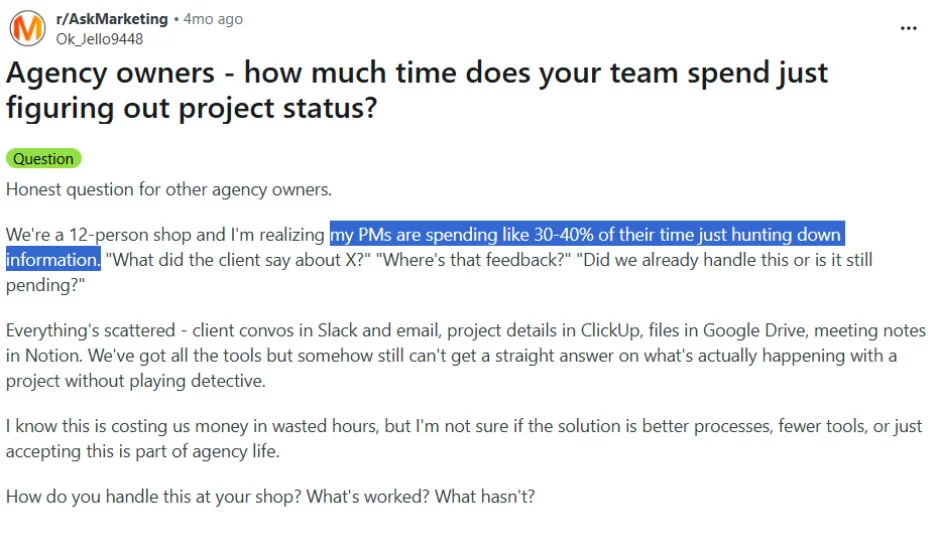
According to insights gathered from agency owners on Reddit, teams are losing between 30% and 40% of their total capacity simply chasing stakeholders for approvals. When you aggregate these minutes—writing follow-up emails, reconciling conflicting feedback across Slack and email, and manually checking status updates—the numbers are staggering.
The Chronology of a Failed Workflow
The average path to approval is a cycle of inefficiency. A typical content approval flow looks like this:
- Initial Submission: Crafting the content and the handoff message (5–8 minutes).
- The "Ghosting" Phase: Waiting 48 hours for a response before initiating a manual follow-up (10–15 minutes).
- Reconciliation: Merging feedback from email, Slack, and document comments (10–15 minutes).
- Final Confirmation: Validating that the corrected version is indeed the final one (5–10 minutes).
Total administrative overhead per post: 35 to 45 minutes.
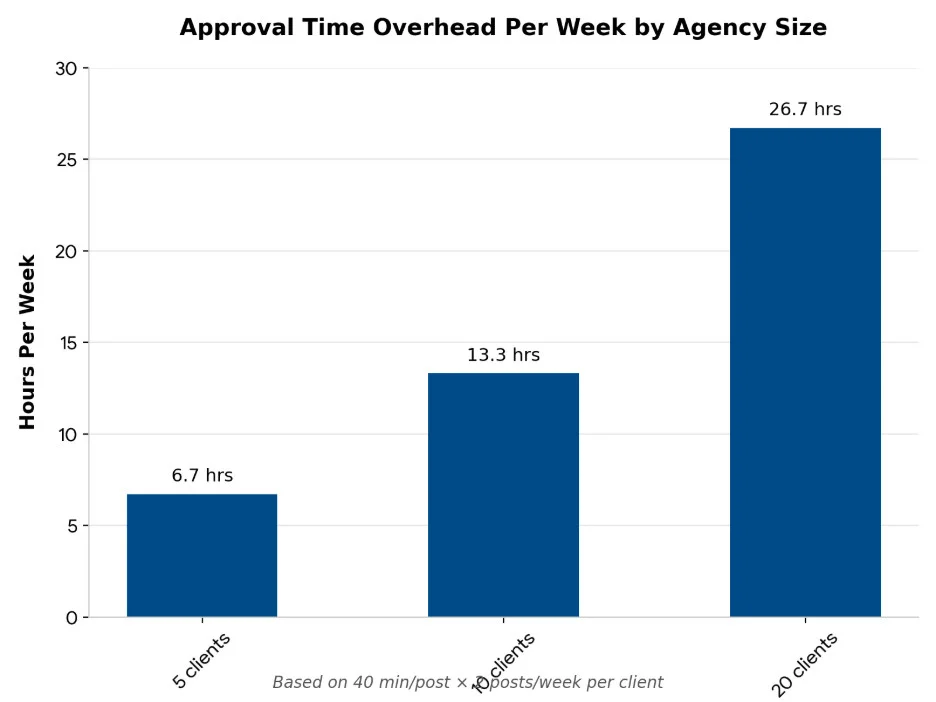
When you scale this across an agency managing five clients, with at least two posts per client each week, you are looking at over six hours of unbillable administrative labor every week. Across a year, this equates to hundreds of hours of "dead" time that could have been dedicated to strategy, acquisition, or higher-level creative execution.
Supporting Data: The Anatomy of "Work About Work"
The issue is not limited to boutique agencies. Research from Asana, which tracked the habits of over 10,000 knowledge workers, found that the average professional spends 60% of their day on "work about work"—status updates, hunting for information, and coordinating logistics—while only 27% of their time is spent on the skilled work they were actually hired to perform.
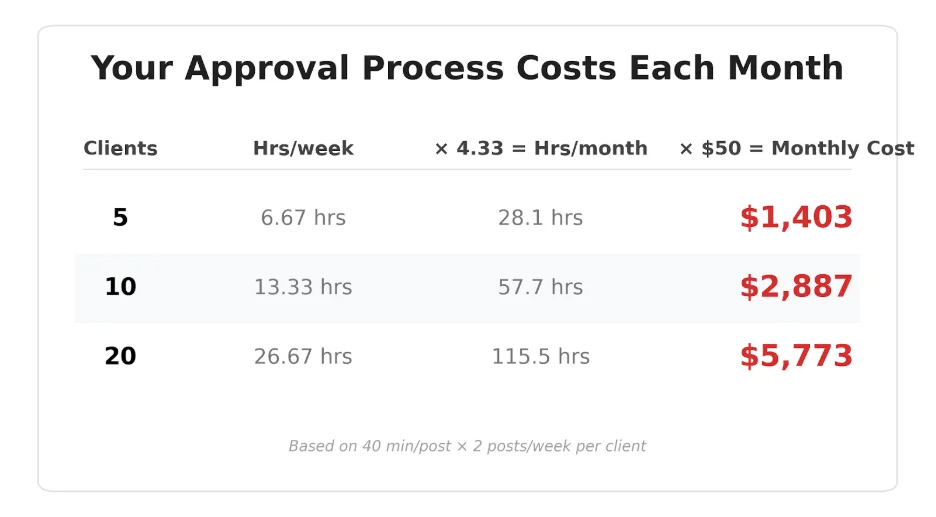
If you are an agency owner, you can calculate your specific "Approval Tax" using the following formula:
(Average minutes per post ÷ 60) × (Posts in approval per week) × (4.33 weeks per month) × (Your internal hourly rate) × (Number of clients) = Monthly Approval Cost.
For a small agency with an internal labor cost of $50 per hour, a 20-client portfolio can easily lose over $5,000 in monthly productivity. This is not just a rounding error; it is the equivalent of paying for a full-time, highly skilled employee whose sole job is to send follow-up emails.
Implications for Agency Health and Morale
The damage caused by inefficient approval loops extends far beyond the bottom line. It creates a "cultural debt" that erodes the foundation of your agency.
1. Revenue and Opportunity Cost
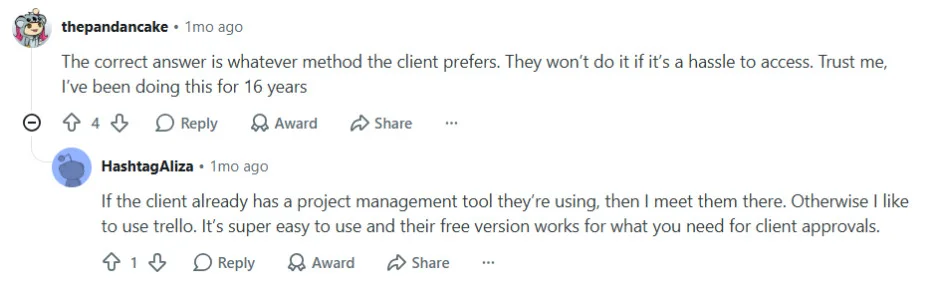
When a post takes eight days to clear the approval gauntlet, it is no longer timely. Trends on social media move in hours, not weeks. By the time a post is approved, the context may be stale, leading to underperforming content. This results in client dissatisfaction, which puts your retainers at risk.
2. The Erosion of Creative Ambition
Morale is perhaps the most difficult metric to track but the most damaging to lose. When creatives know that their work will be trapped in a week-long administrative loop, they stop pitching bold, experimental, or time-sensitive ideas. They begin to produce "safe" content to avoid the friction of the feedback process. As noted by the Chartered Institute of Marketing, 56% of marketers report significant burnout, with broken process flows being a leading contributor.
3. The Scalability Ceiling
The "invisible tax" scales linearly with your success. Each new client you land adds another layer of complexity: another email thread, another spreadsheet, and another inbox to monitor. Eventually, you hit a ceiling where your revenue increases, but your team’s capacity to deliver quality work shrinks.
Why Conventional Fixes Fail
Agency owners often attempt to patch these holes with "quick fixes" that fail to address the root cause.
- The Shared Document Approach: Moving clients into a shared Google Sheet or Notion board does not remove the need for manual intervention. It simply centralizes the silence. You now have a tidy, organized place to look at the work that hasn’t been approved yet.
- The "Strict Email Policy": Mandating reply-by deadlines via email templates works for roughly three weeks. Eventually, the client misses a deadline, the agency makes an exception, and the entire process reverts to the status quo. You cannot enforce discipline via email without creating friction in the client-provider relationship.
These methods fail because they rely on the agency to apply the pressure. In a healthy system, the process should apply the pressure, not the account manager.
The Path Forward: Systemic Accountability
To reclaim these hours, agencies must pivot to a model of automated accountability. This involves five structural changes to the workflow:
- The "Magic Link" Approach: Eliminate logins and fragmented threads. Provide a direct, personalized link to pending content.
- Defined Response Windows: Establish a 48-hour feedback window during the onboarding phase.
- Automated Reminders: Use software to trigger reminders so that the agency is never the one "nagging" the client.
- The Single Portal: Consolidate all feedback, edits, and final sign-offs into one interface.
- The "Auto-Approve" Default: If a client fails to provide feedback within the agreed-upon window, the system should treat the content as approved by default. This changes the dynamic: the client is now responsible for stopping the post, rather than the agency being responsible for starting it.
Leveraging Technology for Operational Excellence
Most social media scheduling tools were built to handle the "when" of posting, not the "how" of the approval cycle. Agencies often find themselves layering WhatsApp, Slack, and email on top of these tools, effectively doubling their workload.
Modern agency-first platforms, such as SocialPilot, are designed to bake these five fixes into the workflow:
- Approvals On-The-Go: Enables clients to review and sign off on posts via a secure, login-free link.
- Client Approval Workflows: Automates the 48-hour response windows, building deadlines into the infrastructure of the platform.
- Pending Approval Reminders: Offloads the manual labor of follow-ups to automated, professional system notifications.
- The Content Approval Portal: Provides a single, visible source of truth for both the agency and the client, eliminating the "did you see my email?" conversation.
- Auto-Approve Toggles: Ensures that campaigns remain on track even when stakeholders are unresponsive.
Conclusion: Stop Paying for Your Own Inefficiency
The approval overhead you see in your calendar is not an inevitable cost of doing business. It is a symptom of a process that has been left to atrophy.
When you fix the process, you don’t just gain back time; you gain the ability to scale your agency without scaling your administrative headcount. A $2,800 monthly loss for a 10-client agency is essentially an extra profit margin that is being thrown away. By shifting from manual, reactive management to an automated, system-driven workflow, you can stop paying for a problem you created and start investing those reclaimed hours into the growth and creative excellence of your agency.












No comments yet. Be the first to join the conversation!