

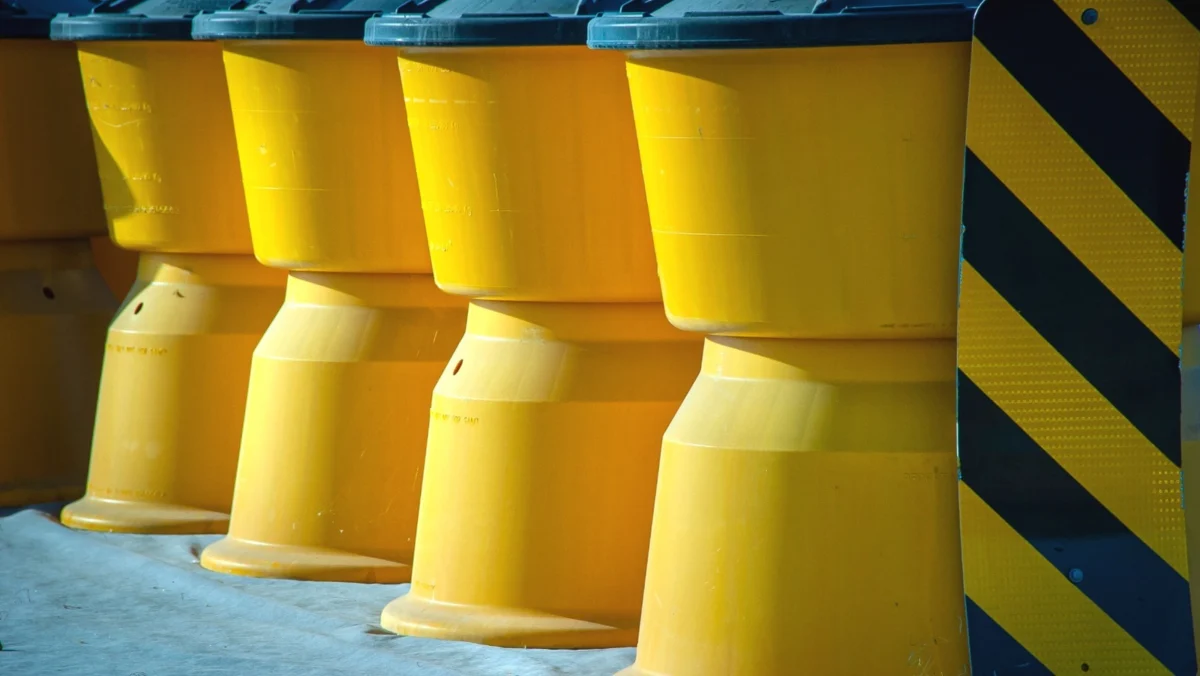
Every driver has encountered them: clusters of vibrant yellow barrels positioned strategically at highway exits, toll booths, and bridge pillars. While they are a common sight on the American landscape, they are often dismissed as simple construction markers or visual warnings. In reality, these objects—officially known as "impact attenuators" or "crash cushions"—are sophisticated life-saving devices rooted in complex physics and a rich history of automotive safety engineering. Far from being random obstacles, these barrels represent a critical line of defense in modern highway design, engineered to transform potentially fatal collisions into survivable events.
The Core Function: Physics in Action
To understand the purpose of a crash barrel, one must first understand the physics of a high-speed collision. When a vehicle strikes a rigid, immovable object—such as a concrete bridge abutment or the end of a steel guardrail—the kinetic energy of the moving car must be dissipated instantaneously. This rapid deceleration exerts immense force on the vehicle and its occupants, often with catastrophic results.
Impact attenuators are designed to manipulate the variables of Newton’s laws of motion. By providing a "soft" interface, these devices increase the duration of the impact. According to the impulse-momentum theorem, by extending the time it takes for a vehicle to come to a complete stop, the average force exerted on the vehicle is significantly reduced.
Think of it as the difference between hitting a concrete wall and hitting a large pile of pillows. The barrels are designed to be sacrificed; as the vehicle plows into the array, the barrels rupture, crush, or displace, absorbing the energy that would otherwise be transferred directly into the car’s frame and the bodies of its passengers.
A Legacy of Innovation: From the Racetrack to the Interstate
The evolution of these safety systems is inextricably linked to the dangerous world of mid-20th-century motorsport. In the 1960s, racing was a perilous pursuit, and the high death toll among drivers prompted a movement toward track safety. Among the pioneers of this movement was John Cooper Fitch, a distinguished American racing driver and inventor.
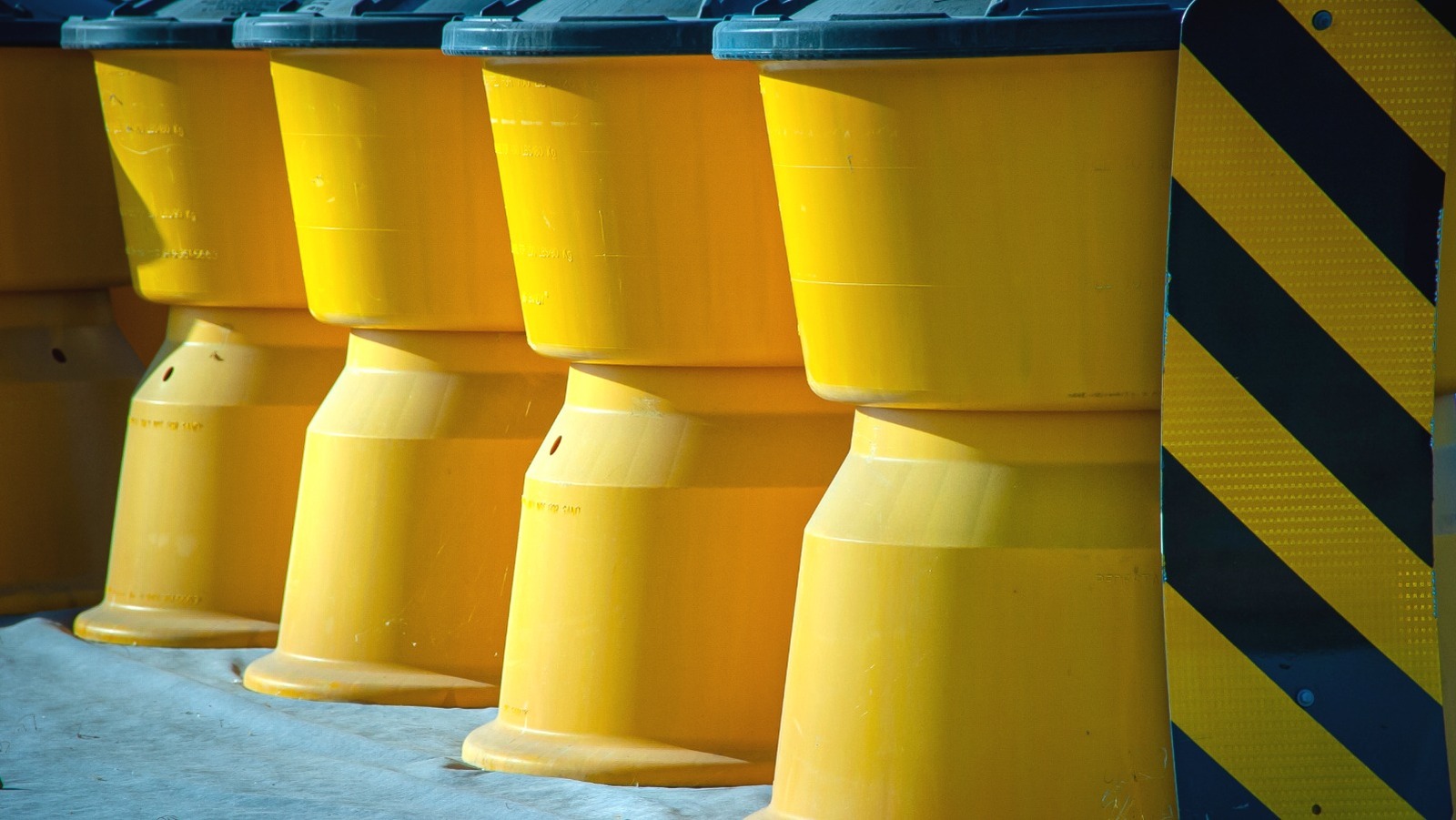
Fitch realized that the same principles used to protect drivers on high-speed ovals could be adapted for public road infrastructure. In the late 1960s, he introduced the "Fitch Inertial Barrier." This system used individual, modular containers filled with a specific mass of sand or liquid. The concept was elegant: by varying the weight of the barrels in a specific sequence, engineers could create a "progressive" stopping system.
When a vehicle strikes a Fitch barrier, it doesn’t just hit a wall; it hits a series of weights. The lightest, least-filled barrels are placed at the front to initiate the energy absorption process, while the heavier, denser barrels are positioned closer to the hazard to provide the final, controlled halt. This design methodology moved highway safety from a reactive stance—simply putting up a barrier—to a proactive, engineered solution.
The Composition of Protection: Sand vs. Liquid
While the yellow color is a universal standard for visibility, the internal composition of these barrels is a subject of ongoing engineering refinement. The two primary materials used to fill these containers are sand and liquid (usually water).
Sand-Filled Barrels
Sand is the traditional choice for inertial barriers. It is highly effective at absorbing impact energy through friction and displacement. Because sand is dense, it provides the "inertia" necessary to stop even heavy trucks. However, sand-filled barrels are static; once they are hit, the sand is scattered, and the barrier requires significant labor to clean up and reset.
Liquid-Filled Barrels
Water-filled systems offer a more modern alternative. Water is excellent at absorbing energy through fluid dynamics, and these systems are often easier to drain and move during temporary construction projects. The critical challenge with water, however, is thermodynamics. To prevent the barrels from freezing into solid blocks of ice during the winter—which would turn a safety cushion into a rigid obstacle—engineers mix the water with additives like magnesium chloride. This keeps the contents in a liquid state, ensuring the system remains "soft" regardless of the ambient temperature.
Deployment Strategies and Structural Arrangement
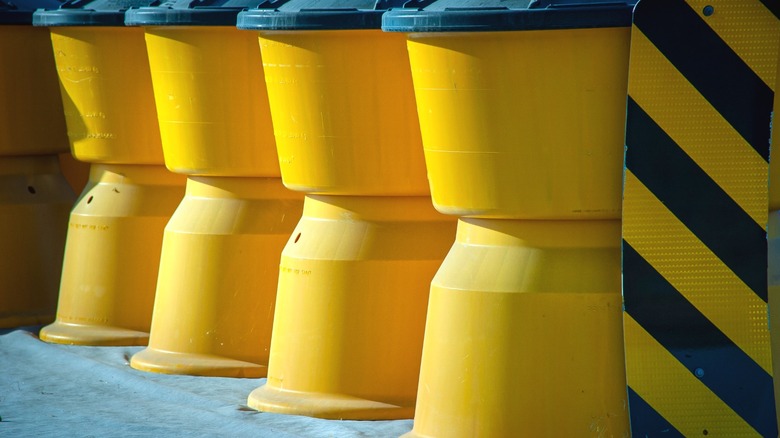
The arrangement of these barrels is never haphazard. Highway departments follow strict federal and state guidelines, often dictated by the Manual on Uniform Traffic Control Devices (MUTCD) and NCHRP Report 350 (or the newer MASH standards).
Progressive Deceleration
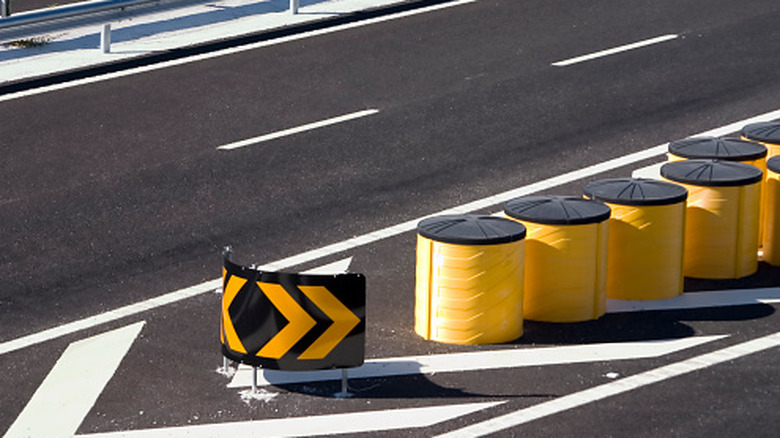
The most common configuration is the "V-shape" or a tiered array. By placing the shortest, lightest barrels at the leading edge, the barrier forces the vehicle to "ramp up" its deceleration. As the vehicle moves deeper into the cluster, it encounters higher levels of resistance. This prevents the "pogo-stick" effect, where a vehicle might bounce dangerously back into traffic, and instead aims to trap or redirect the vehicle away from the hazard.
Redirection vs. Absorption
Modern highway safety also utilizes "gating" and "non-gating" systems. Gating systems are designed to allow a vehicle to pass through the barrier if hit at an angle, safely redirecting it away from the obstacle. Non-gating systems are intended to absorb the energy of a head-on impact. Crash barrels are almost exclusively non-gating, designed to be the final buffer before a vehicle strikes a non-movable structure like a bridge pier.
Official Perspectives and Safety Implications
According to the Federal Highway Administration (FHWA), the use of roadside safety hardware is one of the most effective strategies for reducing fatalities on the nation’s roadways. The implementation of impact attenuators is based on "clear zone" requirements—the distance a vehicle can safely leave the road without hitting a fixed object. Where the geography of a highway prevents a wide clear zone, crash barrels are the mandated solution.
The implications for public health are profound. Statistics consistently show that the presence of properly maintained attenuators drastically reduces the severity of injuries in run-off-the-road accidents. By converting a "hard" crash into a "soft" one, these devices give first responders more time to arrive and significantly improve the survival odds for occupants of all vehicle types, from small sedans to commercial haulers.
The Future of Highway Safety
As we move toward a future of autonomous vehicles and smart infrastructure, the role of physical crash cushions remains vital. While sensors and AI-assisted braking will eventually reduce the frequency of human-error collisions, the reality of high-speed travel dictates that mechanical safety systems will always be necessary.
Current innovations are focusing on "self-restoring" barriers—systems that can absorb an impact and return to their original shape, or modular systems that can be remotely adjusted based on traffic flow. Additionally, the integration of smart sensors into these barrels—which could alert dispatchers the moment a collision occurs—is already in the pilot testing phase in several states.
Conclusion
The next time you pass those yellow barrels on the highway, consider them more than just visual markers. They are the product of decades of research, the descendants of racing technology, and a masterclass in the application of physics to save human life. They represent the quiet, often overlooked science of highway safety—a silent, yellow-clad sentinel waiting at the roadside to ensure that a simple mistake behind the wheel doesn’t become a final one. While we hope never to test their structural integrity, their presence is a testament to the engineering commitment to keep our roads as safe as possible, one barrel at a time.












No comments yet. Be the first to join the conversation!