

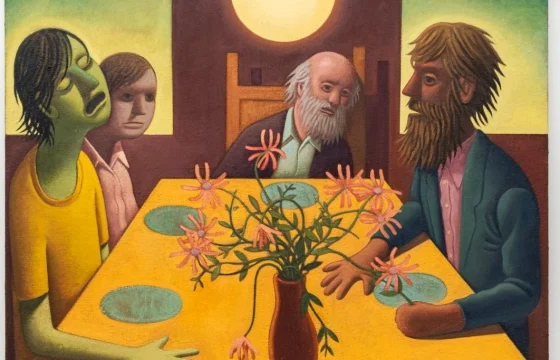
NEW YORK, NY – HESSE FLATOW has officially unveiled Franklin, a poignant and intellectually rigorous exhibition of new paintings and works on paper by artist Nat Meade. Marking his third solo presentation with the gallery, the exhibition invites viewers into a complex psychological landscape where the mundane realities of domestic life collide with the weight of historical, mythological, and existential inquiry. The show, which serves as a profound meditation on the intergenerational transmission of trauma and the transformative power of reconciliation, will remain on view through April 18, 2026.
Main Facts: A Canvas of Archetypes
At the heart of Franklin lies a series of figurative works that function as allegorical mirrors. Rather than functioning as traditional portraits of specific individuals, Meade’s subjects are stylized archetypes—figures that resonate with the collective unconscious. These protagonists navigate the multifaceted roles of the artist’s own life: father, son, partner, and academic.
Meade employs an "allegorical distance" in his painting, a technique that allows him to process personal vulnerabilities—ranging from the grief of his father’s recent passing to the anxieties of his own parenting—through a lens of absurdity, dark humor, and solemn reflection. By stripping his subjects of their specific identities, Meade creates a universal stage where the viewer can confront the "inescapable resonance" of human nature. The exhibition is not merely a display of technical prowess, but a curated exploration of the human condition, grappling with the uncomfortable tension between the violence of the past and the potential for a more harmonious future.
Chronology: The Evolution of a Narrative
The genesis of Franklin can be traced back to a period of intense personal transition for the artist. Following the death of his father, Meade found himself in a state of deep reevaluation, examining the legacy he inherited and the one he is currently constructing for his own children.
- The Period of Turbulence: Early in his career, Meade’s work was defined by figures caught in the grip of chaotic, often hostile environments. Characters were frequently depicted as victims of nature, physically overwhelmed by gale-force winds or the crushing weight of turbulent, crashing waves. This era represented an obsession with the "insurmountable heaviness" of existence.
- The Catalyst of Loss: The death of Meade’s father acted as a pivot point. The artist began to move away from depicting human struggle against external forces, shifting his gaze toward the internal struggles of lineage, memory, and inherited trauma.
- The Current Synthesis (Franklin): The present exhibition represents the culmination of this thematic shift. While the ghosts of his previous work remain—manifesting as specters or vultures—the introduction of younger, more harmonious figures suggests a deliberate movement toward healing. The chronology of Meade’s practice is thus a journey from externalized conflict to an internalized, and ultimately hopeful, reconciliation.
Supporting Data: Symbols, Metaphors, and Literary Allusions
Meade’s work is densely packed with semiotic markers that invite deep interrogation. His ability to blend the high-brow with the low-brow—the art-historical with the pop-cultural—is a defining feature of the Franklin collection.
The Horror of Lineage
The title Franklin serves as an intentional nod to the 1974 horror classic The Texas Chainsaw Massacre. The film is famously centered on a deranged, patriarchal family, a trope that Meade subverts to explore his own "inner turmoil" regarding masculinity. By invoking the film, he addresses the danger of "violent and antagonistic impulses" passed down through generations. He explores the concept of the "patriarchal burden," questioning how a man can separate his own identity from the violent histories that shaped his forebears.
Mythological and Artistic Parallels
Meade draws heavily from the Western canon to ground his contemporary anxieties:
- The Prometheus Motif: In one piece, a vulture picks at a corpse, a direct reference to the eternal punishment of Prometheus. This highlights the unending nature of human suffering when one is shackled to a sense of duty or power.
- Blakean Echoes: A bearded figure, depicted on his hands and knees, evokes William Blake’s Nebuchadnezzar. The reference points to a loss of humanity born from a "lust for power," serving as a warning against the hubris that can erode the familial bond.
- The Cartoon Spirit: In a more whimsical yet haunting touch, Meade utilizes the visual language of classic animation. When a soul "peels away" from a body, it reflects the artist’s own questioning of the separation between the physical and the spiritual. It is a moment of existential pause, where the spirit looks back at the body with a mixture of happiness and regret.
Official Responses and Curatorial Perspectives
HESSE FLATOW has positioned Franklin as a critical milestone in Meade’s career. Gallery representatives have emphasized that the work succeeds because it refuses to offer easy answers. "Meade is doing something rare," a spokesperson noted during the opening. "He is looking at the wreckage of history—personal and global—and choosing to paint a path forward. The vulnerability he displays is not a sign of weakness; it is a radical act of bravery."
Critics who have previewed the collection highlight the distinct difference in how Meade renders adults versus children. "The adults are often haunted, burdened by specters of trauma," one reviewer noted. "But the children—they represent a clean slate. When you look at the boy steering a boat with a torch, you aren’t seeing a person carrying the weight of the world; you are seeing someone learning how to illuminate their own way."
Implications: The Search for Resilience
The primary implication of Franklin is that the "rocky histories" of our ancestors do not have to be the blueprints for our future. Meade’s work argues that acknowledging pain is the only way to facilitate the release required for the next generation to thrive.
The Shift Toward Calmer Seas
The transition in Meade’s work from turbulent, destructive landscapes to "calmer seas" and shallow, tranquil pools is perhaps the most significant takeaway from the exhibition. In one piece, a father tenderly guides his son’s legs in a shallow cove. The water is clear, the sea floor is visible, and the danger is replaced by a sense of stewardship. This imagery serves as a metaphor for parenting: it is not about shielding the child from the world, but about providing a guide to navigate the terrain with wonder rather than fear.
The Stubbornness of Hope
Despite the heavy thematic undercurrents of death and trauma, Franklin is fundamentally a hopeful show. By juxtaposing the "vulture at the corpse" with the "boy with the torch," Meade forces a conversation about the persistence of life. He posits that human nature, for all its capacity for cruelty, possesses an innate, "stubborn resilience."
For the viewer, the exhibition offers a space to process their own familial narratives. Whether one is struggling with the loss of a parent or the challenges of raising a child, Meade’s work provides a visual vocabulary for these experiences. He suggests that while we cannot change the past, we can change the nature of our engagement with it.
Conclusion: A Legacy Reimagined
As Franklin continues its run at HESSE FLATOW, it stands as a testament to the power of painting to act as a therapeutic and social tool. By moving through the "absurd, somber, and humorous," Nat Meade has created a collection that is as intellectually challenging as it is emotionally resonant.
The exhibition is a reminder that the cycle of life—birth, death, and everything in between—is not merely a series of events, but a process of transformation. Through the careful application of paint and the deliberate selection of symbols, Meade has crafted a sanctuary where the ghosts of the past are not banished, but acknowledged, understood, and finally allowed to rest, clearing the path for the next generation to chart their own, unclouded course.
The exhibition is a must-see for those interested in the intersections of contemporary figurative art, the psychological nuances of fatherhood, and the enduring power of the human spirit to find beauty in the face of inevitable mortality.










No comments yet. Be the first to join the conversation!