

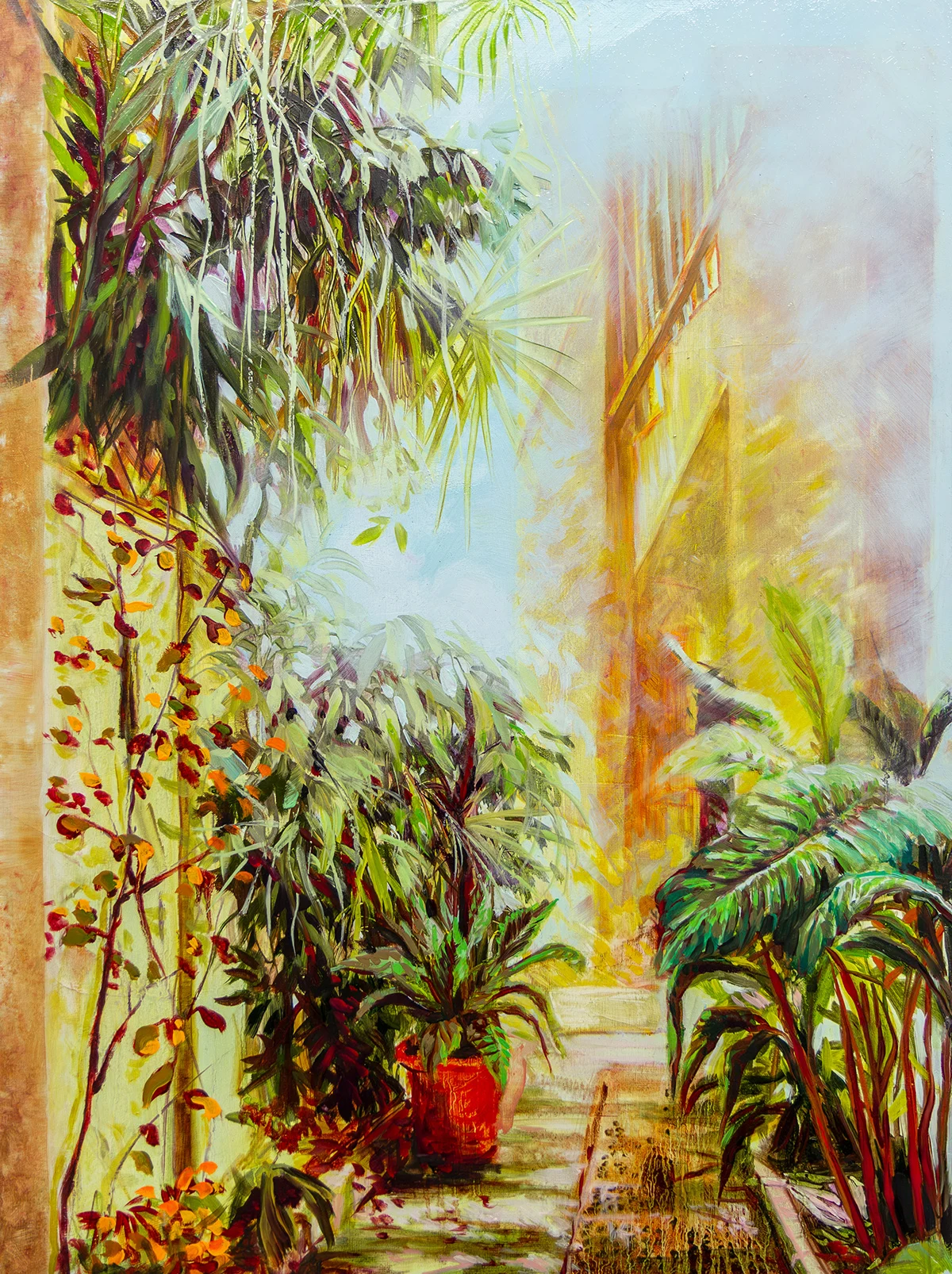
In the contemporary art landscape, few themes are as enduring or as complex as the intersection of personal geography and the construction of identity. For Montreal-based artist Sylvia Trotter Ewens, this intersection is not merely an intellectual pursuit but a lived, visceral reality. Her latest exhibition, Echoes of Elsewhere, currently on display at the Plato Gallery through May 30, serves as a poignant visual interrogation of what it means to exist between cultures—specifically, the landscapes of Honduras and Quebec.
Through a masterful blend of architectural aesthetics, ecological discourse, and deeply personal narrative, Trotter Ewens invites viewers to navigate the fragmented spaces of her own history. By merging the visual motifs of her birthplace with those of her adopted home, the artist crafts a visual language that speaks to the "in-betweenness" of the immigrant experience and the profound, often quiet, weight of adoption.
Main Facts: The Architecture of Displacement
Echoes of Elsewhere is a collection of paintings that functions as a cartography of the psyche. Trotter Ewens utilizes a distinct stylistic approach, layering images derived from her personal archives—photographs captured in both Honduras and Quebec—to create synthetic, ethereal environments.
The exhibition is defined by several core pillars:
- The Medium: Primarily painting, informed by her extensive academic training in Fine Arts.
- The Subject: The synthesis of dual geographies as a proxy for internal identity.
- The Philosophy: An exploration of "liminality"—the state of occupying a threshold between two distinct states of being.
- The Venue: Hosted by the Plato Gallery, a space known for championing narratives that push the boundaries of contemporary visual discourse.
The work is not intended to be a literal representation of either location. Instead, it is a psychological map. By overlapping the lush, vibrant textures of Honduran topography with the cooler, structural aesthetics of Quebec’s architectural landscape, Trotter Ewens creates a "third space." This space is neither here nor there, but rather a hybrid environment that reflects the artist’s unique perspective as someone who has navigated the complexities of being an adoptee and an immigrant.
Chronology: A Trajectory of Artistic Maturation
The evolution of Trotter Ewens’ practice is a testament to the power of institutional support and rigorous self-reflection. Her journey from student to exhibiting professional provides context for the maturity observed in her current work.
Foundations (The Academic Years)
Trotter Ewens’ formal education laid the groundwork for the technical precision seen in Echoes of Elsewhere. She began her artistic trajectory by earning her DEC in Fine Arts from Dawson College, an institution renowned for its focus on fundamental artistic disciplines. This period was crucial in developing her command over form and light.
Following her time at Dawson, she transitioned to Concordia University, a powerhouse for contemporary painting in Canada. There, she completed both her Bachelor of Fine Arts (BFA) and Master of Fine Arts (MFA). It was during these graduate years that she began to shift her focus from traditional landscape painting toward the more conceptual, fragmented approach that characterizes her current work. The transition from technical mastery to conceptual depth was not overnight; it was a process of deconstructing the "landscape" as a static object and rebuilding it as a narrative device.
Development and Transition
Post-graduation, the artist spent several years working within the Montreal art scene, refining her style. This period was marked by an increasing interest in how ecological discourse—the way humans interact with and modify their environment—could serve as a metaphor for personal growth. By the time she began curating the pieces for Echoes of Elsewhere, the methodology was clear: the environment was no longer just a subject; it was a mirror.
Supporting Data: The Science of Identity and Geography
While art is often viewed through a subjective lens, the themes present in Echoes of Elsewhere find substantial support in psychological and sociological studies regarding transnational identity and transracial adoption.
The Liminal Experience
Psychologists often refer to the "adoptee experience" as a specific type of liminality. Because Trotter Ewens was adopted as an infant, her connection to Honduras is one of heritage and genetic memory rather than lived, day-to-day experience. Conversely, her life in Quebec is a lived reality, yet one that exists alongside the persistent, ghostly presence of a distant origin.
Studies on "dual belonging" suggest that individuals who maintain a connection to two distinct cultures often develop a heightened sensitivity to space. They are "hyper-aware" of their surroundings because they are constantly comparing and contrasting them against an internal standard of "home." Trotter Ewens’ work mirrors this; the fragmentation in her paintings—sharp edges, blurred transitions, and discordant color palettes—is a visual representation of the cognitive load required to balance two cultures simultaneously.
Photographic Archives as Evidence
The artist’s use of photography as the foundation for her paintings is significant. By taking photographs in both Honduras and Quebec, she is collecting "data" points from her life. When these are synthesized on canvas, she is creating a collage of her own history. This process mirrors the way memory functions: it is not a perfect recording but a selective, fragmented reconstruction of events. The "echoes" in the exhibition title refer to the persistence of these images across time and space, demonstrating how a photograph can act as an anchor for a memory that might otherwise dissolve.
Official Responses and Critical Reception
The reception of Echoes of Elsewhere has been largely positive, with critics praising the artist’s ability to balance the technical demands of painting with the emotional weight of her subject matter.
The Curator’s Perspective
The Plato Gallery has emphasized that Echoes of Elsewhere represents a shift in their programming toward more introspective, biographical work. "Sylvia’s work doesn’t just show us a landscape; it forces us to inhabit her internal experience," noted a spokesperson for the gallery. "There is a quiet intensity to the way she manages the tension between the organic shapes of Honduras and the industrial, architectural lines of the North. It is a dialogue between two worlds that are usually kept separate."
Peer and Academic Review
Fellow artists and critics have pointed to the "architectural aesthetics" mentioned in her biography as the standout feature of the show. By treating architecture as a psychological frame, Trotter Ewens is able to isolate emotions. When a painting features a doorway that leads nowhere, or a window that looks out onto a landscape that shouldn’t be there, the viewer is forced to confront the impossibility of returning to a "pure" version of either home. It is an acknowledgment that identity, like the painting, is a construction.
Implications: The Future of Cultural Hybridity
The implications of Echoes of Elsewhere extend beyond the walls of the Plato Gallery. As the world becomes increasingly globalized and migration patterns continue to reshape demographics, the conversation surrounding identity, belonging, and displacement is more relevant than ever.
The "Neither Here Nor There" Paradigm
Trotter Ewens’ work contributes to a growing body of art that challenges the notion of a "singular" identity. By embracing the state of being "neither completely of here nor there," she provides a template for others to view their own displacement not as a deficit, but as a site of potential. The "echo" is not a sign of absence, but a presence that lingers, shaping the way the present is experienced.
A New Narrative for Adoptees
For the adoptee community, the exhibition serves as a significant touchpoint. Traditional narratives often focus on the search for origins or the trauma of separation. While these elements are undoubtedly present in Trotter Ewens’ work, she moves the conversation forward into the realm of agency. She is not merely searching for her history; she is actively integrating it into a new, original existence. She is building a home out of the fragments of two disparate worlds.
Final Thoughts
As the exhibition closes on May 30, the legacy of Echoes of Elsewhere will likely reside in its quiet, persistent call for empathy. It challenges viewers to consider their own "landscapes"—the environments that have shaped them, the distances they have traveled, and the fragmented memories they carry with them into the present.
Sylvia Trotter Ewens has succeeded in turning the personal into the universal. By inviting us into her fragmented spaces, she has created a place where we, too, can pause, reflect, and perhaps find a sense of belonging within our own unique, shifting terrains. Whether or not one shares the specific experience of adoption or migration, the exhibition asks the fundamental human question: Where do we end, and where does our environment begin? In the work of Trotter Ewens, the answer is as fluid and beautiful as the landscapes she paints.









No comments yet. Be the first to join the conversation!