Reynand Wu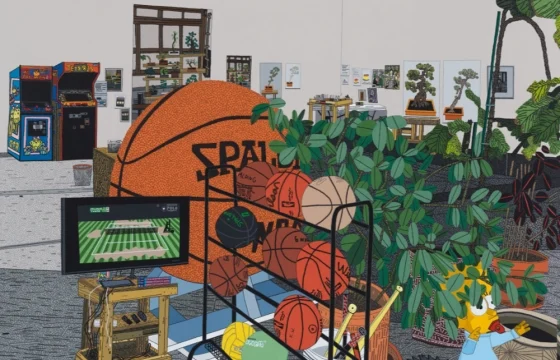
In a vibrant homecoming for one of the most significant voices in contemporary American painting, Gagosian has unveiled a new exhibition dedicated to Jonas Wood’s latest series of tennis court paintings. Marking the gallery’s tenth collaboration with the artist—and, notably, its first exhibition of his work in Los Angeles—this collection serves as a profound meditation on the intersection of spectator culture, formal abstraction, and the domestic interior. The exhibition, which captures the rhythmic geometry of professional tennis, will remain on public view through April 25, 2026.
Main Facts: The Architecture of the Match
Jonas Wood has long been obsessed with the structural potential of the tennis court. Since beginning the series in 2011, he has utilized the standardized dimensions of the court as a playground for formal exploration. In this latest iteration, featuring works produced between 2025 and 2026, Wood presents a high-octane visual dialogue between the reality of televised professional matches and the subjective lens of the artist’s studio.
Each painting captures a specific tournament—ranging from ATP and WTA circuits to the Olympic Games—from the unique vantage point of behind the baseline. The compositions are intentionally foreshortened, pushing the viewer into a position of observation that feels both intimate and detached. Strikingly, Wood omits the human players and officials entirely. Instead, the focus is placed squarely on the surface, the signage, and the architectural apparatus of the stadium.
The crowds, when present, are rendered through rhythmic, repeated brushstrokes that evoke the texture of impressionist pointillism more than the chaos of a stadium audience. By removing the primary subjects of the sport, Wood transforms these iconic venues into abstract stage sets, inviting the viewer to contemplate the color, lines, and saturated palettes of the game itself.
Chronology: A Decade of Developing the Court
To understand the weight of this exhibition, one must look at the trajectory of Wood’s career over the last fifteen years. When Wood first started painting tennis courts in 2011, the project was seen as a pivot toward "serial abstraction." He was drawn to the inherent grid of the court—the lines, the nets, and the specific chromatic identities of clay, grass, and hard-court surfaces.
By 2020, the series had evolved from a direct observation of the game to a commentary on the medium of television. The addition of on-screen graphics—player names and running scores—marked a shift in Wood’s practice, anchoring his paintings in specific, ephemeral moments of broadcast history.
This current 2026 exhibition represents the most complex stage of that evolution. It is no longer just about the match; it is about the experience of the match. The inclusion of Nintendo 3 (2025), a work based on a digital video game, signals a further expansion of Wood’s definition of "sports imagery," acknowledging that in the modern era, our primary relationship with sport is often mediated through screens, pixels, and consoles as much as through physical stadiums.
Supporting Data: The Anatomy of a Painting
The technical complexity of these new works is evident in the variety of compositions on display. Wood employs a vertical canvas to frame a horizontal landscape, creating a jarring, compelling tension that mirrors the experience of watching a match in a dimly lit room.
The Interior-Exterior Dichotomy
A hallmark of this exhibition is how Wood blurs the lines between the public stadium and the private home. In works such as Wimbledon with Wood Grain (2025) and Indian Wells (2025), he juxtaposes the manicured surfaces of the sport with domestic textures like brick, wood grain, and speckled flooring. These elements act as a visual reminder that for most fans, the stadium is a destination reachable only through the television.
The "Studio View" Integration
Perhaps the most ambitious pieces are those that incorporate the artist’s own creative environment. Bball Studio with Tennis Court (2026) serves as a meta-commentary on the entire series. It depicts the artist’s workspace, complete with the detritus of the creative process, while a tennis match hums on a television in the background. Other works, such as Shanghai Masters (2025), integrate wall-mounted notes and architectural elements like palm-filled windows, effectively layering the "real" world of the studio over the "simulated" world of the broadcast.
The Pop Art Heritage
The exhibition also features a bold engagement with art history. By integrating interpretations of Roy Lichtenstein’s Crying Girl (1963), Nude with Blue Hair (1994), and Girl (1963) into three major canvases—Paris Olympics with Crying Girl, Dubai with Nude with Blue Hair, and Hamburg Open with Girl—Wood positions his work firmly within the lineage of Pop Art. This is not merely an homage; it is a critical analysis of how printmaking techniques and mass-media imagery can be repurposed to create new forms of abstraction.
Official Perspectives: The Curator’s View
While Gagosian has remained typically understated regarding the specific valuation of these works, the gallery’s decision to stage this exhibition in Los Angeles—the artist’s home base—carries significant weight. For Wood, who has often been categorized as a "painter’s painter," this show is a deliberate move to bring his global, high-stakes subject matter back to the local context of his studio practice.
Critics and curators have noted that the absence of players in these works is a strategic choice. By stripping away the athletes, Wood forces the audience to engage with the system of the sport. As one Gagosian spokesperson noted during the press preview, "Wood is not painting tennis; he is painting the container of our collective attention. He is showing us how we consume images of power, competition, and geometry in the 21st century."
Implications: The Legacy of the Tennis Court Series
The implications of this exhibition for the contemporary art market and the broader discourse on Pop Art are substantial. Firstly, Wood has successfully moved the tennis court series from a niche exploration of sports into a broader, more philosophical inquiry into the nature of reality. By blending the digital (the scoreboard), the physical (the clay court), and the domestic (the studio wall), he captures the fragmented nature of modern existence.
Secondly, the homage to Lichtenstein cements Wood’s standing as a bridge between the mid-century Pop giants and the contemporary post-digital generation. He proves that the "crossover" between painting and printmaking is not just a technicality, but a conceptual bridge that allows for the remixing of visual culture.
Finally, the exhibition raises questions about the future of the series. If Wood is now beginning to incorporate video game imagery and his own domestic interior into the mix, where does the "tennis court" end and the "everyday life" begin? This show suggests that for Wood, the tennis court is no longer just a subject—it is a language.
As the exhibition continues through April 2026, it serves as a litmus test for the enduring power of figurative abstraction. In an era dominated by rapid-fire digital imagery, Jonas Wood’s slow, deliberate, and highly structured paintings provide a necessary pause. They invite us to look at the lines—the ones on the court, the ones on the screen, and the ones that define the boundaries of our own private worlds. For collectors, scholars, and casual observers alike, this show is not just an exhibition of new paintings; it is a definitive statement on the state of contemporary art in a mediated world.


 Jia Lissa
 Lina Hope