

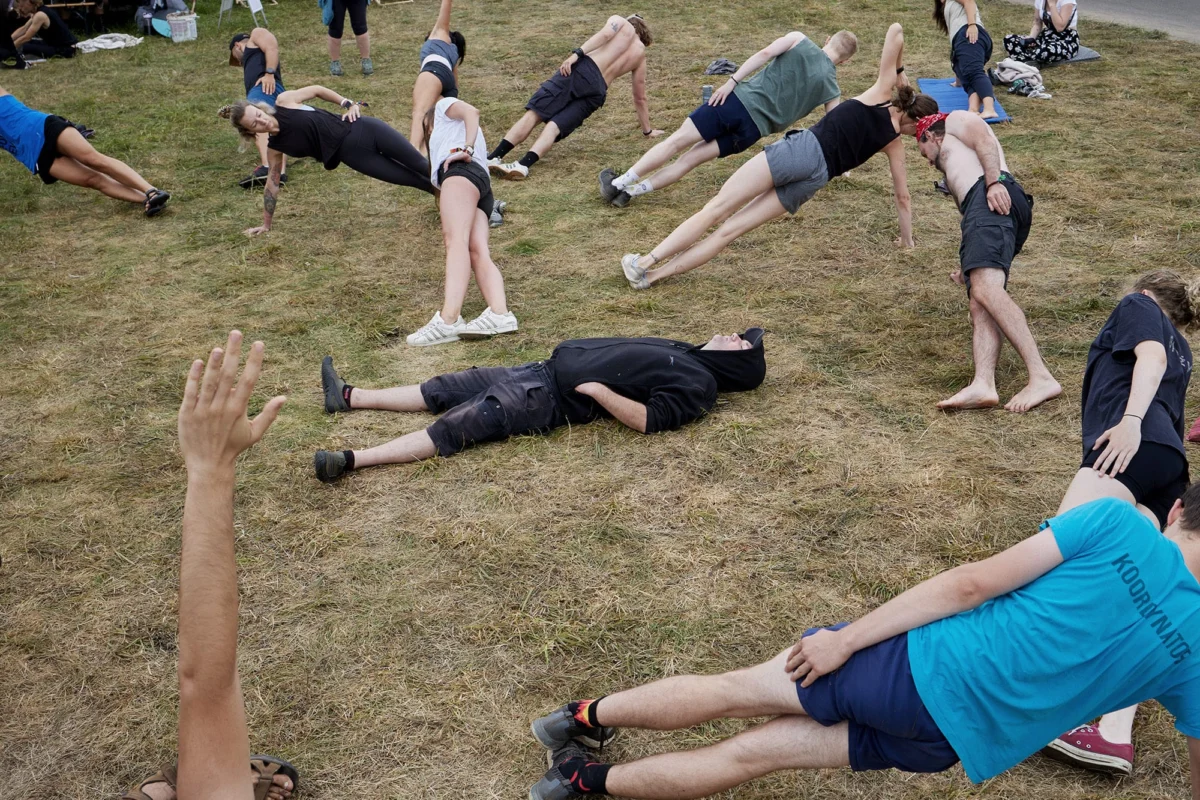
In an era dominated by the relentless pursuit of aesthetic perfection—where algorithms dictate the visual language of social media and polished, curated imagery is the standard—Polish photographer Janusz Jurek is charting a strikingly different path. A graphic designer and commercial photographer by trade, Jurek finds his true artistic release in the unscripted, the messy, and the wonderfully bizarre occurrences of daily life. His street photography is not a pursuit of beauty; it is a pursuit of authenticity found in the periphery.
The Philosophy of the Peripheral
For Jurek, the camera is less of a tool for documentation and more of an instrument for discovery. While many street photographers position themselves at the heart of an event, waiting for the "decisive moment" at the center of the action, Jurek does the opposite. He consciously turns his back on the main attraction, focusing his lens on the reactions of the crowd, the small, involuntary gestures of individuals, and the strange, serendipitous coincidences that occur in the margins.

"The less commercial and more bizarre, the better," Jurek explains. "People are more authentic then, less in control of what they’re doing." By capturing individuals in moments where their guard is down—whether they are caught in a quirky physical configuration or simply reacting to an unseen event—Jurek reveals the humanity that hides behind the polished facade of modern urban existence.
A Chronology of Observation: The Five-Year Project
Jurek’s creative journey as a candid observer has evolved significantly over the last half-decade. What began as a series of disparate snapshots has coalesced into a rigorous project entitled Look, Before It’s Gone.

- Year 1-2 (Foundation): Jurek began by focusing on local festivals and public gatherings in Poland. During this phase, he learned to anticipate the "visual rhythm" of a crowd, learning that the most compelling narratives often happen in the quiet gaps between major performances or speeches.
- Year 3 (Refining the Eye): During the middle phase of the project, Jurek shifted his focus toward urban environments—marketplaces, parks, and busy city intersections. It was during this time that he began to embrace the "anti-aesthetic" of his work. He moved away from the pressure to create "pretty" images and instead leaned into the uncomfortable and the surreal.
- Year 4-5 (Synthesis): The final stages of the project have been characterized by a more refined ability to spot the "visual puns" that define his current style. From a man seemingly inhaling smoke from a nearby fire to individuals walking with watering cans on their heads, Jurek’s work has become a sophisticated study in visual serendipity.
Look, Before It’s Gone is currently being finalized as a comprehensive collection, serving as a testament to five years of patient, observant, and often humorous dedication to the craft.
Supporting Data: The Anatomy of a Candid Moment
To understand the appeal of Jurek’s work, one must look at the technical and compositional elements that separate his photography from the saturated landscape of contemporary street images. His images often rely on what can be described as "visual dissonance."

The Compositional Toolkit
- The Layering Effect: Jurek frequently uses foreground elements—like textiles on a drying line or architectural frames—to obscure part of the frame, creating a sense of voyeurism.
- Juxtaposition: His work often pairs contrasting subjects, such as elderly citizens observing costumed festival participants, highlighting the generational and cultural friction of modern society.
- The "In-Camera" Illusion: Many of his most popular shots rely on perfect alignment, where natural smoke, foliage, or structural geometry creates the illusion that a subject is interacting with something that isn’t actually there.
These technical choices are never accidental. They are the result of a photographer who understands the principles of graphic design—balance, negative space, and visual flow—and applies them to the chaotic environment of the street.
Official Perspectives: The Artist on His Craft
In recent interviews, Jurek has been clear about his motivations. He does not view himself as a traditional documentarian of street life, but rather as an explorer of the human condition.

"I don’t care about the photos being ‘pretty,’" he asserts. "Quite the opposite—for me, street photography is the antithesis of all the technical perfection and imperfection that is everywhere on the internet these days."
His response to the common critique that street photography should be "uplifting" or "artistic" is rooted in his desire to provoke. Whether his viewer feels amusement, curiosity, or a sense of mild, disorienting discomfort, Jurek considers the photograph a success. He is interested in the questions that arise when a viewer looks at a frame: Why is that person standing like that? What are they looking at? Is that real?

The Implications for Street Photography
Jurek’s work arrives at a pivotal time for the medium. As AI-generated imagery and high-end, color-graded street photography become the norm, the "raw" street aesthetic is seeing a resurgence. By focusing on the "uncontrollable" nature of human beings, Jurek offers a critique of the highly curated nature of our digital lives.
Redefining Authenticity
The implications of Jurek’s approach are threefold:

- Rejection of Perfection: By intentionally ignoring the "golden ratio" or the need for pristine lighting, Jurek empowers other photographers to look for the "ugly-beautiful" moments that defined the work of legends like Garry Winogrand or Diane Arbus.
- Focus on the Mundane: His work proves that one does not need to travel to exotic locales to find compelling subject matter. Whether in a local park or a grocery store, the human condition is constantly on display.
- The Viewer as Participant: Jurek’s images require work from the viewer. Because he doesn’t provide a clear, easy-to-read narrative, the audience is forced to piece together the scene, effectively becoming a participant in the creation of the story.
Looking Forward: A Call to Notice
As Jurek prepares for the release of Look, Before It’s Gone, his influence continues to grow within professional and amateur circles alike. His work reminds us that the most profound moments are often those that go unnoticed by the average passerby.
For those looking to engage with his work, Jurek maintains an active presence on Behance and Instagram, where he shares not just his images, but his evolving perspective on the street.

The future of street photography, if Jurek’s work is any indication, lies not in better gear or more expensive post-processing, but in a sharper, more empathetic eye. It lies in the willingness to look away from the spectacle and toward the quiet, awkward, and infinitely fascinating coincidences that happen when we stop trying to control the world and simply start watching it.
As the digital world continues to race toward a future of synthetic perfection, Janusz Jurek stands as a reminder that there is still immense power in the simple, messy, and unscripted reality of being human. Whether through the lens of a camera or the simple act of observation, the message is clear: if you want to see something truly unique, you only need to look—before it’s gone.









No comments yet. Be the first to join the conversation!