

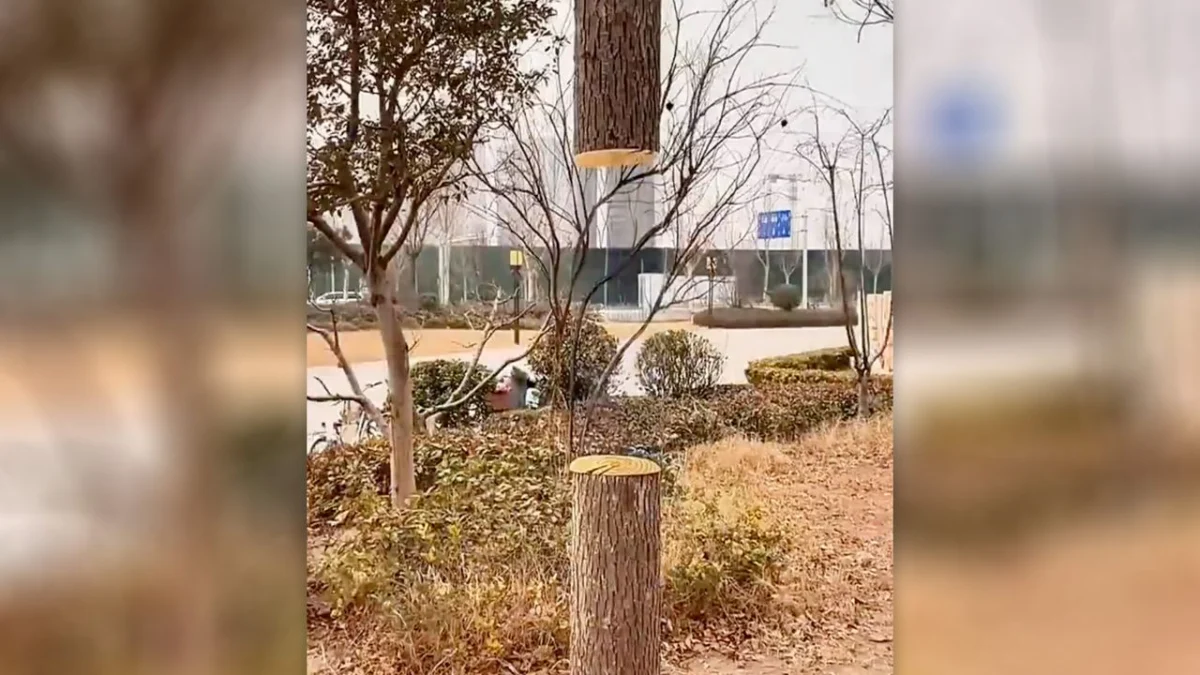
Optical illusions have long held a captive audience, traversing the bridge between recreational curiosity and complex cognitive science. From the classic "Magic Eye" posters of the 1990s to the intricate geometry of M.C. Escher, the human brain’s struggle to reconcile visual input with physical reality has always been a source of fascination. However, a new frontier in "Op Art"—short for optical art—is currently captivating the digital world. At the forefront of this movement is Chinese artist Feng Dengyu, whose recent works demonstrate a level of hyper-realistic precision that seems to literally erase objects from the landscape.
Main Facts: The Art of Disappearance
Feng Dengyu has recently surged to international prominence thanks to a series of viral videos showcasing his ability to make solid objects—specifically tree stumps—seemingly dissolve into thin air. Utilizing nothing more than a paintbrush, a palette of acrylics, and an uncanny eye for color matching, Feng engages in a form of "environmental camouflage."
The process is deceptively simple in concept but daunting in execution. Feng begins by selecting a natural backdrop, such as a weathered tree stump, and placing a canvas or a flat surface directly in front of it. He then meticulously paints the surface to match the foliage, bark, and atmospheric depth of the scenery behind it. When viewed from a specific angle, the transition between the physical world and the painted surface becomes seamless, creating the illusion that the object has vanished. This isn’t digital manipulation; it is a testament to the power of traditional, analog realism.
A Chronological Breakdown: From Canvas to Camouflage
To understand the magnitude of Feng’s work, it is necessary to examine the evolution of his recent project, which has become the focal point of a heated discussion on platforms like Reddit and TikTok.
Phase 1: The Conceptualization
The project began with a fundamental question: Can human perception be tricked by replicating texture and light on a two-dimensional plane? Feng began by scouting locations that offered high-contrast backgrounds—forests, meadows, and rustic stone settings. The choice of the tree stump was strategic; its organic, irregular patterns provide a rigorous test for any artist attempting to replicate nature’s chaos.
Phase 2: The Application
Over several days, Feng applied layer upon layer of paint. The initial stage involved mapping out the general light values—the shadows cast by the sun and the highlights hitting the ridges of the wood. As the days progressed, the artist moved into microscopic detail, recreating the specific moss growth, the fissures in the bark, and the way the light filtered through the canopy above.
Phase 3: The "Reveal"
The climax of the process is the reveal. As the camera pans around the installation, the "magic" takes hold. At the precise focal point, the eye can no longer distinguish between the real tree and the painted surface. The result is a startling visual rupture that forces the viewer to recalibrate their understanding of what they are seeing.
Supporting Data: Why the Brain Struggles with Op Art
The success of Feng’s work is not merely a matter of artistic talent; it is rooted in how the human visual cortex processes information. Op Art relies on the concept of "perceptual ambiguity."
When we look at a scene, our brains use "edges" and "contours" to define the boundaries of objects. Feng’s work essentially blurs these boundaries. By aligning the vanishing points of his painting with the actual physical horizon, he confuses the brain’s depth perception. According to psychological research on visual cognition, the brain is programmed to seek "gestalt"—a sense of a whole. When the visual input is fragmented by perfectly matched textures, the brain struggles to complete the image, leading to the "disappearance" effect.
Furthermore, color constancy—the tendency of the brain to perceive a familiar object as the same color under different lighting conditions—is exploited here. By perfectly mimicking the light conditions of the background, Feng prevents the viewer’s brain from identifying the object as an "intruder" in the scene, effectively rendering it invisible to the conscious mind.
Official Responses and Public Reception
The viral nature of the project has generated significant discourse. On platforms such as r/opticalillusions, users have been both baffled and appreciative of the sheer labor involved.
One Reddit user remarked, "He could’ve stopped way earlier, and it would’ve been good enough. I appreciate that he went the extra mile." This sentiment highlights the intersection of modern "quick-consumption" culture and traditional artistry. In an age of AI-generated imagery and instant digital filters, the raw, manual dedication of an artist spending hours—or even days—on a single tree stump is viewed as a form of rebellion.
Another user added, "This is the best answer to ‘Name a useless superpower’ that I’ve ever seen! Still, extremely impressive." While the comment is lighthearted, it touches on a deeper philosophical point: the "uselessness" of the act is exactly what gives it value. It is art for the sake of perception, a pure exploration of visual truth without the burden of utility.
From an academic perspective, art critics have begun to categorize Feng’s work alongside the greats of contemporary trompe-l’œil (a French term meaning "deceive the eye"). While historical masters used this technique to trick the eye into seeing architectural depth on flat walls, Feng has taken this into the natural world, using the erratic, shifting patterns of nature as his canvas.
Implications: The Future of Optical Illusions
The implications of Feng Dengyu’s work extend far beyond the realm of viral internet content. His success highlights a renewed interest in the physical craft of painting in a post-digital world.
The Rise of the "Analog Illusionist"
As we move deeper into an era of augmented reality (AR) and virtual reality (VR), there is a growing psychological hunger for "analog illusions." When everything on a screen can be faked with a simple line of code, the sight of a human hand painting a tree into invisibility provides a grounding effect. It reminds the audience that the most powerful visual effects are those that interact with the physical laws of light and shadow.
Artistic Influence and Education
The pedagogical value of Feng’s work is also significant. For art students, his process offers a masterclass in observational skills. He demonstrates that the secret to realism is not just seeing what is there, but understanding how light creates the illusion of existence. Many aspiring artists are now turning to his process as a blueprint for learning how to break down complex textures into manageable, replicable layers.
The Intersection of Art and Technology
While Feng uses traditional methods, his work is being disseminated and analyzed through high-tech channels. The interaction between his physical installations and the digital lenses of smartphones creates a hybrid form of art. The camera lens acts as a neutral observer, capturing the illusion exactly as the artist intended, which then allows millions of people to experience the "disappearance" simultaneously. This suggests that the future of Op Art will likely involve a marriage of physical craftsmanship and digital distribution.
Conclusion: A New Way of Seeing
Feng Dengyu’s work is more than just a trick of the eye; it is a meditation on the fragility of our perception. By proving that reality can be "painted away," he invites us to question what else might be hiding in plain sight. In a world that is increasingly loud, fast, and digital, there is something profoundly moving about an artist who chooses to spend his time silently matching the colors of a tree, waiting for the moment when the world disappears.
As Feng continues to push the boundaries of his craft, he challenges us to look closer. The next time you find yourself walking through a forest, you might pause and wonder if the stump in front of you is truly a piece of wood, or if you are simply looking at a masterpiece that hasn’t been finished yet. His work reminds us that while our brains are wired to perceive the world, they are also easily fooled—and in that deception, there is a rare, breathtaking beauty.
For those interested in exploring this art form further, tutorials on color theory and textural mapping are becoming increasingly popular, fueled by the inspiration provided by artists like Feng. Whether you are a seasoned painter or simply an admirer of the impossible, the world of Op Art is currently in a renaissance, and it is a fascinating place to witness the impossible made real.









No comments yet. Be the first to join the conversation!