Azzam Bilal Chamdy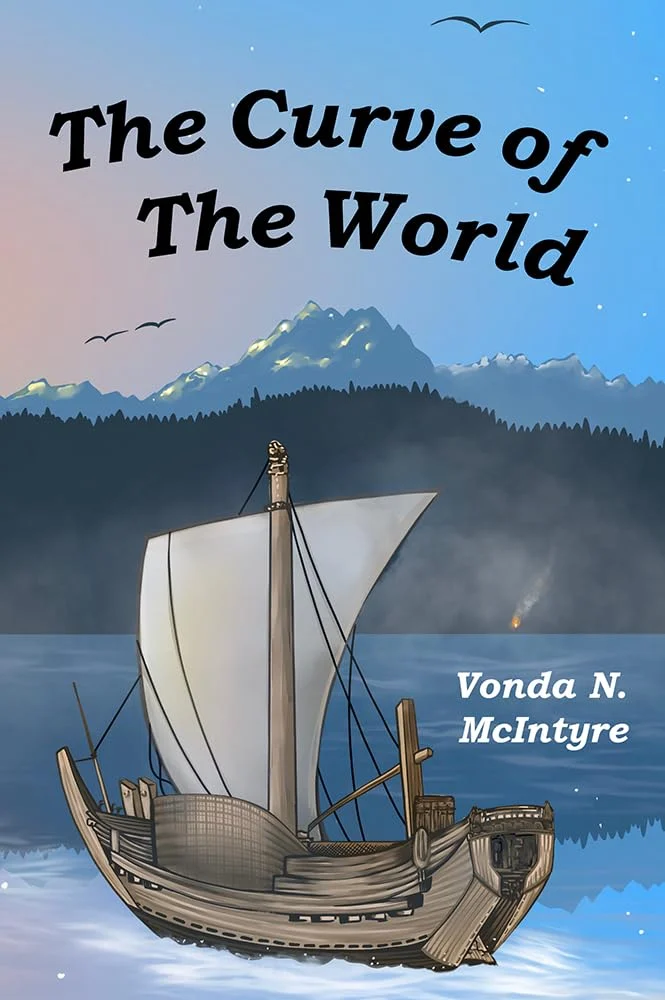
The literary landscape of science fiction and fantasy lost one of its most luminous architects when Vonda N. McIntyre passed away in Seattle in 2019. An icon of the genre, a Nebula and Hugo Award-winning author, and a fierce advocate for feminist activism and collective self-publishing, McIntyre left behind a body of work that challenged the boundaries of human identity and societal structures. Her final act of creation, the novel The Curve of the World, has now been brought to fruition through the dedicated editorial efforts of L. Timmel Duchamp, Nisi Shawl, and their team at Aqueduct Press. It stands not only as a caper across an alternate history but as a poignant, if unfinished, testament to a singular creative vision.
Main Facts: A Voyage Across a Mirror-World
The Curve of the World transports readers to a reality that feels hauntingly adjacent to our own yet fundamentally altered. The narrative centers on the Idaeans, a sophisticated Minoan-inspired civilization that dominates the trade routes and diplomacy of the "Sunset Sea"—a geographical mirror to our Mediterranean.
In this world, the familiar anchors of history are absent: there is no Roman Empire, no Persian hegemony, and the major Abrahamic faiths have not emerged. Instead, the Idaeans navigate a society where literacy and numeracy are rare, specialized technologies. The novel follows Iakinthu, a "Gephyra"—a high-ranking trade manager and political operator—as she embarks on a perilous oceanic voyage. Her mission is personal and maternal: to return her foster son, Renthizu, to his biological family.
However, this journey quickly evolves into an epic expedition from the cradle of civilization across the "Untameable Ocean" to the shores of North America. Along the way, the crew of the Flying Fish confronts brutal, patriarchal barbarians, navigates the remnants of a legacy left by "sea people"—aquatic humans who recur throughout McIntyre’s bibliography—and faces the geological volatility of a world where tectonic shifts mirror the shifting social dynamics of its inhabitants.
Chronology: The Evolution of a Final Draft
The publication of The Curve of the World is the result of a complex editorial undertaking. When McIntyre died, the manuscript was in its fifth iteration, leaving the editorial team with the delicate task of preserving the author’s voice while addressing the inevitable narrative gaps of an incomplete draft.
- 1973–2008: McIntyre seeds the concept of "sea people" through various short stories, including "The Genius Freaks" (1973) and her collaboration with Ursula K. Le Guin, "The Natural History and Extinction of the People of the Sea" (2008).
- 2019: McIntyre passes away in Seattle, shortly before the release of a new edition of her debut novel, The Exile Waiting (1975).
- 2022: The film adaptation of her 1997 novel The Moon and the Sun, titled The King’s Daughter, reaches audiences, renewing interest in her exploration of aquatic humanoids.
- 2026 (Present): The Curve of the World is published, representing the culmination of years of work and the final, posthumous release of her novel-length fiction.
The editorial team, led by L. Timmel Duchamp, has navigated a landscape of "missing pieces." Readers may notice slight inconsistencies—such as the placeholder name "Knossos" appearing alongside the world-specific "Kunusu"—which serve as reminders of the manuscript’s unfinished state.
Supporting Data: Technology, Sociology, and the Supernatural
McIntyre’s worldbuilding remains as meticulously grounded as it is imaginative. While the novel incorporates "supernatural stardust"—specifically the influence of the sea people—it is largely an Iron Age epic.
The Technological Landscape
The setting eschews industrial advancements. There is no gunpowder or automated projectile weaponry. Instead, the Idaeans rely on sophisticated sailing technology, specifically clinker-built ships. McIntyre’s fascination with "alternate technologies" shines through in details such as the vast, black water-reservoir jars adorning Idaean rooftops, a practical solution for a culture that prizes hot bathing and hygiene. However, the author’s reach occasionally exceeds her grasp, as seen in the logistical leap of moving the Flying Fish across the Panamanian isthmus—a sequence that feels more like an impossible, witty thought experiment than a grounded narrative beat.
The Sociological Framework
At the heart of the conflict is a clash of systems. The Idaean culture is largely matriarchal, where women are the primary decision-makers, and fatherhood is viewed as a trivial social construct. This contrasts sharply with the antagonist "black-sailed barbarians," a hyper-patriarchal society where women are treated as property and boys are indoctrinated into a cycle of violence and misogyny. This social friction drives the subplot involving the rescued boy, Bdarde-who-is, whose brutalization by his captors creates a visceral tension that propels the middle chapters of the book.
Official Responses and Editorial Challenges
In the foreword to the novel, publisher L. Timmel Duchamp provides transparency regarding the editorial process. The collaboration between Duchamp, Nisi Shawl, and other editors was aimed at stabilizing the text while honoring McIntyre’s intent.
Critically, the reception of the book acknowledges the "slow-burn" nature of McIntyre’s prose. The first quarter of the novel is widely regarded as a masterful, high-stakes opening. However, the subsequent three-quarters shift toward a travelogue format. Critics have noted that while the descriptions of strange peoples and volcanic geography are vivid, the plot occasionally stalls under the weight of excessive worldbuilding—specifically, the introduction of a "Babel Fish" style translator and the jarring inclusion of characters named "Genji" and "Murasaki," which arguably pull the reader out of the immersive, alternate-historical atmosphere.
Implications: A Legacy of "What If"
The Curve of the World serves as both a conclusion and an invitation. It highlights the inherent danger of a brilliant mind being silenced mid-flow. The novel’s primary strength lies in its urgency; as the Idaeans face both human antagonists and an increasingly unstable environment (represented by the gendered "volcano god" and frequent tremors), the reader is drawn into a genuine sense of existential dread.
The Cost of Worldbuilding
The novel forces a discussion on the balance between narrative momentum and worldbuilding depth. McIntyre was clearly more interested in the how of her world—the daily rituals, the linguistic shifts, and the ecological pressures—than the what of the traditional plot. For long-time fans of McIntyre, these digressions are perhaps welcome, offering one last chance to inhabit the mind of a writer who constantly sought to reframe the human experience through the lens of the "other."
Final Assessment
Ultimately, The Curve of the World is a magnificent, if imperfect, achievement. It is a work that rewards the reader for the effort of navigating its occasionally uneven terrain. While the narrative may lose its way in the later chapters, the vitality of its opening and the depth of its sociopolitical commentary cement its place in the canon of feminist science fiction. It is a final, sprawling, and deeply human gesture from an author who spent her life asking us to look at the world—and all its possible versions—with fresh, critical eyes. For those willing to accept the unfinished edges, the journey across the Sunset Sea is well worth taking.


 Sagoh
Sagoh
 Raul Delapena Setiawan