

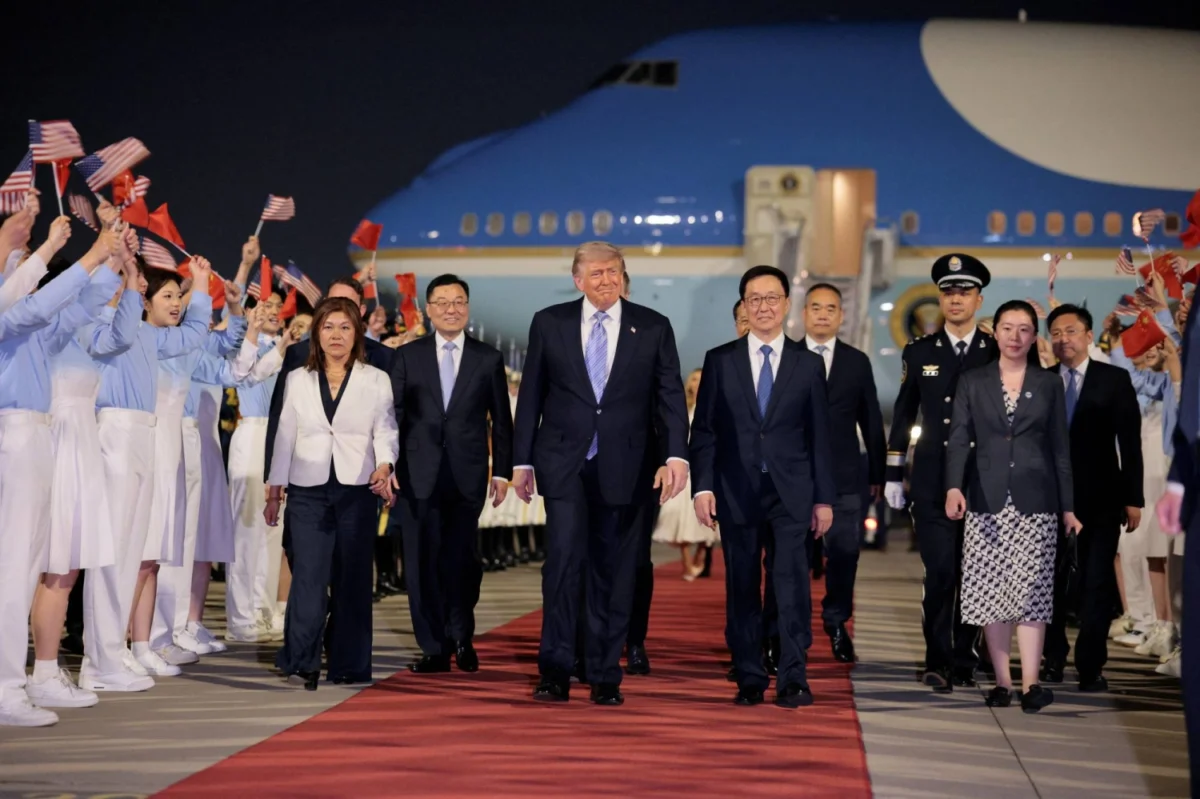
BEIJING — U.S. President Donald Trump touched down at Beijing Capital International Airport on Wednesday, marking a pivotal moment in his second term as he seeks to reset the economic foundations of the world’s most consequential bilateral relationship. Emerging from Air Force One, Trump was greeted by a high-level delegation, a stark visual reminder of the diplomatic choreography required to manage a nation that has evolved significantly since his initial visits nearly a decade ago.
The visit, framed by the White House as a "strategic realignment," brings together the world’s two largest economies at a juncture defined by intense technological competition, trade friction, and a rapidly shifting geopolitical landscape. Accompanying the president is a high-profile contingent of American corporate titans—including Tesla CEO Elon Musk, Nvidia’s Jensen Huang, and Apple’s Tim Cook—signaling that the administration’s primary objective is the aggressive opening of Chinese markets to U.S. industrial and technological influence.
The Mission: A Second Act in Economic Diplomacy
The tone for the visit was set long before the wheels touched the tarmac. In a series of characteristically direct social media posts, Trump framed the trip as an opportunity for "economic liberation."
"I will be asking President Xi, a leader of extraordinary distinction, to ‘open up’ China so that these brilliant people can work their magic, and help bring the People’s Republic to an even higher level!" Trump wrote.
The inclusion of Musk, Huang, and Cook is no coincidence. It represents a "commercial-first" approach to foreign policy, banking on the idea that the lure of American innovation and the necessity of Chinese manufacturing can create a new equilibrium. However, the China that Trump faces today is vastly different from the one he encountered during his first term. Beijing has pivoted toward a model of "self-reliance," investing heavily in indigenous semiconductor production, artificial intelligence, and green energy—sectors where the CEOs accompanying Trump are currently leading the global charge.
Chronology: The Evolution of a Relationship
To understand the stakes of this visit, one must look at the trajectory of U.S.-China relations over the last ten years.
- 2017-2018 (The Initial Engagement): President Trump’s first term was defined by a shift from cooperative engagement to "great power competition." The initiation of Section 301 tariffs on Chinese goods signaled the end of the post-Cold War era of frictionless trade.
- 2019-2021 (The Decoupling Debate): Tensions peaked over telecommunications, with the U.S. moving to restrict Huawei and other Chinese tech firms, citing national security concerns. The COVID-19 pandemic further strained ties, leading to a period of deep mutual suspicion.
- 2022-2025 (The Strategic Pause): A period characterized by "managed competition." Both nations recognized the dangers of a total economic divorce, leading to a delicate dance of maintaining trade ties while restricting access to critical dual-use technologies.
- May 2026 (The Current Summit): President Trump’s arrival marks a move toward "transactional pragmatism." By bringing the titans of Silicon Valley to the table, the administration is effectively outsourcing the resolution of trade barriers to the private sector, hoping that direct negotiation between corporate leaders and Chinese regulators can bypass the bureaucratic gridlock of traditional diplomacy.
Supporting Data: The Economic Reality
The context of this visit is underscored by a shifting economic reality. According to recent trade data, the trade deficit between the U.S. and China has evolved in composition, if not in scale.
While the U.S. remains a primary consumer of Chinese goods, the reliance on high-end semiconductors and AI hardware has created a new theater of competition. Nvidia, represented by Jensen Huang, is currently navigating a labyrinth of export controls that have limited their ability to supply the Chinese market with top-tier AI chips.
Furthermore, Tesla’s presence is indicative of a broader strategy. With a massive Gigafactory in Shanghai, Tesla represents the "model" the Trump administration hopes to replicate across other industries: a company that provides localized value in China while maintaining its status as a quintessential American brand. However, analysts point out that China’s domestic EV market is now fiercely competitive, with local brands like BYD and NIO offering high-quality alternatives at a fraction of the cost, making the market environment significantly tougher than it was in the late 2010s.
Official Responses: Cautious Optimism vs. Strategic Defense
The response from Beijing has been characteristically measured. While state media has touted the visit as a sign of "mutual respect and cooperation," government spokespeople have emphasized that China’s commitment to "national security" remains non-negotiable.

"We welcome American investment that aligns with our development goals," said a spokesperson for the Ministry of Commerce. "However, the era of one-way access is over. We look forward to discussions that reflect the current reality of our respective technological capabilities."
In Washington, the reaction has been more divided. While the business community has praised the president’s direct approach to market access, hawkish members of Congress have expressed concern that bringing corporate leaders to China might lead to "intellectual property leakage." The White House, however, maintains that the presence of these CEOs is a necessary tactic to secure commitments that have been stalled in traditional diplomatic channels for years.
The Implications: A New Global Equilibrium
The implications of this summit extend far beyond the balance sheets of Apple or Tesla.
1. The Technology "Iron Curtain"
If the Trump-Xi talks result in a relaxation of trade barriers for U.S. tech giants, it could signal a thawing in the "tech war." Conversely, if Beijing refuses to budge on its own "Made in China 2025" initiatives, the U.S. may be forced to implement even stricter controls on the flow of capital and data, effectively accelerating the bifurcation of the global internet and manufacturing infrastructure.
2. The Role of the Private Sector in Diplomacy
This trip signals a shift in how modern superpowers interact. The rise of "CEO diplomacy" suggests that the U.S. government views its corporations not just as economic entities, but as the primary instruments of national interest. This creates a complex dynamic where companies like Apple find themselves caught between the demands of the White House and the regulatory requirements of the CCP.
3. Geopolitical Alignment
The summit is being watched closely by U.S. allies in the Indo-Pacific. Nations like Japan, South Korea, and Australia, which are caught in the middle of this economic tug-of-war, are looking for signs of whether the U.S. intends to pursue a "go-it-alone" strategy or if this is a precursor to a broader, more cohesive regional trade framework.
Conclusion: A High-Stakes Gamble
President Trump’s arrival in Beijing is a high-stakes gamble on the power of personality and the efficacy of commercial diplomacy. By elevating the role of corporate leaders in the negotiating room, the administration is attempting to move past the ideological rhetoric that dominated the first half of the decade.
Whether this approach will result in the "opening up" that the president has promised, or whether it will merely highlight the fundamental irreconcilability of the two nations’ economic models, remains to be seen. As the delegation settles into the capital, the world watches to see if this meeting of minds can forge a path of sustainable competition or if it is simply a temporary respite in an increasingly fragmented global order.
For now, the focus remains on the closed-door meetings at the Great Hall of the People. The results of these discussions will define not only the immediate future of U.S.-China trade but the shape of the global economy for the remainder of the decade. As the U.S. seeks to maintain its technological edge, it must contend with a China that is no longer content to simply manufacture—it is now determined to innovate. The result of this collision will likely be the defining story of the 2020s.












No comments yet. Be the first to join the conversation!