

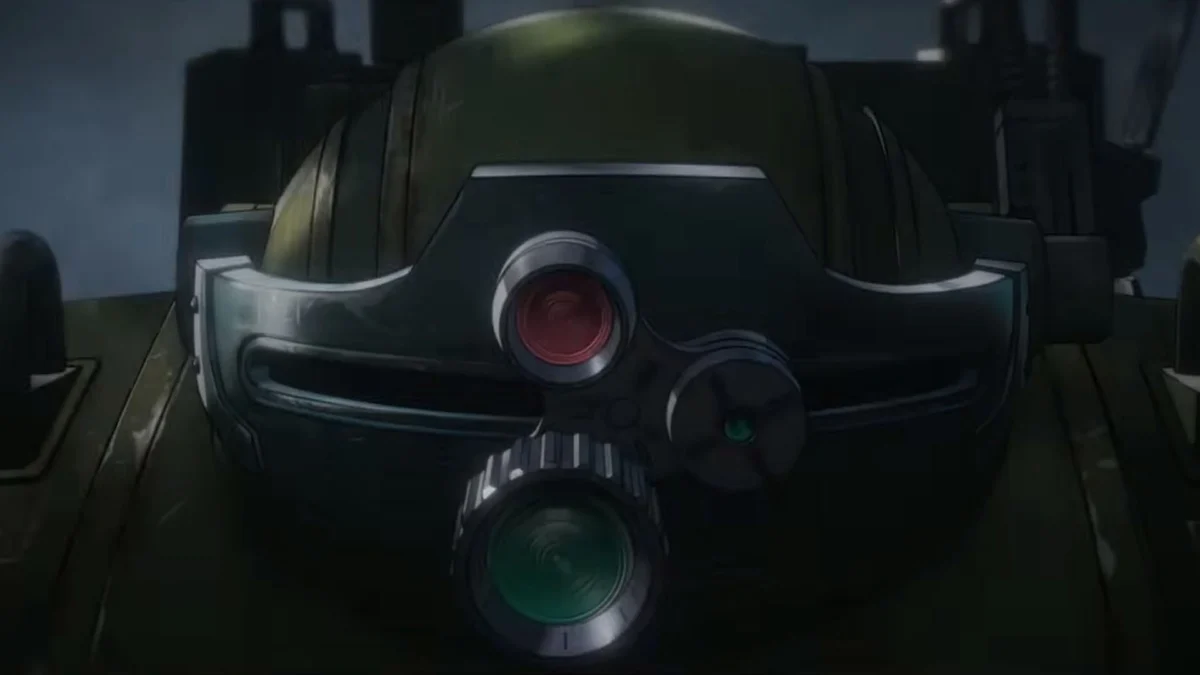
The mecha genre, often defined by the polished heroics of Mobile Suit Gundam or the cosmic spectacle of Macross, has always held a darker, more visceral corner carved out by Armored Trooper Votoms. Today, that corner is set to expand in a way few fans could have anticipated. Bandai Namco Filmworks has officially confirmed the production of Armored Trooper Votoms: Die Graue Hexe (The Grey Witch), a two-part sequel film that promises to bring the franchise’s signature brand of “real robot” grit back to the forefront of anime.
Scheduled for a premiere on November 20, this upcoming project is not merely another entry in a long-running series; it represents a convergence of legendary creative forces that signals a serious, mature evolution for the Votoms universe.
The Core Facts: A Two-Part Cinematic Event
The announcement, made via the official Votoms social media channels, confirms that Die Graue Hexe will be split into two distinct cinematic chapters. This structure suggests a narrative scope far larger than a standard OVA (Original Video Animation) episode, aiming for the pacing and gravity of a full-scale feature film.
The title itself—Die Graue Hexe—carries the weight of the series’ historical penchant for European-influenced military aesthetics. Translated from German as "The Grey Witch," the title aligns with the cryptic, haunting marketing copy released alongside the teaser: "On the endless battlefield filled with madness, where lives are expendable, there is one witch who always comes back to life."

Bandai Namco has also unveiled a suite of new key visuals showcasing the battered, industrial aesthetic that has defined the series since its inception in 1983. These visuals, coupled with the announcement, confirm that while the series is evolving, it remains tethered to the "Vertical One-man Tank for Offense & Maneuvers" (VOTOMS) philosophy: machines that are tools of war, not symbols of hope.
A Legacy of Steel: The Chronology of Votoms
To understand the significance of this new film, one must appreciate the history of the franchise. Armored Trooper Votoms first graced television screens in 1983, created by the visionary Ryousuke Takahashi. Unlike the super-robot shows that preceded it, Votoms introduced a world where mecha were mass-produced, expendable, and prone to breaking down in the mud and grime of the battlefield.
Over the last four decades, the franchise has grown through a complex web of sequels, spin-offs, and side stories, including the fan-favorite Pailsen Files and The Last Red Shoulder. The franchise even dipped its toes into the gaming world with a notable PlayStation 2 title, cementing its status as a cult classic that never truly faded from the consciousness of Japanese animation fans.
By choosing to release Die Graue Hexe in 2026, Bandai Namco is positioning Votoms as a bridge between the classic era of 80s mecha and the modern standard of high-fidelity animation, ensuring that the legacy of Chirico Cuvie—the franchise’s stoic, indestructible protagonist—remains relevant for a new generation.

Creative Synergy: The Oshii-Kawai Reunion
Perhaps the most startling revelation regarding this project is the appointment of legendary director Mamoru Oshii. Known for his philosophical depth and contemplative pacing in works such as Ghost in the Shell and Patlabor 2: The Movie, Oshii’s involvement is a massive statement of intent for the film’s tone.
Oshii is joined by his long-time creative partner, composer Kenji Kawai. The duo’s history is legendary in the anime industry; their collaboration on Ghost in the Shell produced an auditory and visual landscape that defined the cyberpunk genre for decades. Kawai’s ability to blend haunting choral arrangements with industrial, mechanical soundscapes makes him the ideal candidate to score the desolate, war-torn environments of Votoms.
The production team is rounded out by the return of original creator Ryousuke Takahashi, who serves as a supervisor. This ensures that while Oshii will undoubtedly bring his own artistic fingerprints to the project, the soul of the original 1983 series remains intact. Furthermore, the mecha designs are being helmed by Shinobu Tsuneki and Yoshiro Sono, tasked with modernizing the iconic AT (Armored Trooper) units without losing the "lived-in" feeling that makes them so distinct.
Official Responses and Creative Vision
In an official statement regarding his involvement, Mamoru Oshii expressed a sentiment that has resonated deeply with the fan community: he is a genuine, lifelong fan of the series.

"I have always wanted to work on this series," Oshii stated. "I am serious about making a war-action film."
This declaration is critical. It implies that Die Graue Hexe will not be a lighthearted adventure or a reboot designed to sell toys. Instead, it points toward a gritty, tactical, and perhaps psychologically heavy exploration of the Votoms world. Oshii’s desire to craft a "war-action film" suggests that the upcoming project will focus on the tactical reality of the battlefield—the exhaustion, the mechanical failure, and the psychological toll of being a pilot in a war that views human life as a replaceable resource.
Implications for the Mecha Genre
The announcement of Die Graue Hexe has broad implications for the current landscape of the mecha genre. For years, the market has been dominated by Mobile Suit Gundam and various "Isekai-mecha" crossovers. By reviving a grounded, low-tech, and high-fatality series like Votoms, Bandai Namco is effectively testing the market’s appetite for "hard" military science fiction.
If successful, this film could trigger a resurgence of interest in 80s-style mecha anime. It serves as a reminder that the genre is capable of profound narrative complexity and that the "real robot" aesthetic, which emphasizes the machine as a weapon rather than a superpower, still holds significant cultural weight.

Furthermore, the decision to launch the film in two parts suggests a shift in how anime production committees view theatrical distribution. Rather than squeezing a complex narrative into a single two-hour window, the industry is increasingly moving toward multi-part cinematic events that allow for better world-building and character development.
The Global Wait
While the anticipation is palpable, there is one looming question for the international community: when will the world see Die Graue Hexe? As of the time of writing, there has been no official word on a Western release, streaming availability, or theatrical distribution outside of Japan.
However, given the pedigree of Mamoru Oshii and the global cult following of the Votoms franchise, it is highly probable that international distributors are currently in talks to bring the film to a wider audience. Fans in the West, accustomed to waiting for subtitled releases, are already bracing for what could be the definitive mecha event of the decade.
As the November 20 premiere date approaches, all eyes will be on the trailers and further staff announcements. Whether it becomes a defining entry in the Votoms canon or simply a beautiful experiment, Die Graue Hexe is already shaping up to be a masterclass in how to honor the past while pushing a franchise into the future. For now, the "Grey Witch" looms over the horizon, and for fans of the genre, the war is far from over.











No comments yet. Be the first to join the conversation!