

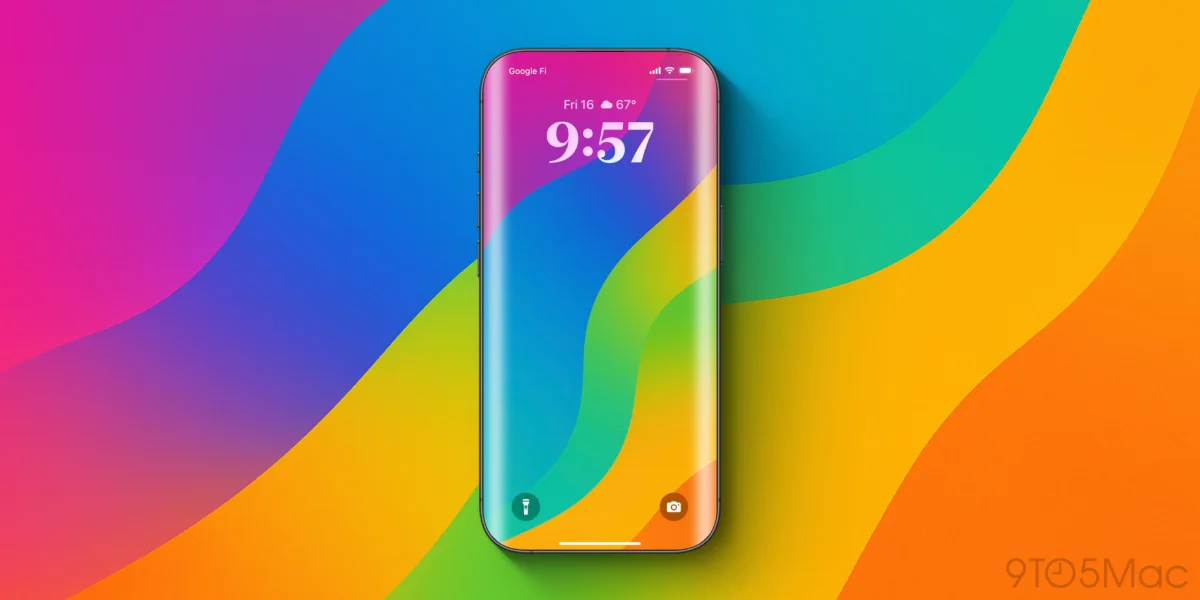
The pursuit of the perfect smartphone—a device that appears as a single, seamless piece of polished glass—has long been the "holy grail" for Apple’s industrial design team. As rumors solidify around the upcoming iPhone 20, the industry’s focus has shifted to a radical new "quad-curved" display technology. However, a recent, albeit contentious, supply chain report from South Korea suggests that Apple’s ambitious vision for 2027 may come at a technical cost: potential screen distortion.
Main Facts: The Bezel-Free Ambition
The core of the current conversation revolves around the transition to a truly bezel-free aesthetic. Reports from ETNews indicate that both Samsung Display and LG Display are currently refining manufacturing processes to accommodate a "4-sided bending" display technology.
The goal is to eliminate the black borders that have defined smartphone screens since the inception of the iPhone. By curving the display glass around all four edges of the device, Apple aims to achieve an optical illusion of a borderless slab. While previous iterations of curved glass have been largely cosmetic, the iPhone 20’s design is rumored to involve complex thin-film encapsulation processes that allow the display to wrap around the chassis entirely.
However, the supply chain report warns of a significant hurdle: the use of magnesium-gallium alloy (Mg·Ag) in the display’s cathode layer. Engineers have noted that while this material is currently viable for mass production, it introduces a "possibility of screen distortion" at the extreme edges where the bending occurs. Furthermore, the current iteration reportedly suffers from a minor drop in luminosity at these curves, a side effect of the material’s refractive index.

Chronology: From Special Edition to Pro Standard
The narrative surrounding the iPhone 20 has shifted significantly over the past twelve months. Initially, industry analysts speculated that the 20th anniversary of the iPhone—which falls in 2027—would be marked by a standalone, limited-run "Special Edition" device, much like the iPhone X was in 2017.
- Mid-2025: Initial leaks suggested a standalone "iPhone 20th Anniversary" model, distinct from the mainline Pro and Pro Max lineup.
- Late 2025: Market analysts began to pivot, suggesting that the "Anniversary" branding might be a marketing overlay rather than a unique hardware tier.
- Early 2026: Consensus shifted toward the features being integrated directly into the iPhone 20 Pro and Pro Max, effectively setting a new standard for the flagship range.
- Present Day (2026/2027 Development Phase): The conversation is now focused on the iterative nature of this technology, with rumors suggesting a "Version 1.0" display for 2027 and a "Version 2.0" refinement slated for 2028.
This evolution confirms that Apple is moving away from experimental "boutique" phones in favor of integrating breakthrough technologies directly into their core product lines, provided they meet strict (if occasionally flexible) internal quality thresholds.
Technical Data and the "Compromise" Debate
The most controversial aspect of the recent reports involves the material science behind the display. The ETNews report originally claimed that Apple was willing to accept a "compromise" in display quality for the 2027 launch to ensure the device hit its milestone anniversary. This language was later amended, suggesting a more nuanced, evolutionary approach.
The Cathode Layer Dilemma
The technical bottleneck is the cathode layer. Currently, the industry standard involves:

- Current Tech (2027): Magnesium-Gallium (Mg·Ag). Pros: Flexible, reliable for mass production. Cons: Potential for edge distortion and decreased brightness at the 4-sided bend.
- Future Tech (2028): Indium-Zinc Oxide (IZO). Pros: Transparent electrodes, superior luminosity, zero distortion. Cons: Currently in the pilot phase and difficult to scale to the millions of units required for an iPhone launch.
This creates a "generational split." By opting for the Mg·Ag alloy in 2027, Apple risks criticism from display purists regarding the slight visual degradation at the edges. However, the move to IZO in 2028 suggests that Apple is treating the 2027 design as a foundational architecture, with the intent to "patch" the hardware limitations within a twelve-month cycle.
Implications for Apple’s Ecosystem
The implications of this potential hardware compromise are far-reaching, affecting everything from manufacturing logistics to consumer perception.
Manufacturing and Supply Chain Stress
Moving to a 4-sided bending process requires a total overhaul of the assembly line. Unlike traditional flat panels, these displays require precise lamination processes to ensure the glass and the underlying OLED layers do not delaminate under pressure. The involvement of both Samsung and LG suggests that Apple is de-risking the supply chain by ensuring two major players are capable of producing these complex panels. However, if yield rates remain low due to the distortion issues, we could see supply constraints for the iPhone 20 Pro at launch.
Marketing the "Glass Slab"
Apple faces a delicate marketing challenge. If the iPhone 20 is launched as the pinnacle of 20 years of innovation, any detectable distortion at the edges could become a point of contention in user reviews. Apple’s marketing team will likely pivot to focusing on the "immersion" and "continuity" of the design, banking on the fact that for the vast majority of users, the aesthetic impact of a bezel-less display will far outweigh the technical nuance of edge-luminosity or minor geometric bending.

The "Pro" Upgrade Cycle
For consumers, this creates a dilemma: do you buy the "anniversary" model in 2027, knowing a more technically refined version is likely coming in 2028? Historically, Apple users have shown a willingness to upgrade annually, but as the hardware maturation cycle slows, the temptation to wait for the "Version 2.0" of new form factors is becoming more prevalent.
Official Responses and Industry Outlook
As is standard practice, Apple has remained silent regarding the rumors. However, the company has filed several patents related to "optical compensation for curved displays," which suggests that even if the physical hardware has inherent limitations, Apple may be looking to use software-based image processing to mask or correct for potential distortions at the display’s edge.
Industry analysts are currently divided. Some argue that Apple would never release a product with a known "distortion" issue, citing the company’s legendary attention to detail. Others argue that the definition of "distortion" in a lab setting may be invisible to the human eye in daily use, and that the "compromise" is merely a matter of degree rather than a functional defect.
Conclusion: A Vision in Transition
The narrative of the iPhone 20 is a case study in the modern smartphone industry’s struggle to innovate. We have reached a point where incremental upgrades are no longer sufficient to drive the massive upgrade cycles of the past. To maintain its market dominance, Apple is turning to radical form-factor changes—like the 4-sided curved display.

Whether the iPhone 20 succeeds as a design icon or serves as an expensive "beta test" for the superior 2028 iteration remains to be seen. What is certain is that the pursuit of the "single slab of glass" is no longer just a design goal; it is a massive engineering undertaking that will define the next chapter of Apple’s hardware legacy. For now, we await the official unveiling, where the company will surely aim to prove that their pursuit of perfection is well worth the technical growing pains.












No comments yet. Be the first to join the conversation!