

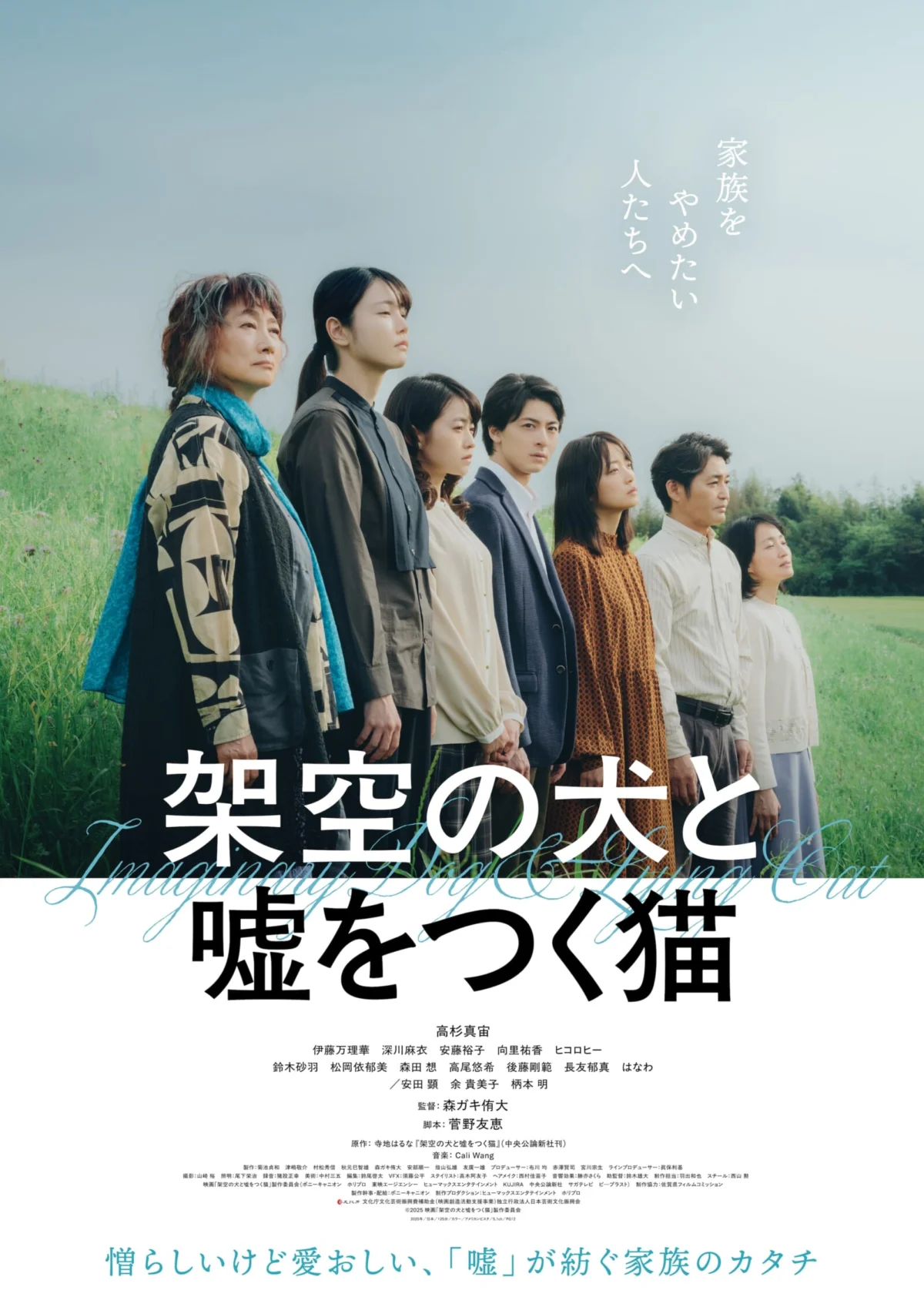
In the landscape of contemporary Japanese cinema, few films dare to examine the hollowed-out spaces left behind by tragedy with the surgical precision of Yukihiro Morigaki’s latest work, The Imaginary Dog and the Lying Cat. Penned by screenwriter Tomoe Kanno, the film is an atmospheric exploration of a family splintered by the death of their youngest child, Seiji, in 1988. Yet, to call this a "family drama" is to overlook its true ambition: it is a haunting study of the things that are not there, a cinematic meditation on the silence that defines human suffering.
The Architecture of Absence: Main Facts
The film spans 25 years, tracing the slow, agonizing erosion of the Haneko family following a singular, off-screen tragedy. Seiji, the youngest son, never appears in the film. He is a ghost, not in the supernatural sense, but in the psychological one. His absence is the gravitational center around which his parents and older brother, Yamabuki, orbit.
Morigaki’s direction is marked by a deliberate restraint. By denying the audience a glimpse of the child, he forces us to confront the same void that the characters inhabit. This is not merely a story about loss; it is a story about the failure of language, the inadequacy of ritual in a modernizing society, and the cold, mechanical indifference of a world that expects those in mourning to simply keep moving.
A Chronology of Rupture
The narrative begins in 1988, a period characterized by Japan’s "bubble" era—a time of immense economic prosperity that stands in jarring contrast to the domestic rot festering within the Haneko household.
- 1988: The Inciting Silence. The death occurs, and rather than coalescing around their shared trauma, the family fractures. The domestic space, once a site of stability, becomes a vacuum.
- The Middle Years (1990s–2000s): The narrative leaps forward, illustrating the stagnation of the family unit. The mother descends into a state of dissociative denial, clinging to the phantom of her son. The father, unable to bear the weight of his wife’s deteriorating mental state or his own culpability, retreats into an extramarital affair. The eldest daughter, meanwhile, weaponizes her grief, transforming it into a sharp, jagged resentment that alienates her from her remaining kin.
- The 2010s: The Long Shadow. As the film reaches its conclusion, we see the cumulative impact of two decades of suppressed trauma. The characters are no longer people so much as they are relics of their own past choices, trapped in a cycle of maladaptive coping mechanisms.
The Power of Ritual: Cultural Context and Failure
One of the most striking elements of the film is the deliberate omission of the butsudan (Buddhist altar). In Japanese culture, the butsudan serves as a critical bridge between the living and the dead. It provides a focal point for incense, offerings, and the daily "continuing bonds"—a psychological concept where the survivor maintains a connection to the deceased through ritualized acknowledgement.
By omitting these rituals, Morigaki suggests that the Haneko family has been stripped of their primary mechanism for processing reality. Without the altar, there is no "release valve" for their agony. Grief, left untended, does not fade; it metastasizes. It takes root in the form of fantasy, silence, and infidelity. The family members are not processing their grief; they are merely surviving it in isolation.
Language and the Systemic Void
At the heart of the film’s moral ambiguity is Yamabuki. He writes letters to his mother, forging his dead brother’s voice to sustain her fragile grasp on reality. To an outsider, this is a lie—a cruel deception. To Yamabuki, it is an act of desperate, albeit misguided, care.
This dynamic invites a critical look at the limitations of language. We possess words for the loss of a parent or a spouse, but we lack a linguistic framework for the loss of a child or a sibling. When an experience is unnamed, it becomes unspeakable, and when it is unspeakable, it becomes unsharable.
The Failure of Mental Health Infrastructure
The film also serves as a scathing indictment of the mental healthcare system in Japan, particularly during the late 20th century. The profound stigma surrounding mental health issues meant that families like the Hanekos were effectively left to rot. There was no professional language for trauma, no institutional support, and no social permission to be "broken." The film posits that the Haneko family’s downward spiral was not just a personal failure, but a systemic one.

Supporting Data: The Nature of Modern Grief
Contemporary psychology increasingly views grief not as a series of stages leading to "closure," but as a lifelong companion. The film’s structure supports this research. By utilizing time jumps, the film rejects the Western "stages of grief" model (denial, anger, bargaining, depression, acceptance). Instead, it shows grief as a tide: it recedes, only to crash back with renewed force at the most mundane, unexpected triggers.
In one particularly poignant scene set two decades post-tragedy, we witness Yamabuki’s emotional collapse. It is a moment of raw honesty that stands in stark contrast to the tidy endings of conventional dramas. This mirrors the reality of long-term trauma survivors, who often find that the world’s insistence on "moving on" is, in itself, a form of cruelty.
Official Responses and Critical Reception
Critics have lauded The Imaginary Dog and the Lying Cat for its refusal to provide the audience with a cathartic release. The film has been described by festival reviewers as "a quiet earthquake." Official statements from the production team note that the goal was to create a space for the "unseen mourner"—the individual whose grief is too quiet, too messy, or too shameful to be acknowledged in polite society.
The film has sparked a conversation in Japan regarding the "hidden" nature of domestic tragedy. In a culture that values tatemae (public face) over honne (true feelings), the film is a bold, disruptive work that peels back the facade of the domestic unit to reveal the decay underneath.
Implications: The Ethics of Fiction
What are the responsibilities of a filmmaker when depicting trauma? The Imaginary Dog and the Lying Cat suggests that the most ethical approach is not to provide a solution, but to provide recognition.
The film posits that:
- Truth is not always a virtue. In the face of insurmountable trauma, a "lie" can be the only thing keeping a person tethered to life.
- Healing is a luxury. For many, the expectation of "healing" is just another way of silencing the victim. The film advocates for the right to exist in a state of ongoing sorrow.
- The world is indifferent. The film’s most chilling takeaway is the impertinence of time. The sun continues to rise, taxes continue to be collected, and life persists even when a soul has been hollowed out.
Conclusion: The Persistence of Memory
The Imaginary Dog and the Lying Cat is not an easy watch. It is a slow, methodical unraveling of the human condition. By focusing on the "missing things"—the altar that isn’t there, the brother who isn’t there, the words that aren’t spoken—Morigaki and Kanno have created a profound piece of art.
It does not offer the audience the comfort of a resolution. Instead, it offers the comfort of being seen. It acknowledges that for many, grief is not a storm that passes, but the climate in which they live. It is a brilliant, devastating portrait of a family that, in their quest to ignore the truth, ultimately discovered that the truth is the only thing that can define them. As we look at the trajectory of the Haneko family, we are left with a lingering question: if we cannot name our pain, are we ever truly free to leave it behind?












No comments yet. Be the first to join the conversation!